
Leprechauns appear sporadically in older Irish saga material (for example the episode in Echtra Fergus mac Léti featuring lúchorpáin) but are not central figures in early mythic cycles. They became prominent figures in later folkloric collections and the late‑19th century literary revival (collectors such as W. B. Yeats and commentators like McAnally), who classified them among solitary fairies distinct from the trooping Aos Sí. Some folklorists recorded folk explanations of mixed supernatural parentage (described by McAnally as offspring of an 'evil spirit' and a 'degenerate fairy'), while scholarly etymologies trace the name through Old Irish forms (luchorpán/lupracán) with multiple proposals for its derivation.
Traditionally described as diminutive (one account gives about three feet high) and male; nineteenth‑century collectors commonly describe red clothing — a red jacket or roundabout, red breeches buckled at the knee, gray or black stockings, and a cocked hat — with regional dress variants. Samuel Lover and Yeats note richly laced red coats and Yeats contrasts solitary fairies' red dress with trooping fairies' green. The modern popular image (small bearded man in green with a hat and pot of gold) is a later, twentieth‑century development and not the dominant color scheme in older sources.
Leprechauns are chiefly portrayed as solitary cobblers or shoemakers who enjoy practical jokes and mischief of a comparatively light, cautionary order. They are associated with hidden or buried treasure — described by Yeats as wealth from 'treasure‑crocks, buried of old in war‑time' — and folklore preserves a motif in which a human who captures a leprechaun may compel him to reveal treasure or bargain for release. Saga material (Echtra Fergus mac Léti) records an episode where three lúchorpáin grant wishes when captured, but collectors stress that bargaining and revelation of treasure are the recurring motifs rather than an inherent, universal power of wish‑granting.
Weaknesses
- conditionOpportunity for capture while mending shoes
- otherSusceptibility to compulsion when physically restrained (captor refuses release until treasure revealed or bargain made)
Wards
- otherNo standardized warding practices recorded in supplied sources
- conditionAvoid approaching or attempting to seize a solitary cobbler at work (sources record capture as a human tactic rather than a protective ward)
Domovoi
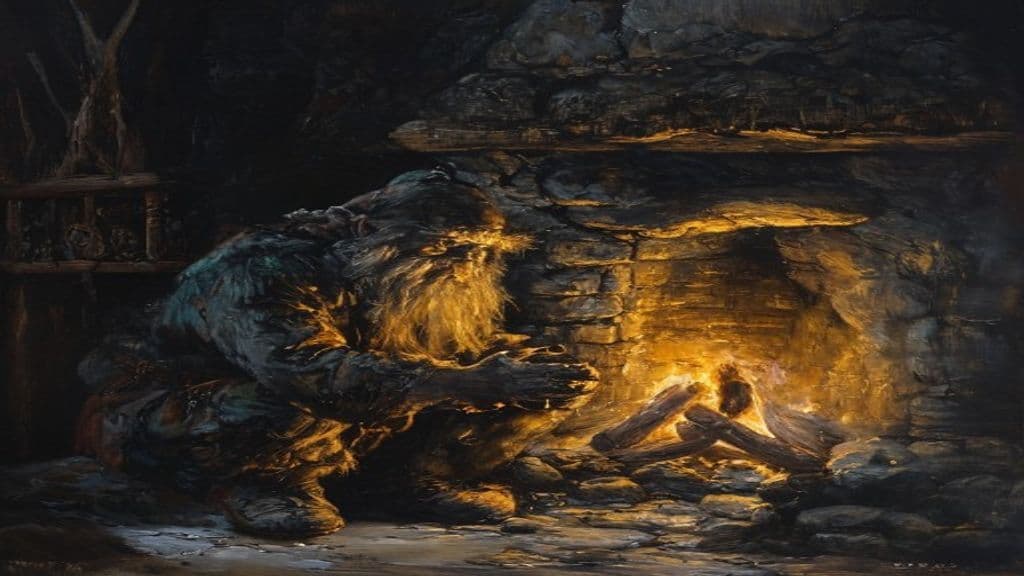
The house spirit of Slavic tradition — a small, invisible guardian of the home bound to a specific dwelling and its family. Protective when respected; dangerous when insulted or forgotten.
Kobold
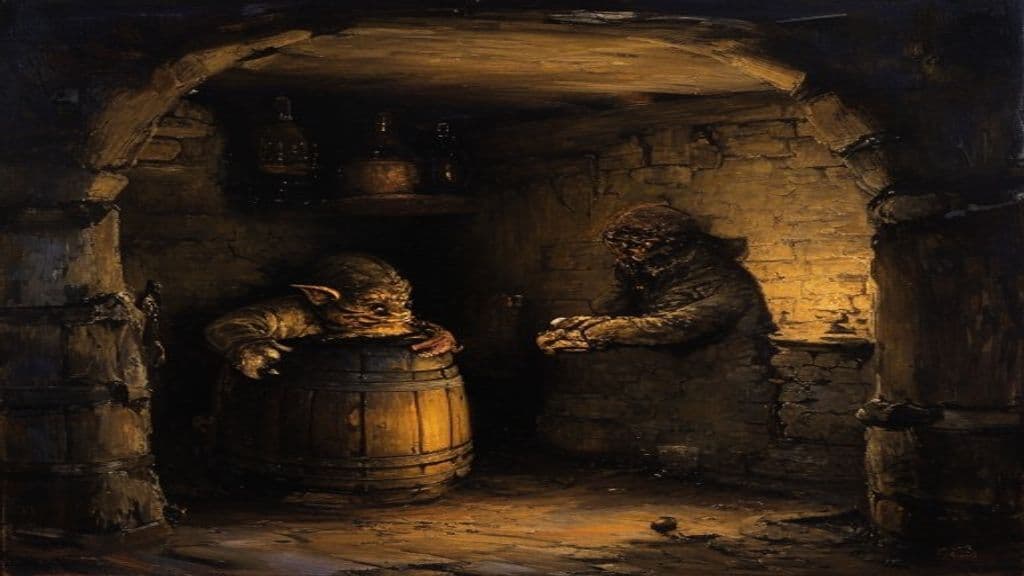
The German household and mine spirit — a mischievous but potentially helpful small being who attaches to a household, bringing luck or disaster depending on how it is treated.
Aengus
Aengus (Óengus, Aonghus) is a member of the Tuatha Dé Danann in Irish myth, portrayed as a youthful, attractive figure associated with love, youth, poetic inspiration and seasonal/solar symbolism; he is linked to Brú na Bóinne (Newgrange) and appears as fosterer, protector, enchanter and avenger in multiple tales.
Alp-luachra
Alp-luachra is an Irish folkloric fairy described as an invisible being that consumes half of a person's nourishment by taking the unseen 'pith' or 'quintessence' of food; accounts say it appears in the form of a newt and crawls down a sleeping person's mouth at water margins.
Anguish of Ireland
A mythological character in King Arthur's stories, described as a king and enemy of Arthur. (Note: - Power tier should be Greater (Anguish is a regional power in the context of King Arthur's stories, not a deity-level Ancient being) - Abilities description is partially accurate; Anguish does acknow)
Bedivere
One-handed knight and marshal of King Arthur's Round Table, known for returning Excalibur to the Lady of the Lake. (Note: - Power tier should be Greater (powerful regional), as Bedivere is a human character with significant roles within the Arthurian court, but not necessarily on a cosmic or deity-level. - Appearance: Th)
Biróg
Biróg (also Biroge, Birog of the Mountain) is a female supernatural helper in Irish narrative tradition who aids Mac Cinnfhaelaidh/Cian in gaining access to the imprisoned Ethniu and rescues the surviving infant of that union; later retellings variably portray her as a leanan sídhe (female familiar spirit), a filidh (poet/seer), or a druidess.
Broichan
A 6th century Celtic wizard documented by Adomnán of Iona, with magical abilities and connections to spiritual or supernatural forces. (Note: 1. Power tier should be Ancient, as a wizard serving a king and having connections to a saint is more deity-level than primordial. 2. Add sensory cues based on the fact that Adomnán wrote about Broich)
Bullaun
A natural feature in Celtic tradition, often imbued with spiritual significance. (Note: - Power tier should be Primordial=cosmic, given its association with natural features and spiritual significance. - Origin story missing entirely; add from source material (if available) or consult ex)
Cat sìth
A feline supernatural being in Celtic folklore, especially Scottish tradition, described in some accounts as a large black cat with a white spot on its chest associated with the fairy/otherworld; alternative traditions identify it as a witch able to transform into a cat up to nine times.
Celtic Calendar
A system used by ancient Celts to organize their timekeeping and festivals, tracking the cycles of nature and marking important events on the lunar and solar calendars. (Note: 1. Power tier: Should be Primordial (since it's an entire system and not directly tied to a specific entity with abilities). 2. Abilities: Add "Organization" or a similar ability that reflects its pra)
Celtic Sacred Trees
In Celtic tradition, sacred trees are imbued with spiritual significance and serve as symbols, conduits for medicinal properties, or abodes for nature spirits. (Note: 1. Power tier is uncertain; the source material does not explicitly describe the trees' power level. 2. Abilities should be more specific; instead of stating they "possess symbolic significance and se)
Clootie Well
A Celtic tradition where individuals leave offerings of cloth or ribbons at holy wells, believed to possess healing properties. (Note: 1. Remove "Power tier: Ancient" as it contradicts the description of abilities (no classical powers) and origin story (not deity-level). 2. Add "Origin story: Based on ancient custom of leaving votive)
Clurichaun
A solitary Irish fairy-like household and cellar spirit associated with drinking places (breweries, pubs, wine cellars). He is a heavy drinker and smoker, a mischievous trickster who can also act as a protective domestic spirit for a household that tolerates him; accounts are primarily from 19th-century collectors and later summaries.
Community Record
- [1]Leprechaun — Wikipedia. Wikipedia contributors. 'Leprechaun.' Wikipedia, The Free Encyclopedia.wiki
- [2]Wikidata: Leprechaun. Wikidata entry for Leprechaun.wiki
- [3]Echtra Fergus mac Léti (saga episode referenced in summaries). Summary of saga episode as cited in Leprechaun (Wikipedia).literary
- [4]The Leprechaun — Emerald Isle Irish and Celtic myths, fairy tales and legends. Online summary of traditional lore and variants.folk
- [5]Cultural commentary and popular afterlives (selection of archived and modern sources listed in research notes). Modern cultural and economic usage 'Leprechaun economics' (referenced in research notes).other