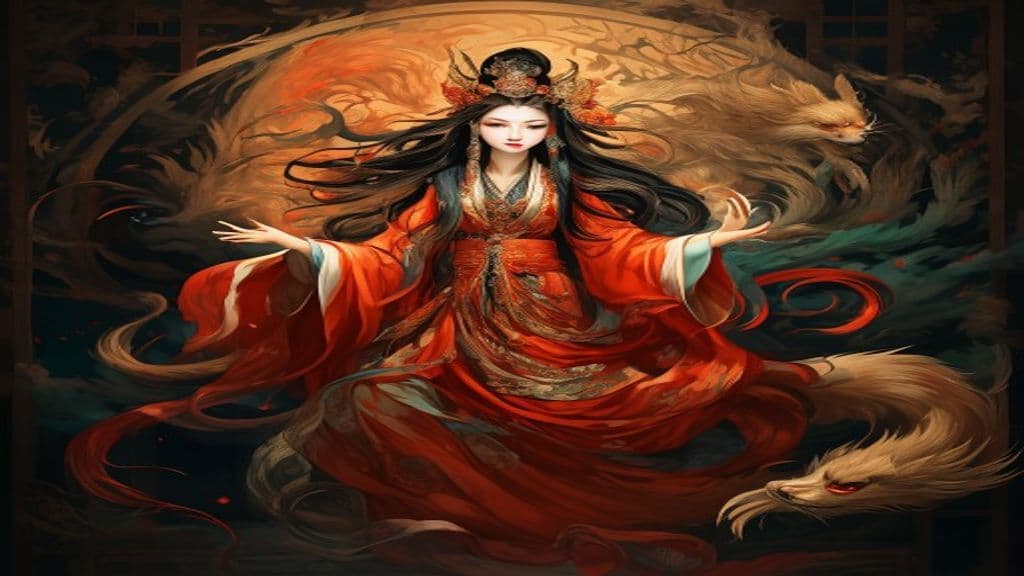
Historically Daji is recorded in later historiography as the favored consort of Di Xin, the last Shang king. From at least the Southern and Northern Dynasties onward, narrative and folk traditions overlaid the historical woman with a fox‑spirit identity: some tales describe a fox spirit that possessed or impersonated the real Daji, while Ming‑period novels (notably Fengshen Yanyi) elaborate a novelistic origin in which a thousand‑year‑old fox spirit occupies or replaces Daji's body to effect the fall of the Shang. Other variations describe the fox killing and impersonating the woman. The fox‑identification is therefore a later mythic accretion superimposed on a historical court figure.
As human in literary and popular accounts, Daji is presented as extraordinarily beautiful and the favorite consort of Di Xin, rising to become his principal companion. In the fox‑spirit tradition she is variably described: many later sources identify her with a nine‑tailed fox; certain tales (e.g., Wang Fa Zhou Pingua) depict a nine‑tailed fox with a woman's face, while Fengshen Yanyi frames the episode as a thousand‑year fox spirit possessing a human body. Folkloric motifs also attribute etiological elements to her disguise, such as tales that she bound her feet to hide fox‑like feet.
Across the narrative corpus Daji (as fox spirit) is able to enter the human world, possess or impersonate a human person, and use seductive influence to captivate King Di Xin and corrupt court conduct. She is depicted as instigating or facilitating wasteful spending, neglect of state affairs, and tyranny; in some tales she commits or orders violence to conceal her secret. Literary traditions often require special magical means or ritual agents to expose, harm, or remove the fox‑spirit (examples include a peach‑wood sword, a mirror, or exorcism by Jiang Ziya), while historical accounts sometimes report execution or suicide of the human consort—showing variation between historiographic and novelistic layers.
Weaknesses
- symbolmirror (used in Wang Fa Zhou Pingua to expose and destroy the fox)
- substancepeach‑wood sword (Yunzhongzi in Fengshen Yanyi gives this to the king; it makes Daji ill and eventually kills her)
- ritualexorcism by Jiang Ziya (novelistic tradition credits Jiang Taigong with exorcising Daji)
Wards
- ritualstate suppression of fox cults (Song dynasty edicts to destroy shrines, e.g., 1111 Kaifeng edict)
- symbolpeach‑wood implements (narrative motif in Fengshen Yanyi)
- symbolmirror (narrative motif in Wang Fa Zhou Pingua)
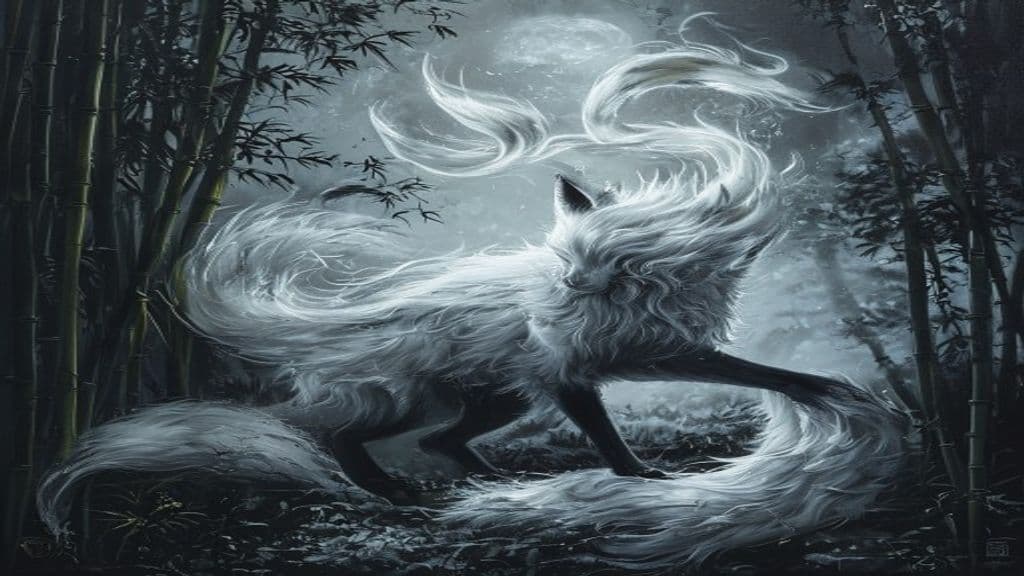
Kitsune
Fox spirits of Japanese mythology — intelligent, long-lived beings who gain additional tails (up to nine) as they age and grow in power. They serve as messengers of the god Inari and as powerful tricksters.

Tamamo-no-Mae
A legendary shape‑shifting fox‑spirit figure in Japanese mythology who, in otogizōshi and later Edo folklore, appears as a favored courtesan in imperial courts, causes a ruler's illness and political disorder, and—after death—was said to embed her spirit in the poisonous Sesshō‑seki stone until Buddhist rites pacified her.

Jiangshi (hopping corpse)
A jiangshi (jiāngshī, 僵尸) is a reanimated human corpse in Chinese popular belief and media that moves with a stiff, hopping gait and is commonly depicted in modern sources as subject to control or containment by Taoist priests using talismans and ritual implements. The contemporary image is heavily shaped by Hong Kong cinema, which standardizes visual motifs (Qing robes, yellow fulu, glutinous rice) and priestly intervention.
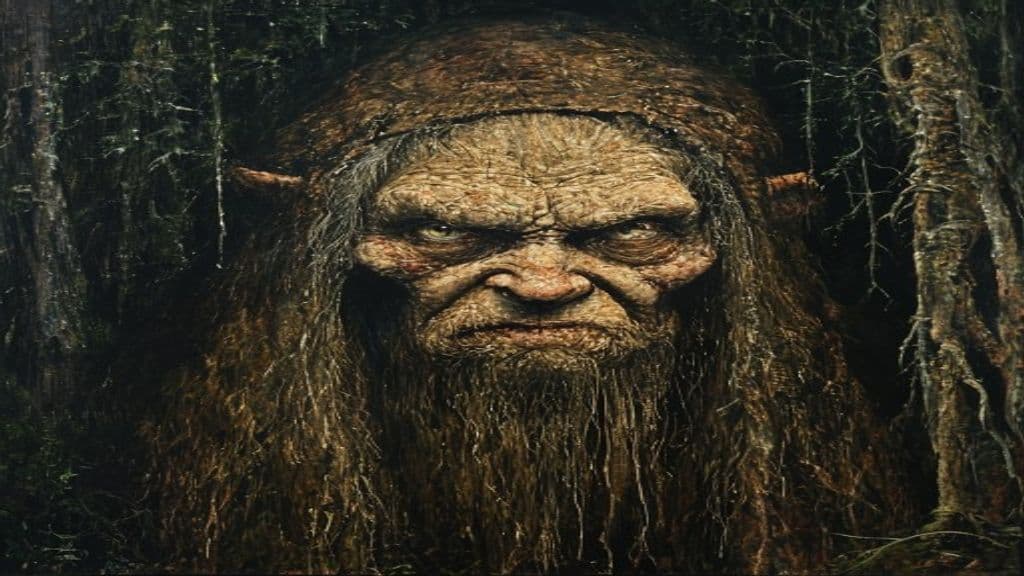
Baba Yaga
Baba Yaga is an ambivalent female figure of East Slavic folktale tradition, depicted variously as a fearsome, child-eating crone or as a helpful, maternal donor. She is associated with the deep forest, a hut described as standing on chicken legs, and the motific accoutrements of a mortar and pestle.

Huli jing (Fox spirit)
Huli jing (狐狸精), commonly rendered in English as "fox spirit," are shapeshifting supernatural beings from Chinese folklore and mythology. Classified among the broader class of yāoguài, they are morally ambivalent figures that may be benevolent, malevolent, or trickster-like depending on the tale and context.
Ao Kuang
Ao Kuang (also attested as Ao Guang) is the Dragon King of the East Sea in Chinese mythology and folk religion, one of a quartet of sea-dragon sovereigns associated in folklore with the cardinal seas. He appears in classical literature and later popular media as a ruler of maritime waters whose favor or displeasure is connected to tides, rain, floods and storms.
Bai Ze
Bai Ze (白澤, Báizé; Japanese Hakutaku) is a legendary sacred creature in Chinese tradition famed as an authoritative recorder of ghosts and gods whose illustrated compendium (Bái Zé Tú) was employed as a household prophylactic against spirit-world harm. The creature’s image and diagrams were used in China and later Japan to identify, ward off, and prescribe avoidance of spectral calamities.
Bi'an
Bi'an is attested in the provided sources primarily as a named member of the traditional roster called the Nine Sons of the Dragon, appearing in catalogues of mythic names. The figure is also present as a name-form within the broader lexical field of Chinese folk religious beings (for example, appearing alongside death-escort deities in separate sources), but the supplied materials do not furnish an independent, detailed myth or cultic biography for Bi'an.
Chang'e
Chang'e (嫦娥), originally attested as Heng'e and linked to the older name Chang Xi, is the female lunar immortal of Chinese myth who resides in the Moon Palace (廣寒宮). Best known from the elixir-of-immortality tale in which she ascends to the Moon and is accompanied there by the Jade Rabbit, she functions across religious and literary contexts as a lunar goddess/immortal and a poetic symbol of solitude and longing.
Chenghuangshen (City God)
Chenghuangshen (城隍神), commonly called the City God, is a tutelary deity in Chinese folk religion tied to a specific settlement. Historically associated with a city's walls and moat, the deity functions as protector of local affairs and as a local official in the postmortem ordering of souls for that place.
Chinese dragon (long / loong)
A central legendary zoomorphic being in Chinese myth and culture (Chinese: long / loong), the dragon embodies auspicious cosmic and ancestral power, especially mastery over water and weather, and functions as an imperial and communal emblem across material culture, ritual performance, and state iconography.
Chinese ghosts
Spirits of deceased persons in Chinese folk belief, integrated with ancestor-worship and syncretic Buddhist ideas; often conceived as potentially malevolent if neglected or provoked, while some deceased become honored ancestral spirits through proper ritual care.
Chinese gods and immortals (shenxian)
A heterogeneous corpus of deities (shen) and immortals (xian) in Chinese religious and mythic thought, understood as manifestations or localizations of the cosmic principle (Tian/Tao/qì). They include celestial gods, local tutelaries, deified culture-heroes, and Taoist immortals formed and sustained by temples, ancestral ritual, and popular cult.
Dragon King
A high-ranking serpent/dragon ruler associated with water, weather, and territorial guardianship across East, South and Southeast Asian folk-religious traditions. Treated as a divine or semi-divine authority (Nāgarāja / lóng / Ryū / Yongwang) who presides over seas, rivers, wells and rainfall and is an object of ritual supplication, especially in rainmaking and agricultural contexts.
Erlang Shen
Erlang Shen (二郎神) is a Chinese folk-religious and Daoist divine warrior associated with flood control, justice, hunting, and the subdual of demons. Venerated as a local river/irrigation protector who was later incorporated into Daoist pantheons and popular literary cosmologies, he is commonly depicted as a third-eyed spear-wielding hero accompanied by a celestial hunting dog.
Five Poisons (五毒, wǔ dú)
A culturally defined set of five hazardous animals in Chinese (and related Vietnamese) folk belief associated with the Dragon Boat Festival/Duanwu (the fifth day of the fifth lunar month). The term names a seasonal cluster of perceived dangers (snakes, scorpions, centipedes, toads, spiders) and denotes traditional prophylactic and talismanic responses; in modern usage the phrase is also repurposed as a political metaphor for five perceived threats to state security.
Guanyin
Guanyin (Guān Yīn, short for Guanshiyin/Guanshiyin 觀世音) is the Chinese manifestation of the bodhisattva Avalokiteśvara associated with compassion. Venerated across Buddhist, Taoist, and Chinese popular-religion contexts, Guanyin is petitioned through temple devotion, recitation, and festivals as a merciful intercessor who 'perceives the sounds of the world.'
Community Record
- [1]Daji – Wikipedia. Wikipedia, 'Daji'wiki
- [2]Yue daji 粵大記 (summary page). ChinaKnowledge.de, 'Yue daji'other
- [3]Daji the Spirit Fox – Tyson Tan (wiki entry). Tyson Tan, 'Daji the Spirit Fox' (web summary of folkloric motifs)other
- [4]Eclectic Empress 291111 (archive). Archive.org item cited in research notesother