
Ao Kuang is presented in the sources as the sovereign dragon-ruler of the Eastern Sea and a member of a dynastic set of sea-rulers: the four Dragon Kings who govern the seas of the four cardinal directions. This placement situates him within the Chinese mythic-pantheon model of territorial or elemental sovereigns: a numinous, kingly being whose household and court occupy the maritime realm. Literary sources and modern summaries note his recurring presence in canonical novels such as Fengshen Yanyi and Journey to the West, where dragon-kings and their relations interact with gods and mortals in narratives that reflect his status as an established sea-deity figure.
The provided sources describe Ao Kuang simply as the dragon or Dragon King of the East Sea and do not supply a consistent, detailed physical description from primary ritual or mythographic texts. In keeping with broad cultural usage, he is therefore represented as a dragon-king figure — a serpent/dragon sovereign associated with the sea — but the available materials do not record canonical bodily features, colors, or regalia in a way that can be reliably cited.
Source materials consistently identify Ao Kuang as the lord or king of the Eastern Sea and associate him in folklore with maritime and weather phenomena: tides, rain, storms and floods. Accounts (including modern popular-media summaries) present him as a being to whom shoreline communities might offer worship or offerings in order to secure calm tides, rain for crops, or to prevent rivers from flooding. One modern summary also reports that his offspring have caused mayhem on earth, indicating a folkloric motif in which his household acts in the human realm. The sources do not provide technical descriptions of mechanisms of control, magical formulas, or an authoritative list of supernatural powers beyond these folkloric attributions and literary roles.
Weaknesses
None recorded.
Wards
- ritualshoreline offerings / worship
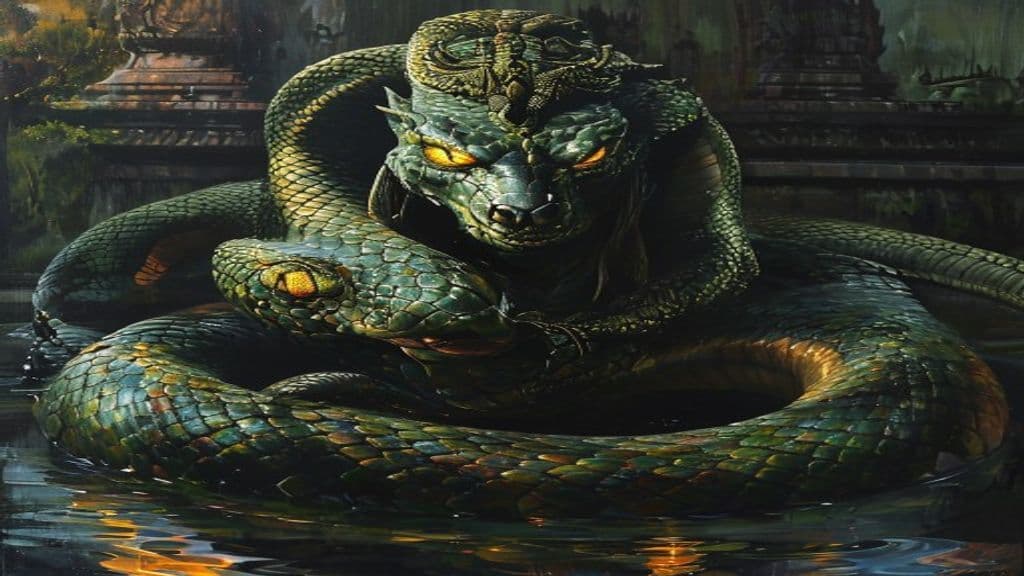
Ao Guang (Dragon King of the East Sea)
Ao Guang is the Dragon King (Dragon God) who presides over the East Sea (Dōng Hǎi) in Chinese mythology, literature, and folk-religion. He is presented in sources as a regional aquatic deity associated with water and weather and appears as a named supernatural figure in classical vernacular novels such as Journey to the West and Fengshen Yanyi.
Asian dragon (long / loong)
The Chinese or Asian dragon (Chinese: long or loong) is a legendary creature in Chinese mythology, folklore, and culture, widely represented as an auspicious, potent being most commonly associated with control over water and weather. It appears across myth, art, and modern public performance rather than as a single folkloric apparition with standardized ritual responses.
Bai Longma (White Dragon Horse)
A dragon-being from the 16th-century Chinese novel Journey to the West who serves as the monk Tang Sanzang's steed during the pilgrimage and is later ordained to the Buddhist office Babu Tianlong Guangli Bodhisattva. Presented in the narrative as a dragon in horse form or a dragon who takes on the role of a horse/servant.
Bai Ze
Bai Ze (白澤, Báizé; Japanese Hakutaku) is a legendary sacred creature in Chinese tradition famed as an authoritative recorder of ghosts and gods whose illustrated compendium (Bái Zé Tú) was employed as a household prophylactic against spirit-world harm. The creature’s image and diagrams were used in China and later Japan to identify, ward off, and prescribe avoidance of spectral calamities.
Bi'an
Bi'an is attested in the provided sources primarily as a named member of the traditional roster called the Nine Sons of the Dragon, appearing in catalogues of mythic names. The figure is also present as a name-form within the broader lexical field of Chinese folk religious beings (for example, appearing alongside death-escort deities in separate sources), but the supplied materials do not furnish an independent, detailed myth or cultic biography for Bi'an.
Chang'e
Chang'e (嫦娥), originally attested as Heng'e and linked to the older name Chang Xi, is the female lunar immortal of Chinese myth who resides in the Moon Palace (廣寒宮). Best known from the elixir-of-immortality tale in which she ascends to the Moon and is accompanied there by the Jade Rabbit, she functions across religious and literary contexts as a lunar goddess/immortal and a poetic symbol of solitude and longing.
Chenghuangshen (City God)
Chenghuangshen (城隍神), commonly called the City God, is a tutelary deity in Chinese folk religion tied to a specific settlement. Historically associated with a city's walls and moat, the deity functions as protector of local affairs and as a local official in the postmortem ordering of souls for that place.
Chinese dragon (long / loong)
A central legendary zoomorphic being in Chinese myth and culture (Chinese: long / loong), the dragon embodies auspicious cosmic and ancestral power, especially mastery over water and weather, and functions as an imperial and communal emblem across material culture, ritual performance, and state iconography.
Chinese ghosts
Spirits of deceased persons in Chinese folk belief, integrated with ancestor-worship and syncretic Buddhist ideas; often conceived as potentially malevolent if neglected or provoked, while some deceased become honored ancestral spirits through proper ritual care.
Chinese gods and immortals (shenxian)
A heterogeneous corpus of deities (shen) and immortals (xian) in Chinese religious and mythic thought, understood as manifestations or localizations of the cosmic principle (Tian/Tao/qì). They include celestial gods, local tutelaries, deified culture-heroes, and Taoist immortals formed and sustained by temples, ancestral ritual, and popular cult.
Daji
Daji (妲己, Dájǐ) is a figure in Chinese narrative and popular religious-cultural materials who blurs human and spirit categories: historically remembered as the favorite consort of King Di Xin of Shang but in later legend and fiction identified as a fox‑spirit (often a nine‑tailed or thousand‑year fox) that possessed or impersonated the woman and precipitated moral and political decline.
Dilong (地龍)
Dilong (地龍; dìlóng, "earth dragon") is a category-name in Chinese dragon taxonomy denoting dragons associated with the earth/ground. The term is polyvalent in sources: it designates an earth-associated dragon-type in cosmological and omen literature, and by analogy names earthly animals (notably the earthworm) used in materia medica.
Community Record
- [1]Ao Guang. Wikipedia: Ao Guang — 'Ao Guang is the Dragon King of the East Sea in Chinese folklore. He is a famous figure in Asian mythology, folk-lore and folk-religion combined. He featured prominently in different classical works including Fengshen Yanyi and Journey to the West.'wiki
- [2]Dragon King of the East Sea. Wikidata label and entry listing Ao Kuang/Ao Guang as a deity in Chinese folk religion.wiki
- [3]Ao Kuang | Forgotten Empires. Forgotten Empires: 'The dragon Ao Kuang is Lord of the Eastern Sea. His three brothers, Ao Qin, Ao Run, and Ao Shun rule the seas of the other cardinal directions. He and his brothers are fickle rulers, and Ao Kuang’s many ill-reputed sons cause their share of mayhem on earth.'other
- [4]Ao Kuang (Smite) | Villains Wiki | Fandom. Smite fandom summary (modern popular-media retelling) describing Ao Kuang as one of the four Dragon-Gods who 'demanded to be worshiped from people at the shorelines for calm tides, rain for their crops, and to not cause rivers to flood' and attributing further character traits in modern retellings.folk