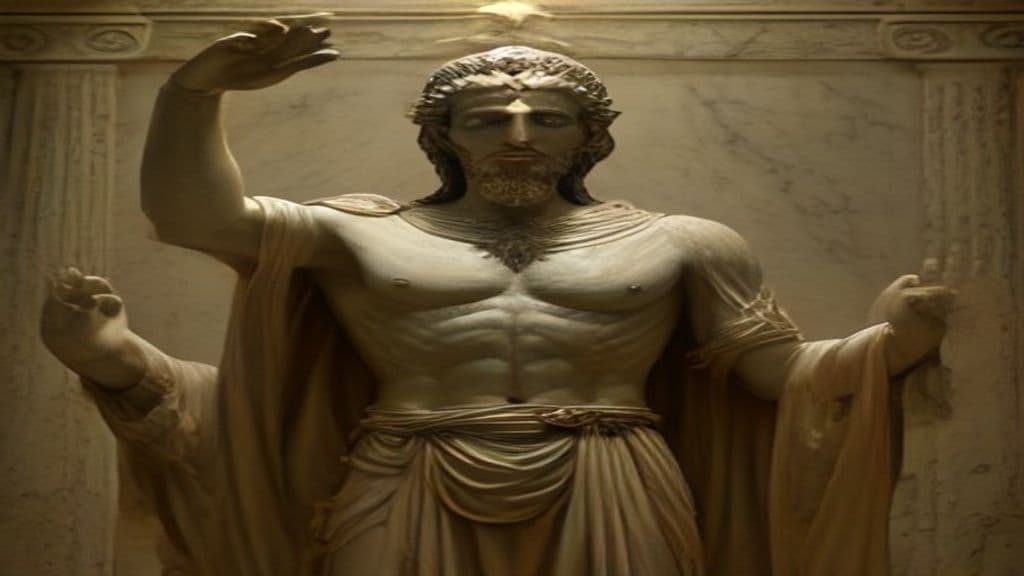
In Homeric tradition (Iliad Book I) Chryses is presented as a venerable priest of Apollo attached to the sanctuary at Chryse near Troy. He appears in the narrative when his daughter, Chryseis, has been taken captive by the Greek forces; when Agamemnon refuses ransom, Chryses makes a formal supplication to Apollo, and the god responds by sending a plague upon the Greek army until the captured woman is returned.
Homeric passages characterize Chryses as a venerable suppliant performing ritual gestures: he presents costly gifts, bears Apollo's ensigns, lifts his hands and prays aloud, and stands in the posture of a supplicant before the Greek camp. No detailed physical description (height, facial features, clothing beyond cult insignia) is given in the cited epic passages.
Chryses possesses no supernatural powers in the sources; his agency is ceremonial and social. As a priest and suppliant he can present offerings and formal prayers to Apollo. It is Apollo — not Chryses — who effects the plague in response to Chryses' petition; Chryses' efficacy derives from his status as priest and the proper performance of supplication.
Weaknesses
- otherNone attested in sources
Wards
- otherNone attested in sources
Chromios
Chromios is an ancient Greek personal name attested for several human figures in classical literary and historical sources (not a single supernatural being). Attestations include Chromios of Aitna, victor in a chariot race celebrated by Pindar (Nemean I, c. 473 BCE); a warrior/captain name found in epic/Homeric indices and scholia; an Argive survivor in the tradition of the Battle of the 300 Champions; and the modern asteroid 32726 Chromios, a Jupiter Trojan named from the Greek onomastic repertoire.
Chromis
Chromis (Ancient Greek Χρόμις) is an anthroponym attested across multiple ancient Greek and Roman mythic episodes. The name is borne by several distinct minor figures — including at least one centaur at the Centauromachy and several mortal warriors in epic war-lists — rather than a single supernatural species or cult figure.
Chrysanthius of Sardis
Chrysanthius of Sardis (Ancient Greek: Χρυσάνθιος; died AD 505) was a late-antique Greek Neoplatonist philosopher and the high-priest of Lydia. A pupil in the lineage of Iamblichus via Aedesius, he is recorded as devoted to the mystical side of Neoplatonism and noted for moderation in his priestly office.
Chrysanthus and Daria
Chrysanthus and Daria are venerated Christian martyrs of the early Church, remembered in liturgical calendars and by the cult of relics. Their legend places them in late third-century Rome, where they converted others and suffered martyrdom; their Acts survive in later Greek and Latin versions judged historically unreliable, while relics attributed to them were translated and enshrined in several medieval sites.
Chrysaor
Chrysaor is a figure from Greek myth born from the beheading of the Gorgon Medusa; traditionally presented as the brother of Pegasus and the father of Geryon, he functions chiefly as a genealogical and etiological link within Hesiodic and related traditions.
Chryseis
A mortal woman in Greek myth best known from Book 1 of the Iliad as the daughter of Chryses, a priest of Apollo, taken as a captive/concubine by Agamemnon; her father's supplication to Apollo and the resulting plague force Agamemnon to return her, illustrating the nexus of religious and political obligation in the epic. Later traditions give her personal names (Astynome) or rework her into medieval figures such as Cressida and, in some post-Homeric accounts, assign her children by Agamemnon.
Chrysopeleia
Chrysopeleia is an Arcadian hamadryad (tree-nymph) of Greek myth whose life is bound to a particular oak (or tree). In the surviving tradition she is rescued when floodwaters threaten her tree, becomes the lover of the mortal Arcas, and bears him two sons, Apheidas and Elatus.
Chrysothemis (daughter of Agamemnon)
Chrysothemis (Ancient Greek Χρυσόθεμις) is a mortal woman in the Greek tragic tradition, presented as a daughter of Agamemnon and Clytemnestra and sister to Electra and Orestes. In surviving dramatic sources she functions as a domestic and psychological foil to Electra: she mourns her father but counsels conciliation and self-preservation rather than avenging Agamemnon's murder.
Chrysus
Chrysus (Ancient Greek Χρυσός, Khrusos) is the personification of the metal gold in ancient Greek literary and scholastic sources. Attested chiefly in poetic lines (Pindar) and scholia, Chrysus functions as a minor divine personification or daimon that indexes gold's value, brilliance, and cosmological provenance rather than a cultic deity with independent mythic narratives.
Chthonia
Chthonia (Ancient Greek: Χθονία, 'of the earth' or 'subterranean') is a polyvalent term in ancient Greek myth and cult used as a personal name for several mythic women, an epithet for gods and goddesses in their earth-or underworld-aspects (notably Demeter), and a poetical/toponymic name for Crete. It marks persons, sanctuaries, festivals and divine functions associated with the chthonic (earth/subterranean) domain rather than designating a single, individuated supernatural being.
Chthonius (Χθόνιος / Chthonios)
Chthonius is an Ancient Greek name and epithet meaning "belonging to the earth/the underworld." It is applied to multiple distinct mythic figures — several mortal or semi-divine personages (a Spartos, a son of Aegyptus, a founder-son of Poseidon and Syme, a Centaur, a Giant) — and used as a chthonic epithet for major gods; in modern taxonomy it names a genus of pseudoscorpions.
Chuchunya (Yeti / Abominable Snowman)
A large, hairy, humanoid creature reported in modern legend and cryptozoology as inhabiting the Himalayan mountains; presented in contemporary sources as a mythical humanoid or cryptid rather than a well‑documented indigenous cosmological being. Much alleged evidence consists of anecdotal sightings, disputed recordings, photographs, and footprint casts, some of which have been judged hoaxes.
Community Record
- [1]Chryses (priest of Apollo) — Wikipedia. Wikipedia: Chryses (priest of Apollo)wiki
- [2]Chryses (mythology) — Wikipedia. Wikipedia: Chryses (mythology)wiki
- [3]The Iliad, Book I — translation (The Internet Classics Archive). Homer, Iliad, Book I (translation) — Internet Classics Archiveliterary
- [4]The Iliad, Book I — translation (Monadnock.net). Homer, Iliad, Book I (translation)literary
- [5]Archive: The Quarrel Between Agamemnon and Achilles (1958 recording archive). Archive recording/edition referencing Iliad Book I materialother
- [6]Name Chryses Meaning - numeroscop.net. Modern name-meaning compilation (not authoritative for ancient etymology)other
- [7]Wikidata: Chryses. Wikidata entry (contains variant attributions; noted as differing from Homeric account)other
- [8]The Girl Chryseïs — Gender & Sexuality in Ancient Greece (essay). Modern commentary on Iliadic episode of Chryseis and Chrysesother
- [9]Iliad scans / editions (oook.info Convivium). Edition/translation resources for the Iliad (Book I passages cited)literary