
In medieval Welsh cosmology the Cŵn Annwn are attendants of Annwn, the Otherworld of bounty and eternal youth. In narrative sources they belong to or hunt for Annwn's rulers (Arawn in the First Branch of the Mabinogi) and later become linked with Gwyn ap Nudd. They function as manifestations or emissaries of Annwn within the human landscape. Under later Christian influence some commentators reinterpreted them as 'Hounds of Hell,' a reclassification that overlays the earlier native framing of Annwn as not equivalent to Christian Hell.
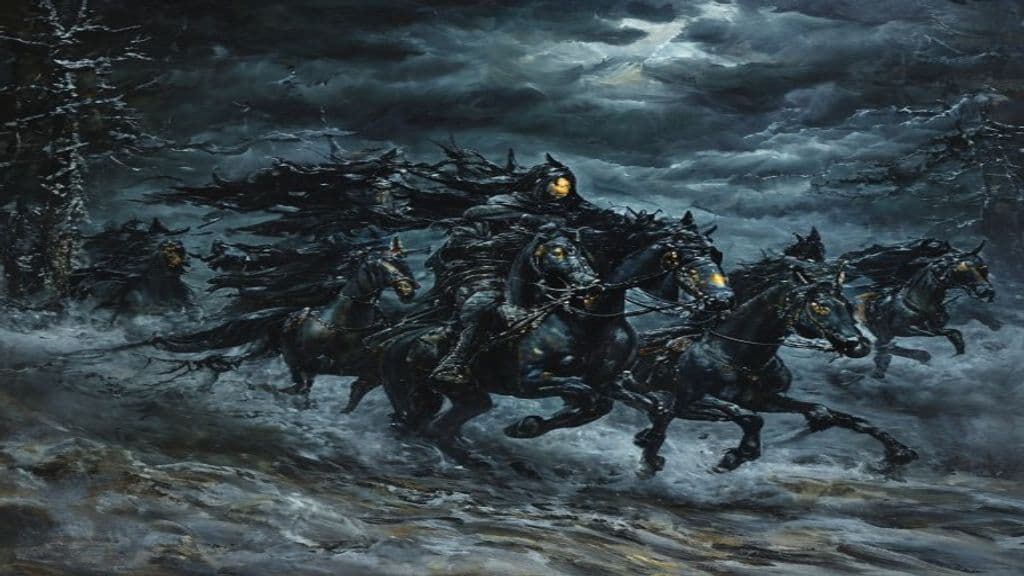
Primary medieval descriptions (e.g., the First Branch of the Mabinogi as cited in summaries) portray them as spectral dogs 'of a brilliant shining white' with red ears: 'For their hair was of a brilliant shining white, and their ears were red.' They are described in modern summaries as a phantom or spectral breed of hounds. Later folkloric and comparative accounts sometimes darkened their image (linking them to black dogs in wider Wild Hunt traditions), but the medieval Welsh sources emphasize white bodies with red ears.
They act as hunting hounds of Annwn: set loose to pursue ordinary game in some tales and, within Wild Hunt motifs, to pursue wrongdoers until they can run no longer. They are connected to Annwn's rulers (Arawn in early narrative; later lore connects them to Gwyn ap Nudd). Some later or folkloric accounts describe them as escorts of souls to the Otherworld, but this is presented in the sources as an occasional or later attribution rather than an exclusive, original function. Their approaching cry is traditionally regarded as a portent of death.
Weaknesses
- otherNarrative account of being driven off by a human pack of dogs (per Pwyll)
Wards
- otherSetting ordinary hunting dogs against them (attested as an episode in the First Branch narrative; not documented as a formal folk ward)
Cáo (Hồ ly tinh)
This entry documents the absence of information on the Vietnamese fox spirit "cáo" or "hồ ly tinh" in the supplied source set. The provided materials do not describe this supernatural figure; they instead refer to unrelated entries (the historical Cao Cao, the Chinese surname Cao, and unrelated archived web pages).
Círdan
Círdan is a named Elf in J. R. R. Tolkien's legendarium, portrayed as a shipwright and leader associated with the Grey Havens (Mithlond) who prepares vessels for the westward departure of the Elves from Middle-earth.
Cù Sìth / Cú Sídhe
A mythic hound in Irish and Scottish Gaelic folklore whose name links the common Gaelic word for 'hound' with the síth/sídhe element associated with the Otherworld; sources identify it as an otherworldly canine comparable in concept to Welsh otherworld hounds. Available documentation for this entry is limited to short encyclopedia-style references (Wikipedia and Wikidata).
Cú Chulainn
A legendary Irish warrior-hero and demigod of the Ulster Cycle, Cú Chulainn is the central martial protagonist of the Táin Bó Cúailnge and a culture-constituting figure whose stories were preserved in multiple medieval manuscripts and continue to appear in modern memorial and institutional contexts.
Cú Sídhe
The supernatural fairy hound of Celtic tradition — enormous, dark green or white, who hunts in eerie silence and whose triple bark is a death omen.
Căpcăun
A monstrous antagonist in Romanian folktales, the căpcăun is typically depicted as a dog-headed ogre who kidnaps and eats people (especially children and young women). It functions narratively as an embodiment of evil alongside other Romanian monsters such as the zmeu and balaur.
D'Bari
The D'Bari are a fictional extraterrestrial, semi-humanoid, plant-like species from Marvel Comics, native to the planet D'Bari IV. Their civilization was nearly annihilated when the Phoenix Force consumed their star during the Dark Phoenix Saga; survivors and individuals appear across subsequent comic stories and adaptations.
D'Spayre
D'Spayre is a fictional extradimensional mystical entity from Marvel Comics who sustains himself by feeding on human despair, despondency, fear, and anguish. Presented as a creation of the Dweller-in-Darkness and a member of the Fear Lords, he operates on Earth to manipulate victims' minds and amplify hopelessness for psychic sustenance.
Da Siming
Da Siming (大司命) is a deified official-title in Chinese religious-cultural frameworks representing an office that administers and ‘‘makes fine adjustments to human fate.’’ The figure appears in textual and religious contexts as part of a bureaucratic cosmology of cosmic administration and is often presented as one half of a dyadic pair with Shao Siming.
Daayan (Dayan, Ḍāin / Ḍāini)
A malevolent female spirit or ghost in Indian folklore, often identified as the restless spirit of a woman who died traumatically or with unresolved circumstances. The vernacular term is frequently rendered in English as 'witch,' but sources emphasize it denotes a post‑mortem vengeful spirit rather than a living practitioner; etymological links are drawn to the Sanskrit dakini, a class of fiendish female spirits in medieval texts.
Dactyls
Dactyls (Ancient Greek Daktuloi, literally "fingers") are archaic mythical figures in Greek tradition associated with Mount Ida; some traditions credit an Idaean Dactyl named Herakles with originating the Olympic Games. The term also appears in later cultural registers (poetic meter, modern astronomical naming).
Daedalion
Daedalion (Ancient Greek: Δαιδαλίων) is a figure from Greek myth: a son of Hesperos/Phosphorus, father of Chione, and brother of Ceyx who, grieving his daughter's death, attempts suicide and is transformed by Apollo into a hawk. The metamorphosis is presented etiologically to explain hawk strength and predatory habits as continuations of his character and grief.
Community Record
- [1]Cŵn Annwn - Wikipedia. Wikipedia: Cŵn Annwn (summary of medieval and folkloric material, including quotations from the First Branch)wiki
- [2]Cwn Annwn (ancienttexts.org entry). Ancient Texts: Cwn Annwn (collection/summary of Celtic material on the hounds)literary
- [3]Reality's End — Cwn Annwn bestiary entry. Bestiary summary describing them as a 'phantom breed of dogs' with Welsh originother
- [4]Archive: Roots0002 / Roots0138 (cultural references). Archive catalogue entries referencing Cwn Annwn in modern cultural materials (music/compilation references)other
- [5]Hellhound - Wikipedia (comparative motifs). Comparative entry noting broader hellhound and spectral hound motifs cited alongside Cŵn Annwnwiki
- [6]Wikidata: Cŵn Annwn. Wikidata item summarizing identifiers and linked data for Cŵn Annwnother
- [7]Christine’s Faery List: Hounds of Hell (comparative cataloguing). Comparative folktale listing linking Cŵn Annwn to wider Hounds of the Night traditions and naming Mallt-y-Nosfolk