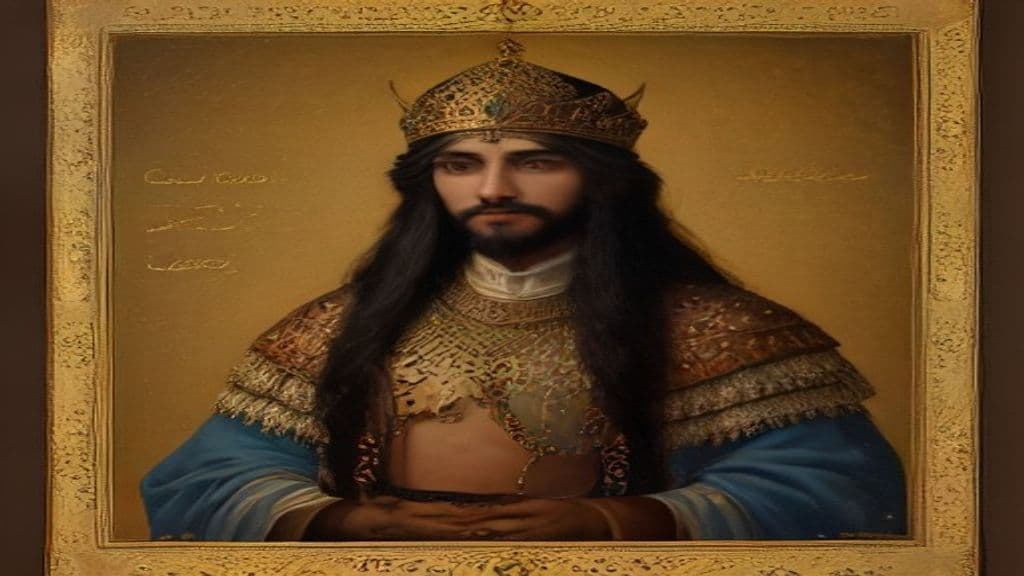
In Iran's national tradition Dara II appears as the final king of the Kayanian dynasty, a terminal royal figure whose reign marks the end of that mythic line. The sources present him as son and successor of Dara I and as a monarch who ruled between fourteen and sixteen years. Later narrative layers identify him with the historical Darius III (r. 336–330 BC). Traditions vary on his maternal identity: earlier accounts name his mother Mahnahid, while later ones call her Thamrusia, described as a Greek woman. In narrative cycles Dara II is placed in conflict with his half-brother Iskandar (Alexander), who refuses to pay tribute and rebels; during that rebellion Dara II is assassinated by his ministers Mahyar and Janushyar (identified with the historical Bessus and Nabarzanes). His line is made the basis for later dynastic claims, including an invented descent used by the Sasanian monarchs through a son named Sasan and claims of descent by the House of Ispahbudhan.
The supplied sources do not provide a physical or iconographic description of Dara II. He is represented in texts as a historical-mythical king and genealogical anchor rather than through detailed depiction of physiognomy, regalia, or visual attributes; extant accounts treat him as a narrative and political figure rather than a visually characterised supernatural entity.
Sources attribute to Dara II political and dynastic actions rather than supernatural powers. Traditions report a reign lasting between fourteen and sixteen years and identify him with Darius III of the Achaemenid Empire. Narratives recount that his half-brother Iskandar rebelled after refusing to pay tribute; during the resulting turmoil Dara II was assassinated by his ministers Mahyar and Janushyar (equated with Bessus and Nabarzanes). Later political-theological traditions used Dara II as an ancestral anchor: the Sasanians constructed a descent from him through an elder son named Sasan to legitimise their rule, and the House of Ispahbudhan likewise claimed lineage through Arsacid connections. The supplied materials do not attribute magical, spiritual, or otherworldly abilities to him.
Bozorgmehr
Bozorgmehr (Middle Persian Wuzurgmihr ī Bōkhtagān) is attested in Middle Persian, Persian epic, and Arabic/Persian historiography as a Sasanian-era sage, minister (wuzurg framadār), and military commander associated with the House of Karen during the late 5th–6th centuries CE. He is remembered as an exemplary court counselor, author of treatises, and a theme figure in literary traditions rather than a supernatural being.
The Book of Zaratosht
A Persian language epic poem from the 13th century CE that tells the story of Zoroaster's life based on oral narratives of Zoroastrians. (Note: - Power tier: Primordial (as it's an ancient text, but its power lies in its narrative and cultural significance, not in actual supernatural abilities) - Appearance: No changes needed - Abilities: Rem)
Daode Tianzun
Daode Tianzun (道德天尊, 'Heavenly Venerable of the Way and its Virtue') is one of the highest deities in Taoist cosmology, a member of the Three Pure Ones and the transcendent personification of the Dao (Way) and De (virtue). Closely identified with Laozi and commonly titled Taishang Laojun, he functions as a supreme heavenly teacher, object of worship, and ruler of the Taiqing (Great Pure Heaven).
Daolghas
Member of the Fianna, a band of warriors in Irish mythology, with supernatural abilities. (Note: * Power tier: Inconsistent with abilities described; should be Primordial or Ancient due to its cosmic/deity-level powers. * Abilities: Not entirely accurate; it's specifically stated that Daolghas ca)
Daoud
Daoud is attested in the provided sources as a male personal name (given name and surname) used across Middle Eastern, North African, and South Asian contexts. The supplied material contains no evidence treating Daoud as a supernatural being within folklore or the Greyhawk setting; all mentions are biographical or documentary.
Daphne
Daphne (Ancient Greek Δάφνη) is a mythic woman or nymph in Greek tradition who, pursued by Apollo, is transformed by a deity into the laurel tree (Laurus nobilis). The story explains the sacred status of the laurel and its ritual use as Apollo's emblem and as the victor's wreath at the Pythian Games.
Daphnis
Daphnis is a legendary pastoral youth in Greek literary tradition, presented as a Sicilian cowherd and an etiological figure for pastoral song. Various ancient authors portray him as beloved or taught by gods and nymphs; his love-affairs, suffering (blinding, petrifaction, or death), and posthumous cultic commemoration at a spring make him a liminal bridge between humans, nature-spirits, and the divine.
Darab-nama (Persian tradition)
Historical romance novel from 12th-century Persia, with possible references to supernatural entities in Persian folklore. (Note: - Power tier: Primordial (due to its historical significance and cultural impact) - Summary: Needs more specific information on supernatural entity references - Appearance: No information provided in )
Daragang Magayon
Daragang Magayon is the heroine of a Bicol legend in the Philippines whose tragic life and death are the etiological explanation for the naming and formation of Mt. Mayon. Presented as a mortal maiden of extraordinary beauty, her story functions as a foundational regional myth and a cultural archetype of idealized beauty and tragic love.
Darak
No attested supernatural being named 'Darak' appears in the provided sources. The term 'Darak' is documented as a toponym (places in Cameroon and Iran), as the Tagalog common name for rice bran used in traditional Philippine medicine, and as a personal or fictional proper name in varied modern sources. There is no corroborated ethnographic or mythological description of Darak as a spirit, deity, or monster in the consulted materials.
Darakh
Darakh is not documented in the supplied sources as a supernatural being; the string 'Darakh' appears in the materials as a place-name in Nepal, a modern surname, a lexical item in a constructed language, and as a name used in fictional/fantasy settings. No folkloric cosmology, powers, appearance, or rituals for a spirit called Darakh are attested in the provided corpus.
Daramulum
Daramulum is a southeastern Australian Aboriginal sky-hero and ancestral figure associated with the major creator Baiame and with an emu-wife. He is embedded in rock‑art, sky knowledge (constellation identification), and initiation ritual practice, notably as a presence voiced through the bullroarer.
Community Record
- [1]Dara II. Wikipedia, 'Dara II' (article summarising traditional accounts and scholarly identifications)wiki
- [2]Dara II (Wikidata). Wikidata entry for Dara II (labelled 'Mythical king')other
- [3]Dara (2) - Biblical Cyclopedia. Biblical Cyclopedia entry noting a separate Lamaism tradition using the name 'Dara' for two goddesses (distinct from the Kayanian king)literary