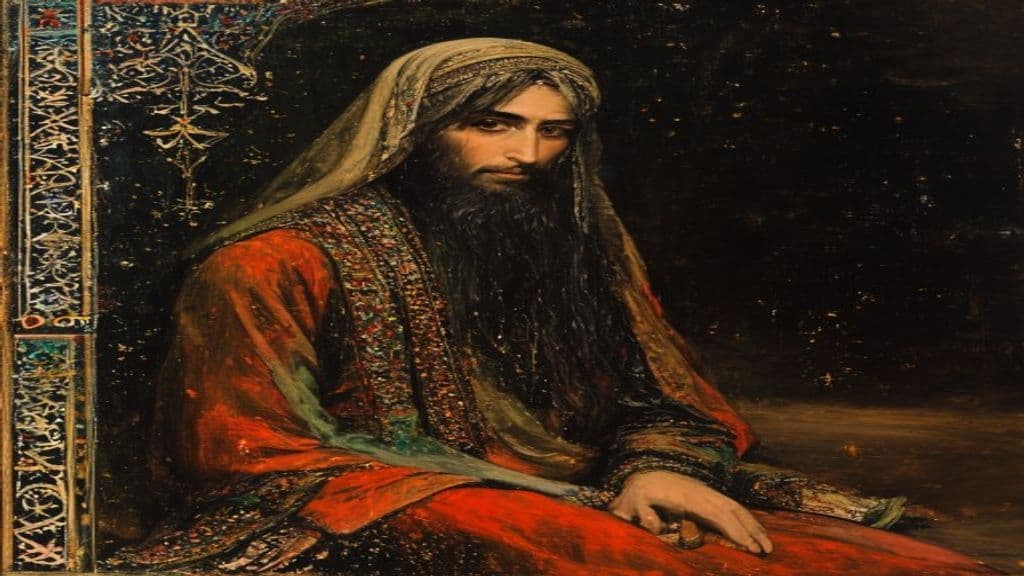
The Darab-nama reflects the worldview and cultural values of 12th-century Persia during the Seljuk period. It showcases Persian literature's rich history, blending elements from mythology, folklore, and historical events.

Al-Jann
Al-Jann (Jann) is a primordial, pre‑Adamite class of beings in Islamic/Arab folkloric tradition presented as the ancestor or earlier population from which the jinn derive. They are said to have inhabited the earth before Adam and in at least one account were ruled by a king named Jann ibn Jann; some folkloric variants describe them as punished and turned into the weakest class of jinn.
Amir Arsalan-e Namdar (The Exalted Prince Arsalan)
A powerful, potentially benevolent figure in Persian mythology with magical abilities. (Note: 1. Power tier needs to be adjusted based on abilities described (as benevolent figure with magical abilities), could be Lesser or Minor Spirit instead of Greater. 2. Summary should mention specific my)
Azadeh
Azadeh (Persian: آزاده) is a Persian female given name meaning broadly 'free' or 'free-minded'; some sources also gloss it as 'someone noble'. The name appears in modern Iranian usage (borne by several contemporary public figures) and as the name of a character in Ferdowsi's Shahnameh. It is a personal name rather than a supernatural being in the provided sources.
Farhad (Persian literature)
In Persian literature and mythology, Farhad is a character associated with the love story of Khosrow and Shirin. (Note: 1. Power tier should be revised to "Minor Spirit" since Farhad's abilities are more related to his devotion and determination, rather than cosmic or deity-level powers. 2. Remove description of "Appea)
Fulad-zereh
A huge horned demon from the Persian story of Amir Arsalan, associated with aerial wanderings and predatory behavior. (Note: 1. Power tier: Lower to "Ancient" or "Greater" as Primordial is typically reserved for entities with cosmic-level powers, which Fulad-zereh's abilities do not suggest. 2. Appearance: Add that it has a)
Huma Bird
In Persian tradition, the Huma bird is a mythical creature that inhabits the air, never touching down on the ground. (Note: - Power tier: Primordial (or not specified at all), as it has cosmic abilities - Appearance: Invisible entity (already correct) - Abilities: Add "existing solely as a concept rather than a tangible be)
Rohham
Loyal paladin and hero in the Persian epic Shahnameh, embodying values of loyalty and military prowess. (Note: * Power tier should be Primordial or Ancient, as Rohham is described as a hero in an epic that deals with "ancient Iranian history and mythology", implying a high level of power. Greater seems too low)
Tahmina
In Persian epic tradition, Tahmina is a human character in the Shahnameh, a 10th-century epic poem. She is Rostam's wife and Samanganshah's daughter, appearing in the story 'Rostam and Sohrab'. Tahmina serves as a figure illustrating themes relevant to 10th-century Persian society. (Note: 1. Power tier should be "Lesser" since Tahmina is a human character with no supernatural powers. 2. Origin story section is missing. 3. Appearance section needs to state that there is no physical desc)
Vis and Rāmin
Vis and Rāmin are the protagonists of a classical Persian romantic tale composed by Fakhruddin As'ad Gurgani in the 11th century. The narrative reflects the traditions and customs of ancient Persia. (Note: 1. Power tier should be "Minor Spirit" given that no supernatural abilities or behaviors are described. 2. Origin story is incorrect; source material states Parthian origin and not likely to have Part)
Zafarnamah (Mustawfi)
Persian epic poem written by Hamdallah Mustawfi, exploring Iranian history and culture. (Note: 1. Power tier should be Ancient (deity-level) does not fit; Primordial is typically reserved for entities related to the creation of the world or fundamental forces. 2. Appearance section is missing 3)
Dara II
Dara II (also Darab II) is a mytho-historical king in Iran's national tradition, presented as the last monarch of the Kayanian dynasty and generally identified with the historical Darius III. He functions in literary and political traditions as a terminal dynastic figure whose person is used to legitimate later houses and to explain foundation traditions for cities such as Dara and Darabgerd.
Daragang Magayon
Daragang Magayon is the heroine of a Bicol legend in the Philippines whose tragic life and death are the etiological explanation for the naming and formation of Mt. Mayon. Presented as a mortal maiden of extraordinary beauty, her story functions as a foundational regional myth and a cultural archetype of idealized beauty and tragic love.
Community Record
- [1]