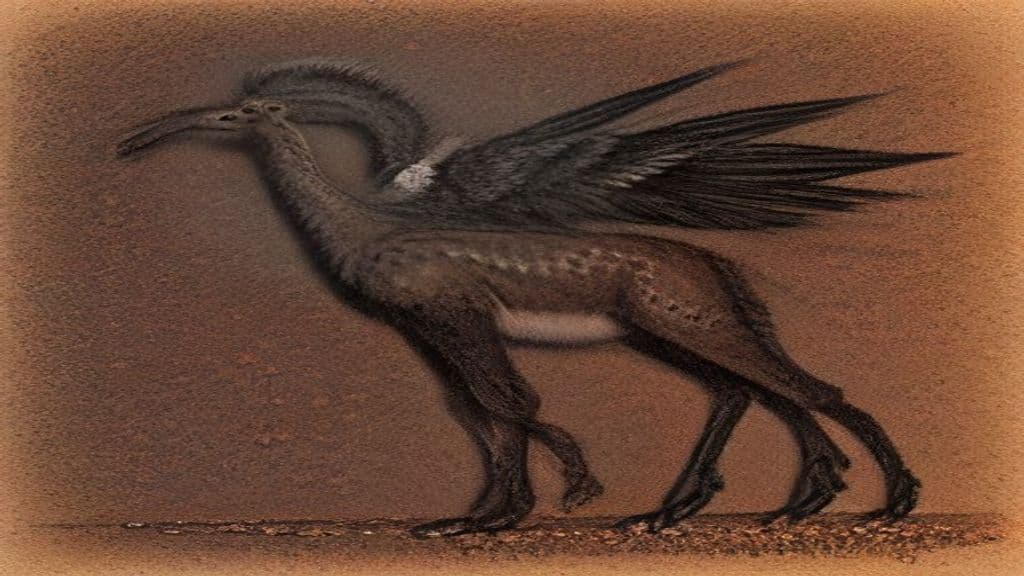
Across the recorded southeastern Australian traditions summarized in the sources, Daramulum appears as a sky-associated ancestral hero linked to Baiame. Regional name variants (Daramulum, Darhumulan, Daramulan, Dhurramoolun, Dharramaalan) reflect local linguistic forms. In at least one noted group (the Yuin), a religious/ritual system centered on Darhumulan has been identified as an element of group identity. Ethnographic and secondary summaries frame Daramulum not simply as an abstract deity but as a figure whose identity connects sky knowledge, rock art, and initiation ceremony within specific locales and custodial groups.
Rock engravings at Ku-ring-gai Chase (off Elvina Track) show Daramulum in semi‑profile with a single arm, an emu‑like back (pointed buttocks), and a disproportionately large foot — imagery that corresponds with the recorded etymology glossing his name as "one‑legged." Some engravings are accompanied by indentations that researchers have interpreted as mappings to star groups. For the Guringai, astronomical identification places Daramulum at Alpha Crucis of the Southern Cross, while the remainder of the Cross is read as the head of his emu wife; these details indicate both a terrestrial (rock‑art) and an astral mode of representation. The sources note these features as regionally situated descriptions rather than universal traits across all Aboriginal groups.
The most consistently attested roles and behaviors in the sources are ritual and locational: Daramulum is a sky‑being whose voice is mediated through the bullroarer during male initiation ceremonies; the instrument must be made from a tree that contains his spirit to function. He is described as dwelling in burls or growths on tree trunks in the bush and as only leaving these tree dwellings for initiation rites. Secondary summaries describe him as a shapeshifter. A modern compilation (single, uncorroborated source) attributes superhuman longevity, resistance to disease and injury, and rapid healing to Daramulum; these physiological claims are not supported elsewhere in the provided material and are therefore marked as uncertain.
Weaknesses
- otherNo recorded hostile weaknesses
Wards
- ritualBullroarer material provenance
- conditionCorrect ceremonial protocol and custodial authority
Daphnis
Daphnis is a legendary pastoral youth in Greek literary tradition, presented as a Sicilian cowherd and an etiological figure for pastoral song. Various ancient authors portray him as beloved or taught by gods and nymphs; his love-affairs, suffering (blinding, petrifaction, or death), and posthumous cultic commemoration at a spring make him a liminal bridge between humans, nature-spirits, and the divine.
Dara II
Dara II (also Darab II) is a mytho-historical king in Iran's national tradition, presented as the last monarch of the Kayanian dynasty and generally identified with the historical Darius III. He functions in literary and political traditions as a terminal dynastic figure whose person is used to legitimate later houses and to explain foundation traditions for cities such as Dara and Darabgerd.
Darab-nama (Persian tradition)
Historical romance novel from 12th-century Persia, with possible references to supernatural entities in Persian folklore. (Note: - Power tier: Primordial (due to its historical significance and cultural impact) - Summary: Needs more specific information on supernatural entity references - Appearance: No information provided in )
Daragang Magayon
Daragang Magayon is the heroine of a Bicol legend in the Philippines whose tragic life and death are the etiological explanation for the naming and formation of Mt. Mayon. Presented as a mortal maiden of extraordinary beauty, her story functions as a foundational regional myth and a cultural archetype of idealized beauty and tragic love.
Darak
No attested supernatural being named 'Darak' appears in the provided sources. The term 'Darak' is documented as a toponym (places in Cameroon and Iran), as the Tagalog common name for rice bran used in traditional Philippine medicine, and as a personal or fictional proper name in varied modern sources. There is no corroborated ethnographic or mythological description of Darak as a spirit, deity, or monster in the consulted materials.
Darakh
Darakh is not documented in the supplied sources as a supernatural being; the string 'Darakh' appears in the materials as a place-name in Nepal, a modern surname, a lexical item in a constructed language, and as a name used in fictional/fantasy settings. No folkloric cosmology, powers, appearance, or rituals for a spirit called Darakh are attested in the provided corpus.
Darda'il
In the cited Islamic tradition, Darda'il (Arabic: دردائيل, glossed 'Journeyers of God') are angels who travel the earth searching out assemblies where people remember God's name. The name is also attested as that of an angel invoked in exorcism; the figure appears in modern cultural references alongside other named angels.
Dardan (Shannara)
In the supplied Shannara source fragments, Dardan is attested only as the personal name of one of the king's guards who was killed by a changeling. The name also exists in real-world onomastic and ethnonymic sources, but those uses are not connected to the fictional character in the provided materials.
Dardanians (Trojan)
A named human people or subgroup in the Homeric Trojan tradition, repeatedly distinguished from the Trojans in epic formulae (e.g., the Iliad). Later Roman poets and classical writers used the ethnonym in genealogical and territorial discourse (Dardania, Dardanus).
Dardanus (son of Zeus)
Dardanus is a mythic progenitor and eponymous founder in Greek tradition, named as a son of Zeus and the Pleiad Electra and presented as ancestor of the Trojan royal line and the namesake of places on the Asian shore of the Hellespont.
Dark Lord
A literary and media archetype representing the supreme antagonist: a centralized embodiment of evil, darkness, or death who commands lesser agents and opposes heroic protagonists. Treated in sources as a narrative trope rather than a discrete folkloric being.
Dark Urge
A player-selectable Origin character concept in the 2023 video game Baldur’s Gate 3: an amnesiac mortal identified as a Bhaalspawn whose narrative revolves around compulsions toward violence and the player's choices to resist or embrace that influence.
Community Record
- [1]Daramulum - Wikipedia. Wikipedia contributors. "Daramulum." Wikipedia, The Free Encyclopedia.wiki
- [2]Daramulum (Wikidata). Wikidata entry Q10466820: Daramulum.wiki
- [3]Daramulum (Aboriginal god of the sky & weather) - marvunapp. Marvunapp. "Daramulum (Aboriginal god of the sky & weather)."other
- [4]DARAMULUM - the Kamilaroi God of Creation (godchecker). Godchecker. "Daramulum - the Kamilaroi God of Creation."other