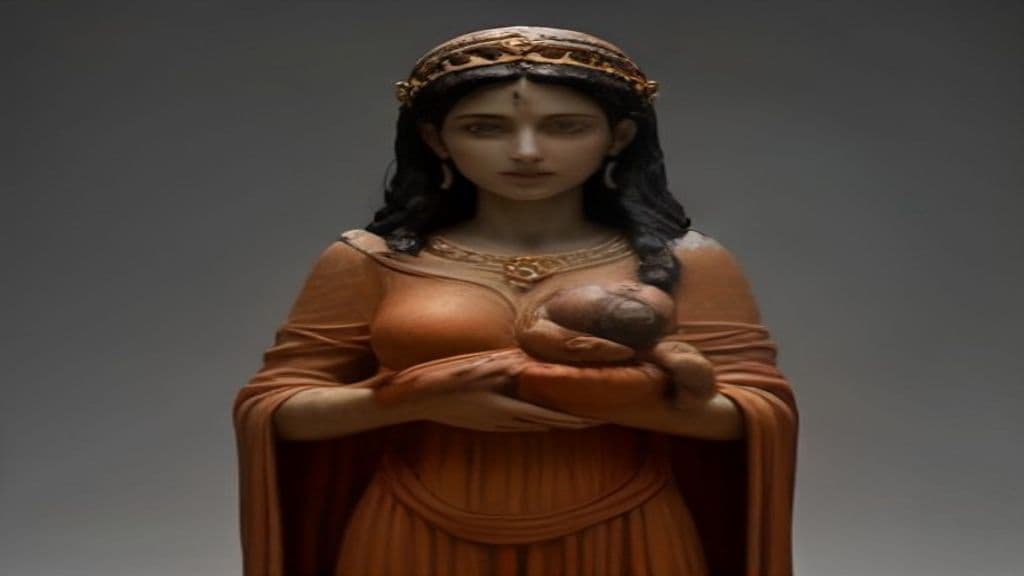
No narrative origin myth for Dea Matrona is recorded in the available sources. The deity is known from onomastic evidence in which the Gaulish theonym Mātr-on-ā (Latinized Dea Matrona) is both a title meaning 'Great Mother' and the name of the river Matrŏna (the modern Marne). Scholarly interpretation treats her as a localized maternal divinity embodied in and naming a landscape feature rather than as an abstract philosophical entity.
Surviving evidence does not preserve a distinct, individualized iconography for Dea Matrona herself. Sources report the general visual vocabulary for Gallic mother-figures (Matronae): inexpensive terracotta statuettes used in household shrines often depict mother goddesses nursing infants or holding fruits, foods, or small dogs in their laps. Matronae are frequently shown in groups (commonly triads or sometimes pairs). Whether the river-Matrona was depicted singly or within triadic representations is not attested in the sources.
There are no direct attestations of explicit supernatural acts or mythic narratives for Dea Matrona in the cited material. Scholarly inferences based on her classification among Matres/Matronae and on associated material culture suggest functions tied to motherhood, fertility, household well-being, and local tutelary protection of place (in this case, the river Matrŏna). These functional attributions are interpretive, drawn from the broader pattern of maternal divine figures in Celtic contexts rather than from recorded myths about Dea Matrona herself.
Dayang Bandir and Sandean Raja
Siblings in Simalungun folklore from Sumatera Utara, involved in family dynamics, ambition, power struggles, and loyalty within a kingdom. (Note: 1. Power tier: Based on the source material, Dayang Bandir and Sandean Raja's abilities are more deity-level (Ancient) as they exhibit human-like abilities but have significant influence over kingdoms)
Dazhbog
Dazhbog is a major figure in reconstructed pre-Christian Slavic religion most commonly identified in medieval East Slavic texts as a solar deity, described in one passage as "the Sun" and named as a son of the smith/sky god Svarog. Linguistic evidence of his name also supports a role as a dispenser of wealth or good fortune.
Daʻat
Daʻat (Hebrew: דַּעַת, "knowledge") is a Kabbalistic locus or mystical state on the Tree of Life in which the sefirot are united; it functions as a mediating point between the transcendent Keter and the manifest sefirotic structure and as a correlate of certain human cognitive-emotional capacities.
De Divinatione
An abstract concept in Roman tradition related to prophecy and divination, described in De Divinatione by Cicero. (Note: * Power tier: The text does not support Primordial power, which typically refers to entities that are cosmic or universal in scope. A more accurate classification would be Ancient (deity-level), as it)
DeSaad
DeSaad is a fictional New God from DC Comics' Fourth World mythos, serving as Darkseid's master torturer, inventor of torture devices, and a manipulative agent of Apokolips. Presented across multiple comic continuities and media adaptations, he functions as a technological and psychological practitioner of cruelty rather than a mystical folkloric entity.
Dea Dia
Dea Dia is an ancient Roman agricultural goddess associated with fertility, growth, and daylight; her cult was maintained by the priestly college the Fratres Arvales, who performed a three-day festival in May in a sacred grove (lucus) and chanted the archaic Carmen Arvale to secure crop success. Her name is interpreted as 'Goddess of Daylight' or 'Bright Goddess' and she is sometimes identified with Ceres/Demeter.
Deacon Frost
Deacon Frost is a fictional vampiric antagonist originating in Marvel Comics (first appearance: The Tomb of Dracula #13, 1973) and adapted across film and anime media. Portrayed variably as an older, 19th-century–styled vampire in the comics and as a youthful revolutionary vampire leader in the 1998 Blade film and later adaptations, he is notable for scientific knowledge and (in comics) the unique ability to create mind-controlled vampiric duplicates.
Deacon Joseph Blackfire
Deacon Joseph Blackfire is a fictional charismatic cult leader and antagonist in DC Comics' Gotham setting. Portrayed across multiple continuities as a power‑crazed con man, long‑lived agitator, and occasional supernatural menace (reanimated corpse or possessing force), he organizes the disenfranchised into violent movements and has on occasion broken Batman's will.
Deadpool
Deadpool is a modern American comic-book anti‑hero created for Marvel Comics: the alter ego of Wade Wilson, a scarred, wisecracking mercenary given an artificial regenerative healing factor through experimental procedures and appearing across comics, films, and games since 1990–1991.
Deadshot (Floyd Lawton)
Deadshot is a fictional human character (Floyd Lawton) from DC Comics, portrayed as an expert marksman and professional assassin who often appears as an antagonist in Batman stories and as a core member of Task Force X / the Suicide Squad. He is characterized by near‑superhuman accuracy, a persistent 'death wish' psychology, and recurring appearances across comics, animation, television, and film adaptations.
Dean Winchester
Dean Winchester is a fictional human character from the American television series Supernatural, portrayed primarily by Jensen Ackles. In‑narrative he functions as one of two protagonist 'hunters' who travel the United States in a 1967 Chevrolet Impala investigating and combating supernatural phenomena; his backstory includes family trauma, training by his father, deals with demons, death and torture in Hell, and resurrection by an angel.
Death (Discworld)
In Terry Pratchett's Discworld fiction, Death is the anthropomorphic personification and institutional office responsible for the ending of lives. Presented as a recurring, sentient character, he appears throughout the series and is used as a satirical reworking of the European Grim Reaper motif.
Community Record
- [1]Dea Matrona (Wikipedia). Wikipedia, entry 'Dea Matrona' (accessed source material summarized for research notes)wiki