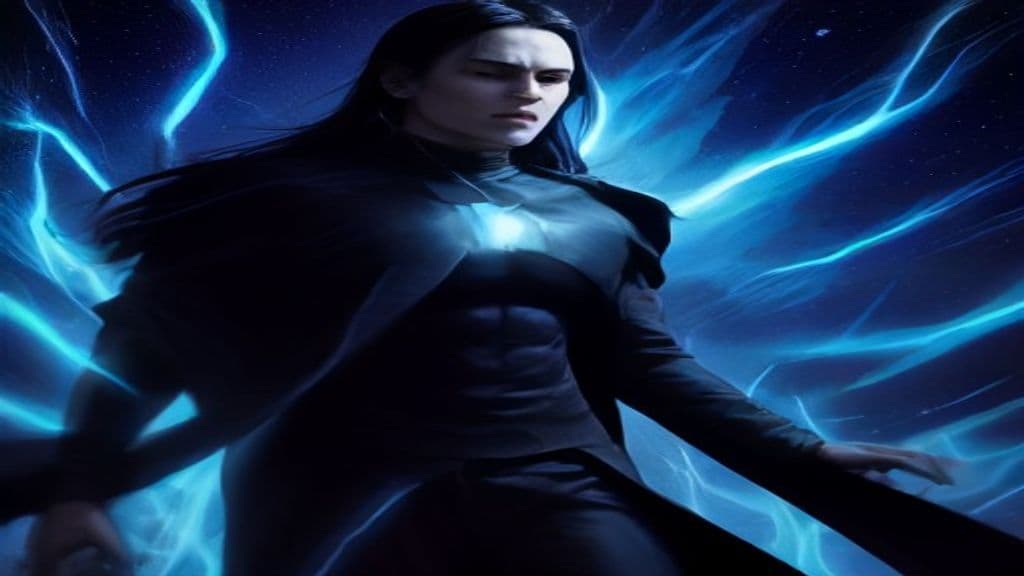
In his primary (1988) origin as told in Batman: The Cult, Deacon Blackfire emerges as a charismatic preacher and organizer who builds an army of Gotham's homeless in the city's sewers, claiming an identity as an immortal medicine man and a dark messiah to recruit followers. Later DC storylines reimagine or extend his fate: during the Blackest Night event his corpse is reanimated by a Black Lantern ring; in The New 52 he appears as an evangelist whose occult influence permeates Arkham Asylum and who commands demonic forces; subsequent Rebirth-era and related arcs depict him attempting to possess living bodies (including an attempt involving Maxie Zeus) and being opposed metaphysically (for example, the Spectre overpowering and removing him from a host). Across continuities his status alternates between human cult leader, an extended‑lifespan conspirator, and a reanimated or possessing supernatural force.
Across sources Blackfire is presented as a charismatic, quasi‑priestly figure — frequently described in reviews and summaries as a 'dark messiah' or 'charismatic quasi‑priest.' Visual specifics vary by continuity and are inconsistently detailed in the cited materials; he is typically depicted in the role of a deaconlike evangelist/conman rather than with a single canonical costume description. Reviews of Batman: The Cult characterize his affect and staging as that of a ritualistic leader organizing the disenfranchised; later depictions (as corpse or possessing spirit) portray him in forms appropriate to corpse or host rather than a single fixed physical portrait.
Sources attribute several recurring capabilities, with emphasis varying by continuity. Noted features include extreme longevity (sources state he is 'over 134 years old' or 'may be over 100 years old' in some tellings), exceptional skill in manipulation and brainwashing (he captures and conditions followers and at one point brainwashes Batman), and the capacity for occult or post‑mortem agency in some storylines (his corpse is reanimated by a Black Lantern power ring in Blackest Night; in later arcs he attempts to possess living bodies and to reenter the world as a disembodied force). His influence operates via psychological coercion and charismatic rhetoric in stories like Batman: The Cult, while other narratives involve necromantic or possession mechanisms requiring metaphysical opposition.
Weaknesses
- conditionCollapse of charismatic authority / public exposure
- otherPhysical defeat or death of the leader (followers have killed him after his failures in multiple accounts)
- otherOpposition by more powerful metaphysical agents (e.g., the Spectre overpowering and removing him from a host)
Wards
- conditionBreaking psychological conditioning through resistance and support (narrative measure: Batman breaks free of his conditioning)
- conditionSocial remedies (addressing homelessness and civic neglect) to reduce the pool of recruits (implied prevention in narratives)
Daʻat
Daʻat (Hebrew: דַּעַת, "knowledge") is a Kabbalistic locus or mystical state on the Tree of Life in which the sefirot are united; it functions as a mediating point between the transcendent Keter and the manifest sefirotic structure and as a correlate of certain human cognitive-emotional capacities.
De Divinatione
An abstract concept in Roman tradition related to prophecy and divination, described in De Divinatione by Cicero. (Note: * Power tier: The text does not support Primordial power, which typically refers to entities that are cosmic or universal in scope. A more accurate classification would be Ancient (deity-level), as it)
DeSaad
DeSaad is a fictional New God from DC Comics' Fourth World mythos, serving as Darkseid's master torturer, inventor of torture devices, and a manipulative agent of Apokolips. Presented across multiple comic continuities and media adaptations, he functions as a technological and psychological practitioner of cruelty rather than a mystical folkloric entity.
Dea Dia
Dea Dia is an ancient Roman agricultural goddess associated with fertility, growth, and daylight; her cult was maintained by the priestly college the Fratres Arvales, who performed a three-day festival in May in a sacred grove (lucus) and chanted the archaic Carmen Arvale to secure crop success. Her name is interpreted as 'Goddess of Daylight' or 'Bright Goddess' and she is sometimes identified with Ceres/Demeter.
Dea Matrona
A Gaulish river-associated mother goddess whose name (Mātr-on-ā / Matrŏna) identifies the river now called the Marne; attested as part of the wider Matres/Matronae mother-figure tradition in northern Europe and interpreted as a localized tutelary maternal presence.
Deacon Frost
Deacon Frost is a fictional vampiric antagonist originating in Marvel Comics (first appearance: The Tomb of Dracula #13, 1973) and adapted across film and anime media. Portrayed variably as an older, 19th-century–styled vampire in the comics and as a youthful revolutionary vampire leader in the 1998 Blade film and later adaptations, he is notable for scientific knowledge and (in comics) the unique ability to create mind-controlled vampiric duplicates.
Deadpool
Deadpool is a modern American comic-book anti‑hero created for Marvel Comics: the alter ego of Wade Wilson, a scarred, wisecracking mercenary given an artificial regenerative healing factor through experimental procedures and appearing across comics, films, and games since 1990–1991.
Deadshot (Floyd Lawton)
Deadshot is a fictional human character (Floyd Lawton) from DC Comics, portrayed as an expert marksman and professional assassin who often appears as an antagonist in Batman stories and as a core member of Task Force X / the Suicide Squad. He is characterized by near‑superhuman accuracy, a persistent 'death wish' psychology, and recurring appearances across comics, animation, television, and film adaptations.
Dean Winchester
Dean Winchester is a fictional human character from the American television series Supernatural, portrayed primarily by Jensen Ackles. In‑narrative he functions as one of two protagonist 'hunters' who travel the United States in a 1967 Chevrolet Impala investigating and combating supernatural phenomena; his backstory includes family trauma, training by his father, deals with demons, death and torture in Hell, and resurrection by an angel.
Death (Discworld)
In Terry Pratchett's Discworld fiction, Death is the anthropomorphic personification and institutional office responsible for the ending of lives. Presented as a recurring, sentient character, he appears throughout the series and is used as a satirical reworking of the European Grim Reaper motif.
Death deity
A category of divine beings associated with death, the dead, or the world/realm of the dead. As a class, such figures occupy central roles in many mythologies and religions, functioning as rulers of the underworld, psychopomps, guardians against chaos, or antagonists in dualistic systems.
Death god (class)
A death-associated divine or semi-divine being identified across cultures as personifying death, overseeing the dead, or governing the underworld. Treated variably as an autonomous sovereign in polytheistic systems and as a role carried out by agents (angels/demons) or subordinate functions under divine sovereignty in some monotheistic texts.
Community Record
- [1]Deacon Blackfire - Wikipedia. Wikipedia, 'Deacon Blackfire'wiki
- [2]Batman: The Cult - Wikipedia. Wikipedia, 'Batman: The Cult' (1988 miniseries)wiki
- [3]Deacon Blackfire | Villains Wiki. Villains Wiki (Fandom), 'Deacon Blackfire' entryother
- [4]Batman: The Cult – Now Read This! (review). ComicsReview 'Batman: The Cult' reviewother
- [5]Batman: The Cult (review) – Rambles.net. Rambles.net review/synopsis of Batman: The Cultother
- [6]Batman reviews: Batman: The Cult. Pulp and Dagger review of Batman: The Cultother
- [7]Batman: The Cult – ComicBookBin review. ComicBookBin review/synopsis of Batman: The Cultother
- [8]Batman: The Cult – Deluxe Edition – Now Read This!. ComicsReview piece on Batman: The Cult deluxe edition (contextual commentary)other
- [9]Deacon Blackfire (DC Database). DC Database (Fandom), 'Deacon Blackfire' entryother