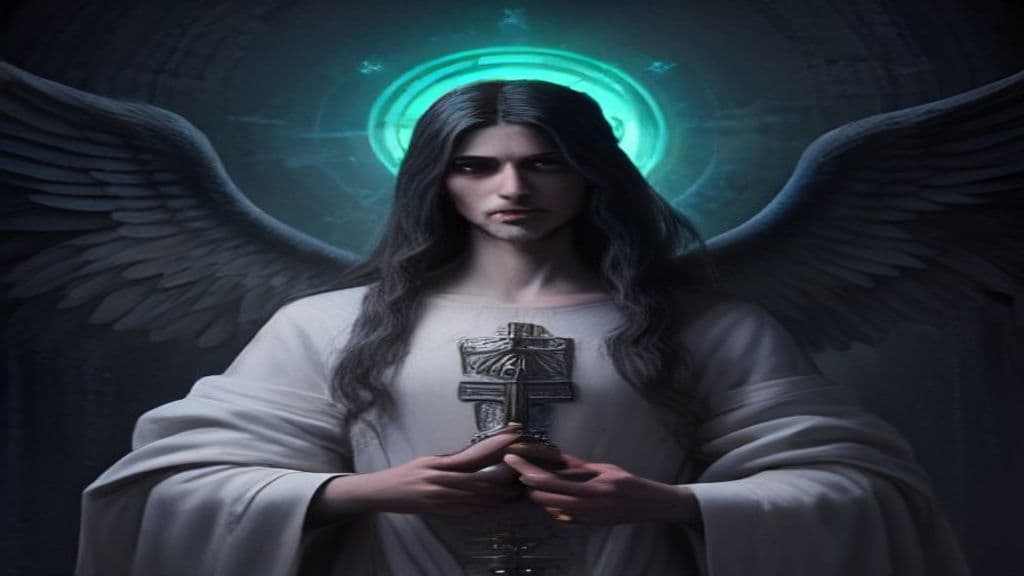
In the rabbinic/Talmudic-derived schema of national tutelary angels, a set of some 70 or 72 angels were assigned as patrons or guardians of the world's nations. According to the summary of these legends in modern reference sources, Dobiel rose in the heavenly hierarchy to officiate in Heaven as Gabriel's temporary proxy for 21 days during a period when Gabriel had been disgraced for intervening on behalf of Israel. After occupying that office Dobiel is said to have acted on behalf of the Persian people in the divine council; the story is given in the context of a larger tale in which most national angels became biased toward their own nations (with Michael singled out as the exception). These details are reported in modern summaries of the Talmudic legend rather than in the supplied primary text excerpts.
No traditional physical description, iconography, or appearance details for Dobiel are provided in the supplied sources. The available accounts treat Dobiel as a heavenly official and party representative in the divine council; modern summaries and database entries (Wikipedia, Wikidata) record his role but do not describe bodily form or visual attributes.
Sources summarize Dobiel's functions in the heavenly bureaucracy: he could 'officiate in Heaven' (serving for 21 days as Gabriel's proxy), act as an advocatory or intercessory agent for Persia, and function as one of the special accusers of Israel in the heavenly court. The narratives emphasize political/representative powers—occupying an office, interceding for a nation, and pressing accusations in divine deliberations—and behaviorally he is described as helping the Persian people 'at the expense of every other nation' after assuming the officiating role.

Gabriel
A principal heavenly messenger in Jewish, Christian, and Islamic literatures, Gabriel is portrayed as an archangel who reveals and explains divine messages, announces births and divine intent, and executes certain divine judgments in apocalyptic texts.
Michael
Michael is presented in the supplied sources as a masculine given name and disambiguation headword applied to people, historical rulers, cultural works, places, and other uses; the provided material treats it as an onomastic item rather than as a single supernatural being.
Diyin Dinéʼé
Diyin Dinéʼé (Navajo: "Holy People") are the central sacred personages of the Diné Bahaneʼ (Navajo creation narrative). They are active figures in the prehistoric emergence stories that locate and order the Diné people and serve as the foundation for traditional Navajo life and ceremony.
Diyu (Buddhist tradition)
The realm of the dead or 'hell' in Chinese mythology, combining elements from Buddhist and traditional Chinese beliefs about the afterlife. (Note: 1. Remove "Primordial" power tier designation as it implies cosmic-level power, which is not supported by the source material (Diyu is described as a realm or "hell", not an entity with vast cosmologi)
Diü
No folkloric or mythological entity named "Diü" (or "Diu") is documented in the supplied sources. The string appears only in the provided materials as a place name, a botanical genus, or unrelated contexts, and no information about a supernatural being by that name is contained in those sources.
Djen (no attested supernatural entity in supplied sources)
The supplied source corpus contains no documentation of a supernatural being called 'Djen'. Instances of the string 'Djen' appear only as modern personal names, place-names (notably the Djendjen/Djen Djen port in Algeria), acronyms, or parts of titles; nothing in these sources describes a spirit, deity, monster, or other folkloric entity named 'Djen'.
Djinn
The class of supernatural beings created from smokeless fire in Islamic cosmology — a parallel civilization to humanity, capable of belief or unbelief, with their own prophets, society, and judgment before God.
Dobhar-chú
The 'water hound' of Irish folklore — a ferocious hybrid creature, part otter and part dog, lurking in Irish lakes, known to have killed people and capable of pursuing its hunters at terrifying speed.
Dobrynya Nikitich
A Slavic bogatyr (heroic warrior) based on a historical warlord, reflecting medieval ideals of chivalry and nobility. (Note: - Power tier: Primordial (no supernatural abilities are mentioned, but he is a bogatyr, which implies a higher power tier) - Sensory cues: not present in source material - Weaknesses: not present in s)
Doc Samson (Leonard Skivorski Jr.)
Doc Samson is a created American comic-book figure (Marvel Comics) — a psychiatrist who gains gamma-induced superhuman strength and long green hair after exposing himself to siphoned gamma radiation. He functions as both a practicing clinician and a recurring superhuman actor within serialized Marvel storylines, notably in relations to Bruce Banner / the Hulk.
Doctor Bong
Doctor Bong (Lester Verde) is a fictional human supervillain from American comic books published by Marvel Comics. A satirical 'mad scientist' figure created by Steve Gerber and Marie Severin, he is best known for a bell-shaped helmet whose strikes produce technological effects and for his work in genetic engineering.
Doctor Cyber
Doctor Cyber is a recurring DC Comics antagonist associated principally with Wonder Woman. Across publishing eras she appears as a brilliant criminal mastermind, a cybernetically augmented villain obsessed with regaining her beauty, a participant in composite cybernetic constructs, and in Rebirth as an artificial-intelligence persona derived from a deceased scientist's memory.
Doctor Destiny
Doctor Destiny is a fictional DC Comics supervillain, usually the criminal scientist John Dee (occasionally rendered John Deegan in adaptations), who acquires dream‑linked artifacts—most notably the Materioptikon/Dreamstone—and uses them to enter and manipulate dreams and, at times, to manifest dream‑content in waking reality.
Doctor Doom
Doctor Doom (Victor von Doom) is a fictional supervillain in American comic-book popular culture, created for Marvel Comics as the armored, hooded sovereign of the fictional nation Latveria who blends advanced science and sorcery. He serves as a recurring antagonist—most notably to the Fantastic Four—and functions as a narrative symbol of arrogance, technological hubris, and authoritarianism.
Community Record
- [1]Dobiel. Wikipedia, 'Dobiel' (summary of Talmudic legend and name etymology)wiki
- [2]Dobiel (Wikidata). Wikidata entry for Dobiel (concise data point: guardian angel of Ancient Persia)other
- [3]Dobiel — Megami Tensei Wiki (Fandom) (fictional adaptation). Megami Tensei Wiki (fan wiki describing a modern fictional/game adaptation of Dobiel; cited here only as an adaptation source and not as the traditional portrayal)other
- [4]CIA Reading Room document (archival listing included in research notes). Archive.org listing provided in research notes (included among supplied source URLs)other
- [5]Albany History Fair (archival listing included in research notes). Archive.org listing provided in research notes (included among supplied source URLs)other