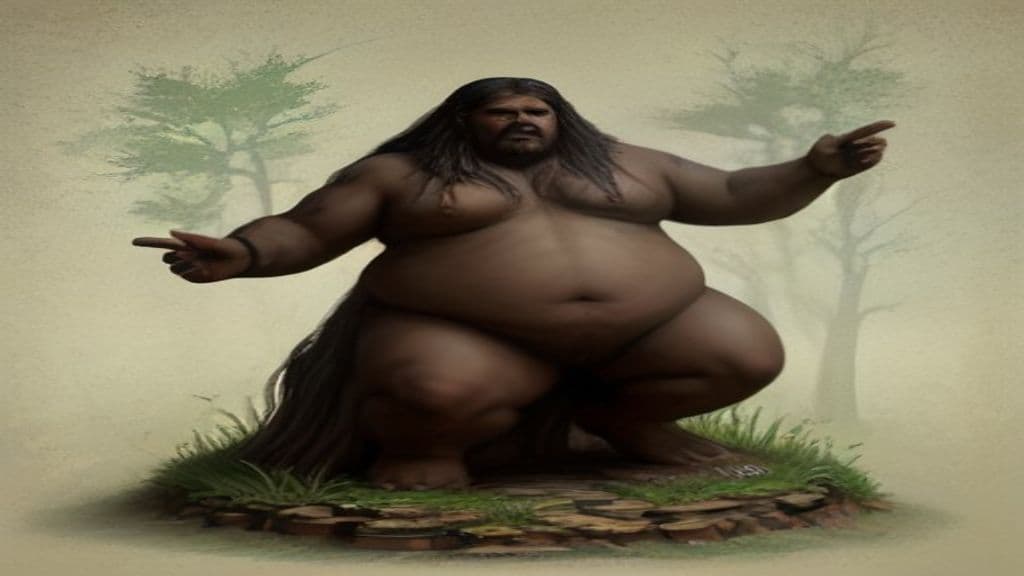
In Tolkien's internal history the Drúedain (self-name Drughu) were early-migrating Men who left Hildórien and were among the first to cross the Anduin; some settled in the White Mountains and some went into Beleriand in the First Age where they lived among the Haladin and were friendly with Elves. A portion accompanied the Edain to Númenor but had left or died out there before the Downfall (Akallabêth). By the Third Age surviving groups lived in the Drúadan Forest and on the cape of Andrast, remembered in place-names such as Drúwaith Iaur ('Old Drûg land').
Other peoples describe the Drúedain as stumpy, clumsy-limbed, with short thick legs, fat gnarled arms, broad chests, fat bellies, and heavy buttocks; they were said to somewhat resemble Dwarves in stature and endurance. Their faces were judged 'unlovely'—wide, flat, and expressionless—with deep-set black eyes that 'glowed red when angered', horny brows, flat noses, and wide mouths. Hair was sparse and lank, with little facial hair except in a few men. They were described as short-lived and wore simple clothing (grass skirts are attested in at least one portrayal).
Sources report that the Drúedain 'had certain magical powers' (wording presents this as a reported attribute rather than detailed, named abilities) and that they 'sat still in meditation for long periods.' They were famed for exceptional woodcraft: in the Third Age Drúedain resisted and harassed Orcs with poisoned arrows and could guide allies through secret forest paths. They bore deep hatred of Orcs. They also made carved guardian statues for places and homes; some accounts state that certain statues 'evidently had the power to come to life.'
Weaknesses
- conditionshort-lived (reported low longevity)
- otherwidespread fear and loathing by neighboring Men (social vulnerability)
- otherdeep enmity with Orcs (historical antagonism rather than a weakness)
Wards
- othercarved guardian statues (placed by Drúedain to guard places; some accounts say these could come to life)
Dryad
A type of Greek nymph associated with trees—especially oak—often depicted as long‑lived nature spirits whose lives are connected to particular trees in some subtypes. Dryads enforce respect for trees and may punish mortals who harm them without prior appeasement.
Dryalus
Dryalus (Ancient Greek: Δρύαλόν) is an individual centaur named in Hesiod's Shield of Heracles and later summaries; he is listed among the centaur combatants at the wedding of Pirithous and Hippodameia who fought the Lapiths in the Centauromachy. Surviving attestations are brief genealogical and catalogue-type mentions rather than extended mythic narratives.
Dryas
Dryas is an ancient Greek personal name borne by multiple mythic figures (heroes, princes, hunters). Etymologically linked to the Greek word for oak (drus, δρῦς) and by extension to dryads, the name recurs across genealogies and heroic lists rather than denoting a single supernatural species.
Dryope
Dryope (Ancient Greek: Δρυόπη) is a personal name borne by several distinct female figures in ancient Greek and Roman literature rather than a single consistent supernatural type. Bearers of the name include a mortal daughter of Dryops who bore Amphissus to Apollo, a figure identified with the Roman Fauna mothering Tarquitus by Faunus, a nymph said to have seized Hylas in accordance with Hera's will, a Theban woman who joins the Maenads and gives birth during Bacchic rites, and a Lemnian mother of the Oenotropae by Anius.
Dryops of Oeta
In Greek myth Dryops is presented as the eponymous ancestor of the Dryopians; the surviving source material records his role as a name-giver rather than a narrative character, spirit, or deity.
Drífa
No folkloric or mythological account of a supernatural entity named Drífa is present in the provided sources. The string Drífa/Drifa appears in the materials as a modern Icelandic personal name, a fictional princess in a novel, and as a biological genus name; no indigenous cosmology, appearance, abilities, or rituals for a spirit called Drífa are documented in the source set.
Duamutef
Duamutef is one of the four Sons of Horus in ancient Egyptian funerary religion, a jackal‑headed mummiform guardian whose primary role is to protect the internal organs of the deceased (most commonly the stomach) and to ensure restoration of the body in the afterlife. He appears on canopic jar lids, amulets, and tomb furnishings across a long chronological span from the New Kingdom through the Late Period and beyond.
Duela Dent
Duela Dent is a fictional, non-supernatural character from DC Comics who adopts multiple villain‑linked aliases (notably Joker's Daughter and Harlequin) and alternately appears as ally and antagonist to the Teen Titans and related teams. Her identity, age, and parentage vary across continuities and she is most often portrayed as a human acrobat who uses clown‑themed gadgets and is frequently institutionalized.
Duende
Duende is a polyvalent category of Iberian and Ibero‑American household and nature spirits comprising many regional types (Anjanas, Busgosos, Diaños, Enanos, Trasgos, Nuberos, etc.). They range from benevolent water‑nymphs and shepherd‑helpers to mischievous household intruders and shapeshifters, and are rooted in rural popular cosmologies where specific places (springs, forests, homes) are inhabited by agents with varied moral dispositions.
Duergar
Two distinct uses of the name appear in the sources: (1) a traditional English folk designation for the Simonside Dwarfs — a local small‑folk or hill spirit group associated with the Simonside Hills of Northumberland (also called Brownmen and Bogles); and (2) a modern fantasy role‑playing race: a subterranean dwarf people in tabletop RPGs (Dungeons & Dragons, Pathfinder and related SRD material) with defined physiology, resistances, and subterranean culture.
Duffer (Narnia)
A brief, secondary-source attestation names 'Duffer' as an invisible dwarf-type being in the fictional setting of The Chronicles of Narnia. Available sources supply only a single-line identification and do not provide canonical details from the primary texts.
Dukljan
Adversary of God in Slavic mythology, embodying qualities and actions of Roman emperor Diocletian. (Note: 1. Power tier should be Lower (consistent with his role as an adversary, not a cosmic being). 2. Summary needs to include that Dukljan is in Serbian mythology, not Slavic. 3. Appearance, Abilities, Se)
Community Record
- [1]Drúedain (Wikipedia). Wikipedia: 'Drúedain' article summarizing Tolkien's legendarium and scholarly commentary (includes notes from Tom Shippey, John S. Ryan, Verlyn Flieger).wiki
- [2]Woses (Tolkein Gateway / Drúedain). Tolkein Gateway entry summarizing canonical appearances and naming (Drúedain / Woses).other
- [3]Drúedain index (Valar Guild). Encyclopedic index and summary of Drúedain references and toponymy.other