
The term appears in Middle High German as trute (female trutin/trutin), with dialectal forms such as trūde (Thuringian) and trūd (Swabian, Bavarian, Austrian, Rhenish Franconian). Current philological opinion favors derivation from Middle High German trute related to Old Norse troða 'to tread, to trample' and hence to modern German treten ('to tread'), linking the name to the creature's nocturnal 'treading' on sleepers. An alternative etymology recorded in Grimms' dictionary connects trute to MHG trût ('dear, beloved') as a possible euphemistic naming practice; this view is recorded in older scholarship but considered less probable by some modern commentators. These attestations place the Drude within a long-standing Germanic lexicon of nocturnal pressure-causing spirits.
Accounts emphasize variability: the Drude may assume various sizes, being tiny enough to enter houses as a small creature (even likened to a butterfly) or capable of growing into a giantess that leaves large footprints on stone. Some traditions describe only the witch's spirit leaving the body to perform nightly visitations, indicating an incorporeal or partially incorporeal mode when active. The Drudenfuss (literally 'drude's foot') motif is interpreted locally as representing the agent's footprint.
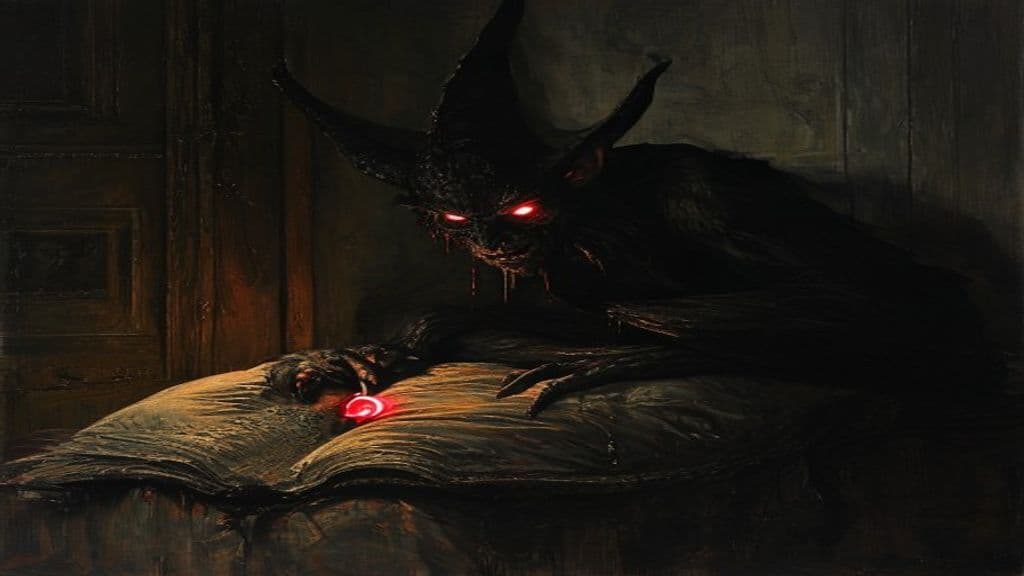
The Drude's principal function is causing Alpdruck ('elf pressure') — visiting sleepers at night to press upon them and produce nightmares or a sensation of suffocation. Traditions attribute to it shape-changing between very small and very large sizes and spirit-projection (the witch's spirit departing the body to perform nocturnal attacks). Folk responses indicate interaction mechanics: a victim who seizes an object may compel the Trude to beg for its release; localized customs report that throwing a pillow, pronouncing a holy name, or placing a hackle (comb) spikes-up on the chest will repel or deter it.
Weaknesses
- symbolDrudenfuss / Drudenkreuz (pentagram or hexagram applied as apotropaic emblem)
- otherSeizing an object to compel the Trude to beg for its release
- ritualPronouncing a holy name (reported in Absam) to frighten it away
- substanceHackle/comb placed on the chest with spikes upward (Tyrolean custom: Absam and Zirl)
- otherThrowing a pillow at the Trude (reported in Innsbruck)
Wards
- symbolDrudenfuss / Trudenfuss (painted emblem — historically hexagram, later pentagram) placed on house walls, doors, cradles, bedsteads, and public spaces
- otherTrudenfuss charm made of fir wood placed in cradles (Ötztal) to prevent pressing of infants
- otherHorseshoe or Trudenfusz affixed to stable doors to protect livestock
- symbolTriple crosses or marked staffs (related regional protective marking practices referenced alongside Drude apotropaics)
Drekavac
A South Slavic night-haunting revenant-like creature whose name means "the screamer"; traditionally linked to the restless souls of improperly buried or unbaptised dead (including sinful adults and unbaptised children) and reported in many regional variants that foretell death or disease and frighten the living.
Drelnza
Drelnza is listed as a named entry on a compiled list of characters from the Greyhawk campaign setting. The sole provided source supplies only the name; no descriptive, mythological, or functional information about Drelnza is present in that source.
Drioma
A Slavic spirit associated with the evening and night hours, known for interacting with children and adults. (Note: 1. Power tier should be Ancient, not Primordial, as Drioma's abilities are described as entering houses through cracks and fissures, but no cosmic or universal-level powers mentioned. 2. Add sensory c)
Drizzt Do'Urden
Drizzt Do'Urden is a fictional drow (dark elf) character created by R. A. Salvatore for the Forgotten Realms (Dungeons & Dragons). Portrayed across multiple novels and short stories, he is an atypical member of drow society who rejects its evil norms, becomes an exile, and wanders between the Underdark and the surface as a warrior and moral focal figure in the setting.
Drosera (sundews)
Drosera, commonly known as sundews, is a genus of carnivorous plants in the family Droseraceae. The genus contains at least 194 species distributed on every continent except Antarctica and is characterised by glandular, mucilage‑covered tentacles that trap and digest insects to supplement nutrient-poor soils.
Drow (Dungeons & Dragons tradition)
A fantasy subrace of subterranean elves developed within the Dungeons & Dragons game tradition, depicted as dark-skinned, white‑haired elven people who dwell in the Underdark and are historically associated with potent magic, priesthoods (notably Lolth-worship), and complex underground societies. The game-term borrows its name from northern British Scots dialects (trow/drow) ultimately related to Old Norse words for revenant/troll-like beings.
Drudwas ap Tryffin
A human warrior and knight associated with Arthurian and medieval Welsh tradition, noted chiefly for possessing three supernatural birds (Adar Llwch Gwin) given to him by his fairy wife; a late tale records that his literal command to those birds led to his death.
Drudwyn
A fabulous wild boar figure attested in Arthurian/Welsh tradition; the sources provided identify the well-known monster Twrch Trwyth as a 'fabulous wild boar' whose hunt is narrated in the Welsh prose romance Culhwch and Olwen. The name 'Drudwyn' appears in the query but is not attested in the supplied source excerpts.
Drummer of Cortachy
A site-bound ghost associated with Cortachy Castle and the Ogilvy (Earls of Airlie) family, reputed to sound a martial tattoo on a drum — sometimes with ghostly pipes — as a portent of imminent death among the castle's owners. The legend appears in nineteenth- and twentieth-century collections of Scottish ghost stories and in modern summaries.
Dryad
A type of Greek nymph associated with trees—especially oak—often depicted as long‑lived nature spirits whose lives are connected to particular trees in some subtypes. Dryads enforce respect for trees and may punish mortals who harm them without prior appeasement.
Dryalus
Dryalus (Ancient Greek: Δρύαλόν) is an individual centaur named in Hesiod's Shield of Heracles and later summaries; he is listed among the centaur combatants at the wedding of Pirithous and Hippodameia who fought the Lapiths in the Centauromachy. Surviving attestations are brief genealogical and catalogue-type mentions rather than extended mythic narratives.
Dryas
Dryas is an ancient Greek personal name borne by multiple mythic figures (heroes, princes, hunters). Etymologically linked to the Greek word for oak (drus, δρῦς) and by extension to dryads, the name recurs across genealogies and heroic lists rather than denoting a single supernatural species.
Community Record
- [1]Drude — Wikipedia. Wikipedia contributors. 'Drude.' Wikipedia, The Free Encyclopedia. https://en.wikipedia.org/wiki/Drudewiki