
Folklore treats the drekavac not as a single fixed species but as a class of restless dead or revenant phenomena. Sources commonly link its origin to improperly handled deaths: souls of sinful adults, of those who died in irregular circumstances, and especially unbaptised children. In some tales the soul of an unbaptised child rises from its grave and haunts the living until properly baptised; other accounts give origins as undead men, ghosts of soldiers or other disturbed dead.
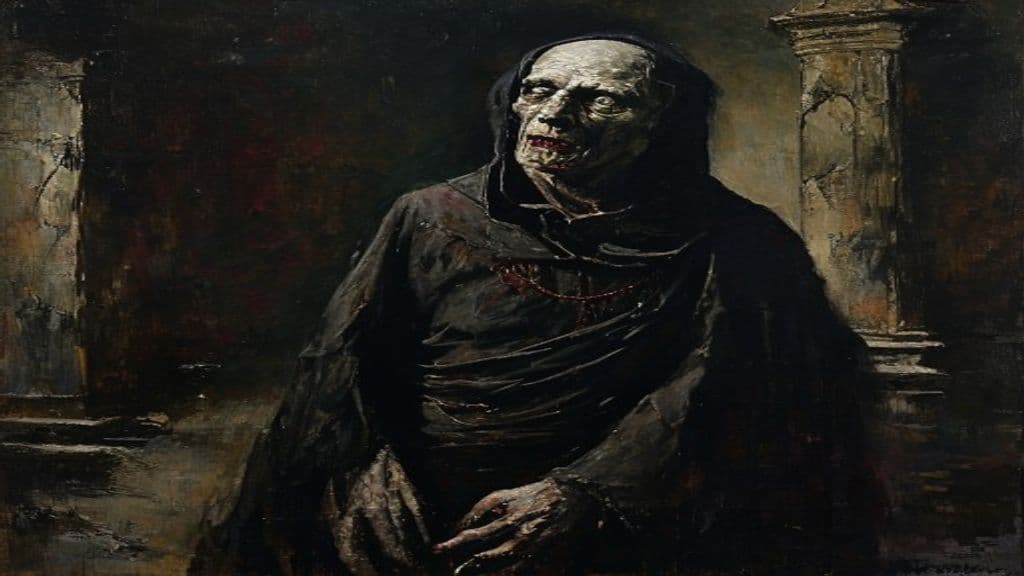
Descriptions vary widely by locality. Reported forms include an undead man rising from a grave, an unbaptised child's spindly corpse with a large head, a humanoid canine walking on hind legs (Eastern Serbia), ghostly soldiers (Maglaj), vampire-like revenants (Kozarska Dubica), a long-necked long-legged creature with a cat-like head (Arilje), a one-legged humanoid with glowing eyes (Sredačka župa), and animal apparitions such as dappled foals, dogs, cats, or birds (Prijepolje, Lešak, Dragačevo). A localized Banovići report describes an ape-like form with long limbs and a dog-like elongated head. Common motifs across variants are night appearance, unsettling proportions (elongated neck/body, large head), and association with graves or dead children.
Core traditional attributes are vocal: loud, terrifying screeching at night and entreaty when in child form (begging for baptism). The drekavac functions as an omen—child-forms are said to predict human death while animal-forms predict cattle disease—and is believed to cause illness if its shadow falls on a person. It is said to avoid dogs and bright light. Modern role-playing and cryptid sources add mechanics such as fog transformation and disease‑carrier properties, but these are adaptations of folkloric motifs rather than claims from traditional sources.
Weaknesses
- conditionbright light (avoided)
- conditiondogs present (avoided)
- ritualbaptism / proper Christian mortuary rites (preventative and curative for unbaptised-child variants)
Wards
- conditionkeeping bright light / illumination
- conditionpresence of dogs
- ritualensuring baptism and correct burial rites for infants and those who died under problematic circumstances

Bukavac
Bukavac is a demonic mythical creature from Slavic (Serbian) popular belief, attested chiefly in Syrmia. Described as an aquatic, nocturnal menace, it was said to emerge from lakes and pools to make loud noises and to jump onto people and animals, strangling them.
Vampire (tradition)
A class of revenant beings in southeastern and eastern European folk belief that subsist by feeding on the vital essence (generally blood) of the living. Recorded chiefly in early modern to modern oral traditions, these vampires are typically described as reanimated corpses whose presence explains unexplained illness, death, and post-mortem disturbances in their communities.
Ala
A female weather-being in South Slavic folk cosmology (Bulgaria, Serbia, North Macedonia) associated with hail, destructive storms, and voracious appetite; she is said to lead hail-producing clouds to destroy crops and is sometimes blamed for eclipses by attempting to devour the Sun or Moon.
German
German is a South Slavic male vegetation and weather spirit recorded in eastern Serbia and northern Bulgaria. Known primarily through ritual effigies and rites performed by girls and young women, he is associated in folk belief with bringing rain and hail and with a symbolic death-and-revival cycle tied to agricultural fertility.
Vampire (tradition)
A class of revenant beings in southeastern and eastern European folk belief that subsist by feeding on the vital essence (generally blood) of the living. Recorded chiefly in early modern to modern oral traditions, these vampires are typically described as reanimated corpses whose presence explains unexplained illness, death, and post-mortem disturbances in their communities.
Drakaina
A drakaina (Ancient Greek: δρακαίνη; Latinized dracaena) is the specifically female form of the Greek drakon — a she-serpent or she-dragon — attested in myth as a class of monstrous beings. Named exemplars (Campe, Delphyne, Echidna, Sybaris, Python in comparative accounts) appear in narratives as dangerous, often chthonic or liminal guardians and progenitors rather than as a single uniform monster.
Drakh
The Drakh are a fictional extraterrestrial polity in the Babylon 5 setting portrayed as a covertly hostile, technologically capable race that conducts fleet actions, espionage, and biological/nanotechnological warfare in the post-Shadow War era.
Draugr
In Nordic folklore the draugr (plural draugar; anglicized draug) is an archaic term for a malevolent revenant — a dead person who returns and remains active in the world of the living. Accounts emphasize variability: traits, behaviours, and descriptions change between stories and across regions, especially in early medieval Icelandic sagas and surviving Norwegian folklore.
Draupadi
Draupadi is a central figure of the Indian epic Mahabharata: princess of Panchala born from a royal yajna, the common wife of the five Pandava brothers, and in many accounts a partial incarnation of the goddess Shri and close friend (sakhi) of Krishna. Her narrative role includes the public humiliation in the Kuru court, exile, participation in the events leading to the Kurukshetra War, later queenship of Indraprastha, and final ascent toward heaven in which she falls first.
Drax the Destroyer
Drax the Destroyer is a fictional Marvel Comics character: a resurrected human spirit placed into a powerful new body by cosmic forces to serve as a champion created to oppose Thanos. Over decades of publication he functions as a cosmic warrior and member of teams such as the Infinity Watch and the Guardians of the Galaxy, with published power-set changes and multiple media adaptations.
Drelnza
Drelnza is listed as a named entry on a compiled list of characters from the Greyhawk campaign setting. The sole provided source supplies only the name; no descriptive, mythological, or functional information about Drelnza is present in that source.
Drioma
A Slavic spirit associated with the evening and night hours, known for interacting with children and adults. (Note: 1. Power tier should be Ancient, not Primordial, as Drioma's abilities are described as entering houses through cracks and fissures, but no cosmic or universal-level powers mentioned. 2. Add sensory c)
Drizzt Do'Urden
Drizzt Do'Urden is a fictional drow (dark elf) character created by R. A. Salvatore for the Forgotten Realms (Dungeons & Dragons). Portrayed across multiple novels and short stories, he is an atypical member of drow society who rejects its evil norms, becomes an exile, and wanders between the Underdark and the surface as a warrior and moral focal figure in the setting.
Drosera (sundews)
Drosera, commonly known as sundews, is a genus of carnivorous plants in the family Droseraceae. The genus contains at least 194 species distributed on every continent except Antarctica and is characterised by glandular, mucilage‑covered tentacles that trap and digest insects to supplement nutrient-poor soils.
Community Record
- [1]Drekavac (Wikipedia). Wikipedia: 'Drekavac' entry (various paragraphs on names, forms, origins, behaviours, and regional variants).wiki
- [2]Drekavac - PathfinderWiki (adaptation). PathfinderWiki: modern role-playing adaptation describing undead game-stat attributes (not traditional folklore).wiki
- [3]Drekavac - Pathfinder Fandom (adaptation). Pathfinder Fandom: summarizes game/mechanical reinterpretation (fog form, disease mechanics) — modern adaptation.wiki
- [4]Drekavac | Cryptid Wiki | Fandom. Cryptid/modern cultural reinterpretations and reported sightings (modern/cryptid framing).other