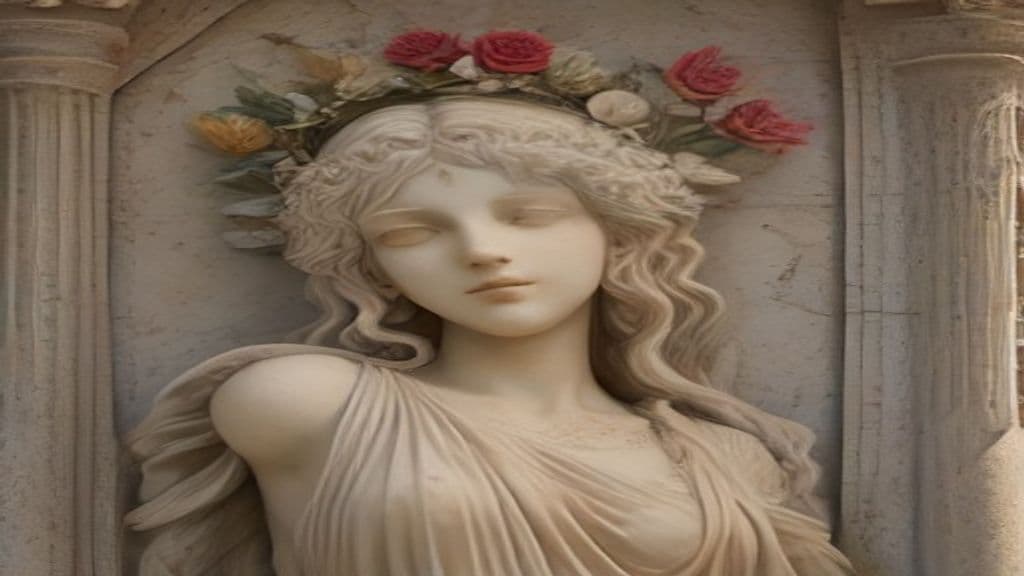
Erato is named among the Muses in Hesiod's Theogony as a daughter of Zeus and the Titaness Mnemosyne, situating her within the divine genealogy that links inspiration to memory and divine order. She is attested in classical literary practice—invoked by Hellenistic and Roman poets when a poet seeks erotic or love-directed poetic voice—examples cited in the secondary sources include Apollonius of Rhodes' invocation at the start of Book III of the Argonautica and Virgil's invocation at the start of Book 7 of the Aeneid. Later literary and local traditions associate Erato with love narratives (for example the Rhadine tradition and a Samian tomb pilgrimage noted in classical accounts), but the primary attestations emphasize her role within the canonical group of Muses rather than as an independent cult with detailed ritual manuals.
Classical and later iconography commonly represents Erato with attributes linking her to love and lyric performance. She is often shown wearing a wreath of myrtle and roses and holding a lyre or small kithara (in keeping with her musical/lyric domain). From the Renaissance onward, artistic depictions frequently add motifs such as two turtle-doves at her feet (noted in Simon Vouet's works), an occasional golden arrow (a symbol of eros), and sometimes the presence of the god Eros, who may appear holding a torch. Sources observe variation in representation across periods and media.
As a Muse, Erato's operative 'power' is inspirational: she is the patron and personification of erotic lyric and of mimic imitation, the divine source poets invoke to secure the appropriate voice, tone, and affect for love-themed poetry. An Orphic hymn summarized in the literature attributes to her the capacity to 'charm the sight,' emphasizing her role as an alluring, aesthetic inspirer. Classical sources record her literary invocation rather than accounts of tangible supernatural interventions, hostile acts, or possession.
Aceso
Aceso (Ancient Greek: Ἀκεσώ, Akesó) is an ancient Greek goddess who personifies the process of healing and convalescence. She is attested as a daughter of Asclepius and Epione and was worshipped in healing centers such as Athens and Epidauros, appearing in sculptural reliefs alongside her family.
Achelous
Achelous is the personified river-divinity of the Achelous River in ancient Greek religion and mythology. Regarded among the potamoi (river-gods), he is portrayed as a shape-changing elemental deity associated with springs, naiads, and the production of abundance (the horn/cornucopia motif); he appears in myths chiefly as suitor to Deianeira and as Heracles' opponent.
Actia
Actia (Ancient Greek: Ἄκτια) is attested in the supplied sources not as a supernatural being but as (a) the ancient festival and epithet of Apollo Actius associated with Actium and Nicopolis, and (b) a modern taxonomic and commercial name (genus of flies; company and product names). No folkloric or mythic entity named Actia is documented in the provided materials.
Adikia
Adikia (Ancient Greek: Ἀδικία) is the personification and embodiment of injustice and wrongdoing in ancient Greek religious and visual culture, typically portrayed as the opposite and vanquished counterpart of the goddess Dike (Justice). She appears chiefly in archaic vase-paintings and emblematic visual programs where Justice punishes or restrains her.
Adonis
Adonis is a mythic mortal youth in ancient Greek tradition, beloved by goddesses (notably Aphrodite and Persephone) whose death and seasonal return are the focus of the women’s midsummer festival Adonia. The cultic practices—planting short-lived 'gardens of Adonis' on rooftops, ritual lamentation, and casting an effigy and withered plants into the sea—symbolically link him to vegetation cycles and Near Eastern dying-and-regenerating god traditions.
Adrasteia
Adrasteia is an ancient Anatolian/Greek goddess associated with mountain-mother cults and later identified with the Greek notion of inescapable fate and retributive necessity. She appears in Phrygian contexts as a mountain goddess connected to Cybele, in Cretan myth as a nurse of the infant Zeus, and by the fifth century BC is often equated or associated with Nemesis and other personifications of necessity.
Adrestia (Adrasteia)
Adrasteia (also Adrestia and multiple orthographic variants) is a figure in classical Greek tradition whose roles shift from a Phrygian mountain/mother-goddess probably associated with Cybele, to a Cretan nymph entrusted with nursing the infant Zeus, and by the fifth century BC identified with Nemesis as a deity/personification of divine retribution and balance.
Aeacus
Aeacus is a mythic king of the island of Aegina in Greek tradition, famed for his justice and piety. After death he is accorded a permanent office in Hades as one of the three judges of the dead alongside Minos and Rhadamanthus, and he is the eponymous ancestor of the Aeacidae.
Aegina
Aegina is an eponymous nymph of Greek mythology who personifies the island of Aegina in the Saronic Gulf. She is remembered primarily as the mother of the hero-king Aeacus and as the island’s mythical ancestress, anchoring local civic identity and cultic landscape.
Aesculapius (Asclepius)
Aesculapius (Greek Asclepius) is the classical divine-hero of medicine and healing in ancient Greek religion and later Roman cult. He functioned as the patron and legitimating divine figure for temples, attendants (therapeutae), and organized healing practices; his emblem, the rod of Asclepius (a snake-entwined staff), endures as a symbol of medicine.
Agathos Daimon (Agathodaemon)
A beneficent household and civic daemon attested in classical Greek and Graeco‑Egyptian religion. In domestic Greece it is a household spirit honored with post‑meal libations; in Ptolemaic Alexandria it appears prominently in serpentine civic and household forms and is syncretised with various Egyptian protective and fate deities in late antiquity.
Agetor
Agetor (Ancient Greek: Ἀγήτωρ; alt. Hegetor) is not an independent being but a theonymic epithet applied to multiple Greek gods—primarily Zeus in Lacedaemon, and also Apollo and Hermes—emphasizing a leading or ruling function of the deity in cult and literature.
Community Record
- [1]Erato. Wikipedia, 'Erato' article (accessed source material provided).wiki
- [2]Erato (Wikidata). Wikidata entry for Erato (identifier Q11843192).other
- [3]Erato (gastropod). Wikipedia disambiguation entry noting modern taxonomic reuse of the name 'Erato'.wiki
- [4]Erato (archive references and cultural reuses). Archive materials and modern cultural reuses of the name 'Erato' (provided in research notes).other