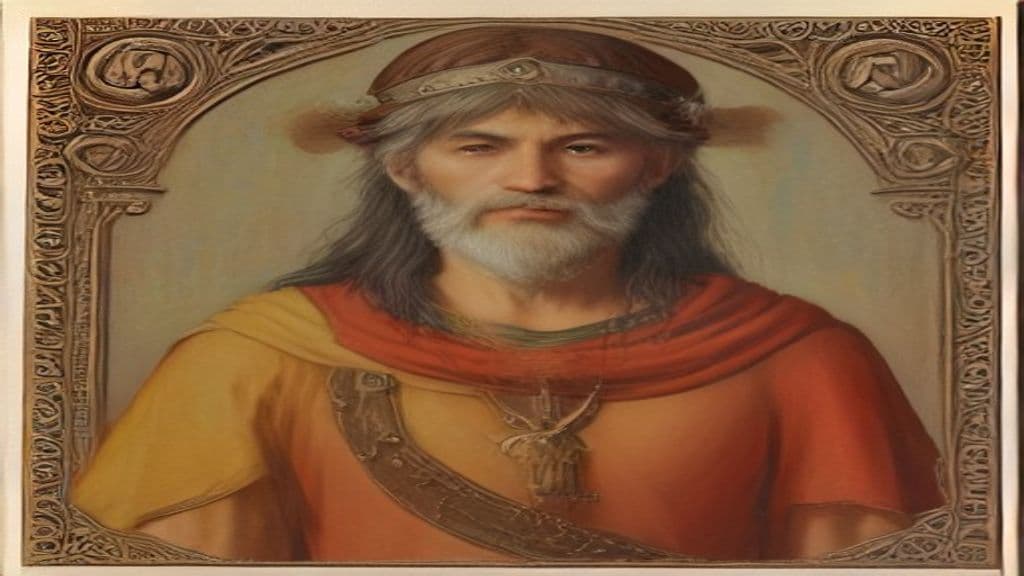
The name is commonly analyzed by scholars as built from Proto-Germanic elements (*ermena- 'great, universal' + *-rīks 'ruler'), yielding a formation meaning roughly 'great/universal ruler' — a reconstructed etymology reflected in Gothic *Airmanareiks and in later Latin and vernacular attestations. Historically, Roman sources (Ammianus, summarized by later writers such as Jordanes) present Ermanaric as a fourth-century king of the Greuthungi; medieval Germanic poetry transforms that historical king into the legendary Eormenric/Jǫrmunrekkr whose acts and punishments drive revenge narratives.
Surviving historical and legendary sources give no consistent physical description. Accounts emphasize character and reputation (warlike, powerful, treacherous, 'wolfish') rather than concrete physiognomy or dress. Jordanes reports a longevity claim (death aged 110) in his narrative tradition, but physical attributes (height, facial features, distinctive clothing) are not supplied in the cited corpus.
Sources attribute to Ermanaric great political and military capacity as a late-antique Gothic king — a wide realm and a reputation as 'most warlike' (Ammianus/Jordanes summaries). Legendary materials foreground his capacity for extreme cruelty and harsh punishments (notably the trampling of Svanhild/Sunilda with horses and the hanging of his son in some versions), and they depict him as the initiator of blood-feud cycles whose opponents (grieving kin and avengers such as Hamdir and Sörli or Sarus and Ammius) ultimately wound or cause his ruin. Claims about the precise territorial extent of his realm and the cause of his death vary across sources and are matters of scholarly dispute (e.g., Wolfram's hypothesis of a vast realm vs. more skeptical positions).
Weaknesses
- conditionvulnerability to human vengeance (wounding by avengers or pressure from hostile peoples)
- conditionmilitary pressure (accounts report suicide or downfall under attack by Alani/Huns in some sources)
Wards
None recorded.
Erkliğ Han
Erkliğ Han is a Turkic–Altai celestial lord associated with space, stars, meteorites (falling stars), and the planet Venus. Traditionally titled a Han (ruler), he is described in source material as responsible for visible stellar phenomena, linked in some lists with virility and read as a martial symbol by analogy to his action at sunrise.
Erlang Shen
Erlang Shen (二郎神) is a Chinese folk-religious and Daoist divine warrior associated with flood control, justice, hunting, and the subdual of demons. Venerated as a local river/irrigation protector who was later incorporated into Daoist pantheons and popular literary cosmologies, he is commonly depicted as a third-eyed spear-wielding hero accompanied by a celestial hunting dog.
Erlik
Erlik (Erlig, Erlik Khan; Mongolian Erleg/Yerleg) is the chthonic ruler of the underworld in Turkic and related steppe mythologies, associated with death, disease, and malignant spirit-agents. He functions as judge and lord of the lowest realm (Tamag), opposes upper-world figures like Ülgen, and demands sacrifices to avert his taking of souls.
Erlking
A sinister Germanic spirit of forest and mist who takes children — appearing to them as a welcoming figure while adults see nothing, the child dying in its parent's arms.
Erlkönig (Erlkönig / Erlenkönig)
A supernatural, kingly figure in Goethe's ballad who addresses, lures, and ultimately causes the death of a child during a night ride. Presented in the sources as a 'king of the fairies' or a demonic, otherworldly ruler who speaks promises and threats while his manifestations are ambiguously perceived as natural phenomena.
Ermac
Ermac is a fictional character from the Mortal Kombat video game franchise, presented in‑universe as an amalgam of the souls of deceased warriors who serves as a supernatural combatant. The character originated from a developers' diagnostics label and fan rumor which the franchise later incorporated into official canon; Ermac is noted for a red ninja appearance and telekinetic powers.
Ernmas
Ernmas is an ancestral maternal figure among the Tuatha Dé Danann recorded in medieval Irish sources. She is attested chiefly as the mother of two important triads (Ériu, Banba, Fódla and Badb, Macha, Mórrígan) and several sons, and is said in at least one source to have been killed during the first battle of Mag Tuired.
Erra
Erra (also Irra) is an Akkadian/Babylonian deity associated with mayhem, pestilence and episodes of political upheaval. Centerpiece of the first-millennium BCE Erra epic, he is attended by the advisor Išum and the destructive group called the Seven (Sibitti/Sebetti), and in tradition is sometimes assimilated to the god Nergal.
Erragal
Erragal (also Errakal, Errakalkal, Errakar, Erkal) is a Mesopotamian deity attested from the Isin‑Larsa through Neo‑Babylonian periods. He is polyvalent in function: identified with a star in the MUL.APIN tradition and invoked apotropaically in incantation series, associated in some texts with storm/destructive power and, in some contexts, linked to the underworld; scholarly opinion differs on whether he is distinct from, derived from, or an epithet of Erra.
Erudinus
Erudinus is a named local pagan god attested by a single Roman-period votive altar inscription found at Monte Dobra near Torrelavega in Cantabria. The altar, discovered in 1925, bears a dedicatory text placing an altar "DEO ERVDINO" and is dated by Roman calendrical and consular formulae (sources disagree whether the inscription was once thought to date to 399 AD but is now dated to 161). No myths, attributes, iconography, or ritual prescriptions for Erudinus survive beyond the inscription and its archaeological context.
Erulus
Erulus is a martial-royal figure attested only in Vergil's Aeneid (Evander's reminiscence). Described as king of Praeneste and unusually endowed at birth with three lives (animae) and three sets of arms by the goddess Feronia, he appears as a past opponent whom Evander recalls having slain by taking all three lives.
Erymanthian boar
A singular monstrous wild boar of Arcadian myth associated with Mount Erymanthos; a primeval, destructive animal subdued by Heracles during his Fourth Labour. The creature personifies dangerous wilderness tied to a sacred mountain landscape rather than a personal named monster.
Community Record
- [1]Ermanaric (Wikipedia). Wikipedia, 'Ermanaric'wiki
- [2]Ermanaric (Wikidata). Wikidata entry Q28987other
- [3]Guðrúnarhvöt (reading / summary). Archive.org — Guðrúnarhvöt reading / summaryliterary
- [4]Ermanaric (archive materials / historical biography). Archive.org — Ermanaric historical/biographical compilationother
- [5]Dreams of the Wolf – Swanhild’s Story (Deor Reader blog). Deor Reader — 'Dreams of the Wolf – Swanhild’s Story'literary
- [6]Die Edgarsage und ihr Verhältnis zur Ermenrich- und Tristansage (archive). Archive.org — scholarly text discussing Ermenrich traditionother