
In the surviving literary tradition Erra appears as a powerful divine actor whose waking precipitates a period of devastation. The poem ascribed in its colophon to the transcriber Kabti-ilani-Marduk presents the text as revealed in a visionary dream; in the narrative the Sibitti (the Seven) urge Erra to lead the destruction of humankind, and his advisor Išum attempts to mollify him. The epic frames episodes of war, invasion and plague as the result of Erra's stirred restlessness and the actions of divinely appointed instruments, and at times the god's agency supersedes the authority of other major deities (the poem even reports that Marduk relinquishes his throne to Erra for a time).
Surviving literary sources emphasize Erra's actions, entourage and function rather than providing a sustained physical portrait. The epic consistently presents him accompanied by the Seven (Sibitti/Sebetti)—described as 'sons of heaven and earth' and 'champions without peer'—and by the advisor Išum. Modern scholarly descriptions sometimes characterize the Seven as personified weapons; beyond this, the provided materials do not record a detailed anthropomorphic or iconographic description of Erra in the extant texts summarized here.
Erra's primary function is to incite and execute widescale violence and pestilence: in the epic his rousing initiates campaigns that bring invasion, plague and the overturning of social order in cities such as Babylon, Sippar and Uruk. The Seven act as assigned instruments of destruction, urging Erra to lead, and Išum functions as an interlocutor who tries (and in the narrative initially fails) to calm him. The poem describes righteous and unrighteous alike being struck down and reports Erra withdrawing to his seat in Emeslam after devastation. Literary and ritual practice treated portions of the Erra text as a source of power—inscribed on amulets and used in exorcistic contexts—indicating the poem's dual role as description of destructive agency and as a means to propitiate or guard against it. At some point in the tradition Erra was assimilated to Nergal, linking him to underworld/war/plague functions.
Weaknesses
- ritualpropitiatory prayer (epic's concluding prayer)
- ritualinscription of portions of the Erra text on amulets (exorcistic/prophylactic use)
Wards
- ritualamuletic inscription of the Erra text
- mantrarecitation/propitiatory prayers from the Erra poem
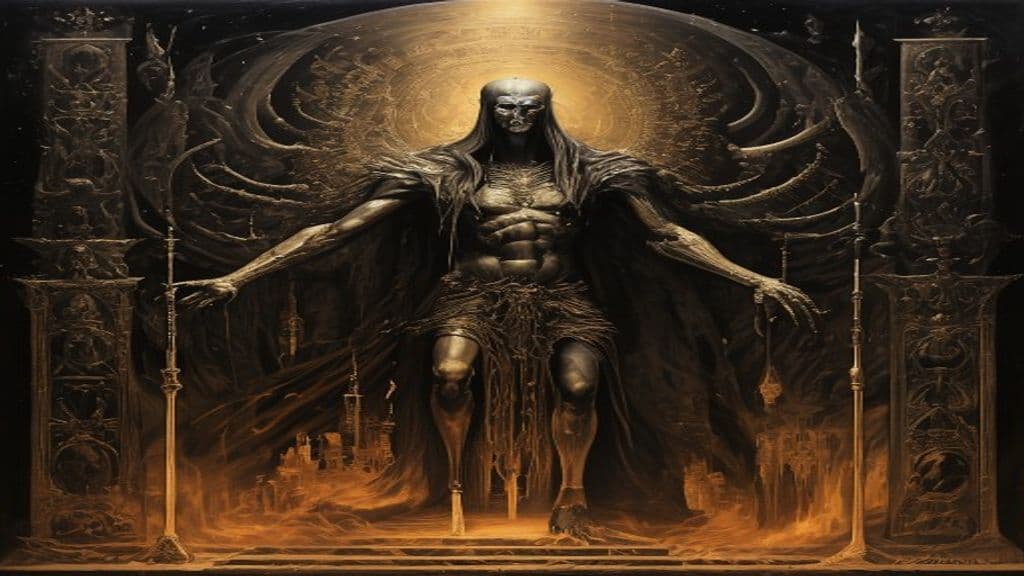
Nergal
Nergal is a major Mesopotamian deity associated with war, disease, inflicted death, and rulership of the underworld. Principal cult center at Kutha (temple E‑Meslam), he appears in hymns and myths (e.g., the Epic of Erra, "Nergal and Ereshkigal") and is sometimes equated with or called Erra or Meslamtaea.
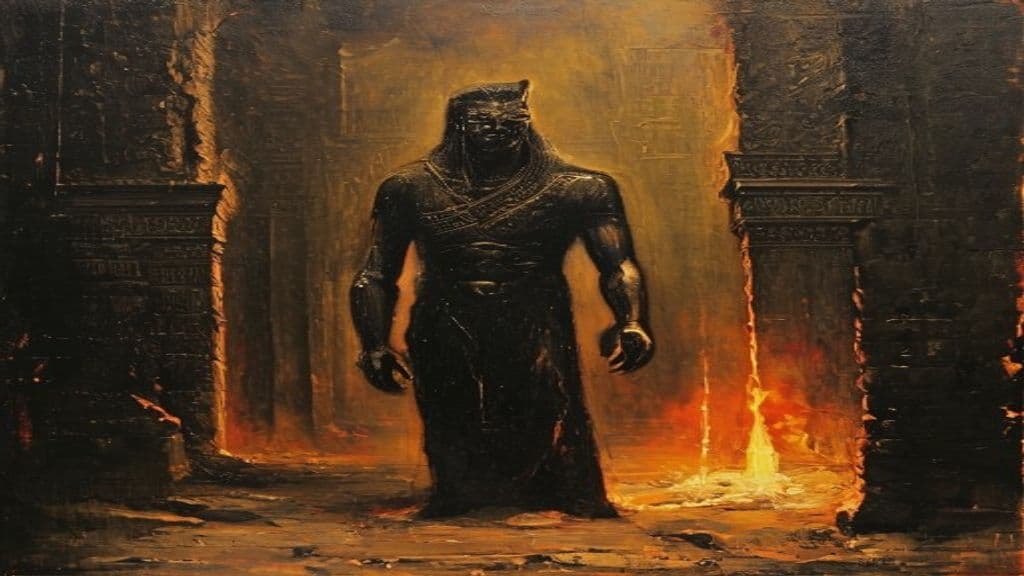
Ishum
Ishum (Akkadian Išum) is a Mesopotamian deity of Akkadian origin who functions primarily as a nocturnal, ambulatory guardian associated with streets and the protection of houses from without; in later periods he is integrated into the underworld retinue as an attendant (sukkal) of Nergal/Erra and appears in literary texts such as the Erra epic.
Adapa
Adapa is a mythic figure from ancient Mesopotamian (Sumerian and Akkadian) literature: a mortal fisherman and temple sage of Ea at Eridu endowed with exceptional wisdom. He appears in a fragmentary tale in which he breaks the wings of the south wind and is summoned to the divine court; his name was later invoked in exorcistic and ritual contexts as an authoritative identity.
Akhkhazu
Akhkhazu (also Ahhazu; Sumerian Dimme-kur) is an Akkadian-era Mesopotamian malignant spirit described as a demon of jaundice who 'seizes' victims, brings fever and plagues, and is cited in later summaries as one member of a triad with Labasu and Labartu. Later popular summaries also describe her as preying on nursing infants while mothers slept.
Alû (Alu)
A named lemma attested in modern reference lists as 'ALU / Alu', but for which the supplied research corpus contains no substantive primary- or secondary-source information about nature, appearance, powers, or rituals in Mesopotamian tradition.
Amurru (Martu)
Amurru, Sumerian Martu, is a Mesopotamian deity who functions as the divine personification of the Amorites. Originating in Mesopotamian textual practice, he is associated with the steppe and mountains, depicted with a crooked staff, portrayed in hymnography as warlike and lightning-armed, and from the Old Babylonian period acquires a prominent exorcistic cultic role.
Anshar
Anshar is a Mesopotamian primordial deity whose name (Cuneiform AN.ŠÁR) literally means "whole sky" or "the whole heaven." He functions as an abstract ancestral figure in theogonic genealogies (not actively worshiped as a regular cult deity) and appears in literary contexts—most notably the Enūma Eliš—and in god lists where he legitimizes later supreme gods.
Anu
Anu (Sumerian An; Akkadian Anu/Anum) is the divine personification of the sky in ancient Mesopotamian religion, traditionally ranked at the top of god‑lists as the source of heavenly authority (anûtu/anuti) and the fount of legitimate rule for gods and kings. Though supreme in genealogies and astronomical schema, many periods portray him as a relatively passive or figurehead deity whose active cultic role is limited until a late Seleucid reinvention in Uruk.
Anunnaki
A variable collective of major deities in ancient Sumerian, Akkadian, Assyrian and Babylonian religious literature, described as offspring or descendants linked to the sky god An (Anu) and an earth/mother figure (Ki/Ninhursag). Texts portray them as participants in the divine assembly, decreers of human fate, and in some traditions a group of seven underworld judges; their number, membership, and functions vary across sources.
Anzû (Imdugud)
Anzû, also called dZû or Imdugud, is a large storm-associated bird-figure in Sumerian/Akkadian/Babylonian myth. Portrayed as a hybrid (commonly a massive bird with a lion's head or as a half-human storm-bird), Anzû is credited in mythic narratives with seizing the Tablet of Destinies and thereby challenging the authority of chief gods such as Enlil.
Apkallu (Abgal)
Apkallu (Akkadian; Sumerian: Abgal) are polyvalent Mesopotamian wisdom figures attested as mythic/semi-divine sages (notably a group of seven), as professional human experts (ummânu), and as apotropaic images used in household and cultic ritual. They are closely associated with the god Ea (Nudimmud) as transmitters of secret knowledge and are represented in diverse iconography including fish-man and bird-headed types.
Asakku
A class of Sumerian disease-demons born from the union of heaven and earth, who lodged themselves in people's bodies and caused wasting fevers and convulsions.
Asarluhi
Asarluhi (also Asalluhi, Asarluhe, Asaralimnuna, Asaralim, Asalim, Asarnuna) is a Mesopotamian deity primarily associated with incantations and exorcism who commonly operates alongside his father Enki. He is likely identical with an earlier deity attested from the third millennium BCE called Asar (Asaruludu in some modern datasets).
Atra-Hasis
Atra-Hasis is the eponymous human protagonist of an 18th-century BCE Akkadian epic. Presented as a priest whose name is glossed 'exceedingly wise', he functions as the human interlocutor in narratives of the Mesopotamian creation of mankind and the divinely-sent deluge, and is also listed in the Sumerian King List as a ruler of Shuruppak.
Community Record
- [1]Erra (god) - Wikipedia. Wikipedia, 'Erra (god)'wiki
- [2]Erra (Wikipedia alternate). Wikipedia, 'Erra'wiki
- [3]Erra and Ishum aka The Erra Epic - GatewaysToBabylon. GatewaystoBabylon, 'Erra and Ishum'literary
- [4]Erra and Ishum - Biblioteca Pleyades transcription. BibliotecaPleyades, 'Erra and Ishum'other
- [5]Archive copy referencing Erra material (Catastrophes of Darkness). Archive.org, 'Catastrophes of Darkness 181222'other