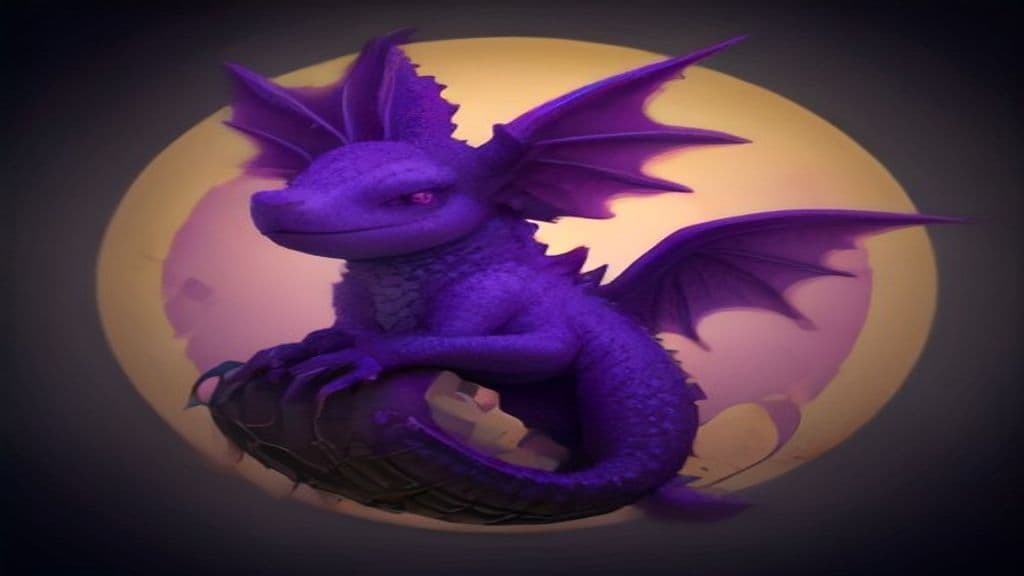
Figment was created by Walt Disney Imagineering as the personification of the phrase "figment of the imagination" for the Imagination! pavilion at Epcot. The character debuted with the pavilion's attraction Journey Into Imagination (original ride opened March 5, 1983) and was developed as part of attraction narrative by Imagineers including Tony Baxter. In transmedia adaptations, notably the Marvel/Disney Kingdoms comics, an alternate fictional origin depicts Figment as an inventor's childhood imaginary friend brought to life by a device called a "Mesmonic Spark Converter," but this is a narrative reworking within comics rather than an independent cultural origin.
Figment is depicted as a small purple dragon with distinct composite features from the original attraction's song and design: two tiny wings, large yellow eyes, horns resembling a steer's, and a crocodile-like snout, summarized in the lyric describing him "From head to tail, he's royal purple pigment." In attraction media and merchandise he frequently appears in costume variants (superhero, astronaut/spacesuit, cowboy, knight, etc.) and exists in physical forms as ride props and plush merchandise.
Within the ride and related media Figment functions as a dramatized embodiment of imagination: he performs playful, cartoon-like transformations (producing objects from thin air, changing costumes, altering props or scenes) as narrative and visual effects. He acts as catalyst for creative exploration in attraction scripts (Dreamfinder teaches him to use imagination). In the Disney Kingdoms comics he is portrayed fictionally as brought to life by technology (Mesmonic Spark Converter) and participates in adventures with Dreamfinder—this is a fictional comic origin rather than evidence of supernatural agency in cultural practice.
Fiacha mac Delbaíth
Fiacha mac Delbaíth is a legendary figure of early Irish tradition presented as a member of the Tuatha Dé Danann who served as a High King of Ireland. Medieval compilations record his accession, a ten-year reign, and his death in battle as part of the narrative sequence of prehistoric rulers.
Fictitious Kings in Korean Genealogies
Entities appearing in 15th-16th century genealogies of Cheongju Han, Haengju Gi, and Taewon Seonu descent groups. (Note: - Power tier is Minor Spirit (but no description of abilities implies they might be lower still) - Origin story lacks clear indication that association with Jizi is an "Early Modern fabrication", inst)
Ficus Ruminalis
In ancient Roman mythology, the Ficus Ruminalis is a wild fig tree associated with mythological events and protected by deities. (Note: * Power tier should be adjusted from Ancient to Lesser (due to lack of deity-level powers or abilities) * Origin story should be rephrased to clarify the Ficus Ruminalis is not an entity in itself, bu)
Fides
Fides is the Roman personification and goddess of trust, faithfulness, and good faith (bona fides). Treated both as an ethical virtue and a divine presence, she was cultivated in public religion through ceremonies and temples to uphold social and legal trust.
Fiery Flying Serpent
A metaphorical creature representing the Assyrian kingdom's power and destruction, used in Jewish tradition. (Note: * Power tier should be Greater, not Primordial, as it's a symbolic representation of a powerful regional entity (the Assyrian kingdom) rather than a cosmic or primordial force. * Abilities section nee)
Fiery Serpent (Slavic)
A supernatural entity from Slavic folklore, described as a manifestation of fire in the sky or air. (Note: 1. Power tier should be adjusted from Primordial to Ancient, as it appears to be a deity-level entity rather than a cosmic one. 2. Add sensory cues for sounds associated with the entity (e.g., roaring)
Filippo Argenti
Filippo Argenti is a historical 13th-century Florentine nobleman (Adimari family, Black Guelphs) who appears as a named damned soul in Dante Alighieri’s Divine Comedy (Inferno, Canto VIII), located among the wrathful in the river Styx. In Dante’s poem he functions as a recognizable moral exemplum of wrath: he accosts the pilgrim and is subsequently attacked by other wrathful souls.
Fimafeng
Fimafeng is a named serving-man in the hall of the sea-god Ægir in the Norse poem Lokasenna. He is praised for his skillful service at a divine feast and is suddenly slain by Loki, an act that provokes the gods to drive Loki out of the hall.
Fin Fang Foom
Fin Fang Foom is a Marvel Comics extraterrestrial dragon-like monster (a Makluan) created by Stan Lee and Jack Kirby. In-universe he is an alien of great size and power who arrived on ancient Earth, has been awakened and contained multiple times, and whose portrayals range from invader/weapon to a reformed/rehabilitated being.
Fingolfin
Fingolfin is a named Elven king of the Noldor in J. R. R. Tolkien's legendarium. Son of Finwë, he led the greatest host of the Noldor that fled Aman, became High King of the Noldor in Middle-earth after Maedhros renounced his claim, maintained a long siege of Angband, and finally rode alone to challenge Morgoth, wounding him before being slain.
Finn (Frisian)
Finn is a named legendary Frisian king of the heroic age attested in Old English poetry (Widsith, the Finnesburg Fragment) and in the episode preserved within Beowulf. He appears in narratives of inter-ethnic warfare, hospitality, and the uneasy settlements that follow slaughter, sometimes portrayed as ruling honorably over surviving enemy retainers and in other variants as slain in the conflict.
Finnic Incantations
A collection of traditional magical formulas and spells used to effect change in the world, primarily found in Finnish folklore. (Note: - Power tier should be revised to Primordial as the described abilities suggest a profound impact on the world, implying they are not just "powerful regional" but rather have a more fundamental effect)
Community Record
- [1]Figment (Disney) — Wikipedia. Wikipedia contributors. "Figment (Disney)." Wikipedia, The Free Encyclopedia.wiki
- [2]Figment (Disney) — alternate Wikipedia entry. Wikipedia contributors. "Figment (Disney)." Wikipedia, The Free Encyclopedia.wiki
- [3]Figment 2 : the legacy of imagination. Volume 2 (archive summary). Archive.org listing for Figment 2: The Legacy of Imagination (Disney Kingdoms comic coverage).other
- [4]3D scan / archive of Figment plush. Archive.org item: 3D scan / model related to Figment plush/prop.other
- [5]Journey Into Imagination With Figment – Attraction Checklist #015 – Saturday Morning Media. Attraction checklist and synopsis referencing Figment's role in the ride and media.other
- [6]Main Street Gazette: Tell a Good Story - Issue #5: Figment. Main Street Gazette article on Figment history and fan response.other
- [7]WDW Radio #855 - Tony Baxter, Figment, and the Art of Imagination at Disney. WDW Radio interview/discussion referencing Tony Baxter and Figment's creation.other