
The term appears in Old English poetry as fyrdraca (attested in Beowulf) where it names a dragon-like monster; in later centuries the same compound vocabulary continued in English as "firedrake" and was applied both to dragons in poetic usage and to observed fiery aerial phenomena. Renaissance writers such as William Fulke (1563) record popular sightings treated as either supernatural (the Devil in dragon form) or explain them as natural vapors and meteors, showing the term's survival from medieval dragon-poetry into early modern attempts at meteorological explanation.
In the sky firedrakes are described as sparking streaks or shafts of fire, a golden stripe that sweeps across the evening sky, a flaming broom or sheaf, a fiery steelyard balance, or a glowing ball of blue fire releasing sparks. Swedish accounts emphasize a wingless 'worm-dragon' with no visible limbs; East Slavic descriptions include a long flaming shaft (Russian коромысло, 'fiery carrying pole') or a flaming broom. In Slavic narratives the same being may also appear on the ground in human shape and is said in some stories to enter houses through chimneys.
As aerial phenomena they display flight as streaks, brooms, shafts or balls of fire emitting sparks (often read as meteors or ignes fatui). In Slavic traditions the firedrake is agentive: it can shapeshift (air-serpent in flight; human guise on the ground), enter homes through chimneys, visit and seduce women at night—sometimes taking the form of a dead or absent husband—bring ephemeral gifts (reported to turn to horse manure at sunrise), inseminate women leading in stories to abnormal pregnancies and monstrous births, and cause wasting illness, mental disturbance, hallucination, and death. In Swedish and English contexts the phenomenon is more often ambiguous or interpreted as omen-like (devil or sign of Last Judgment) rather than consistently anthropophagous or vampiric.
Weaknesses
- othernone recorded in sources
Wards
- otherno traditional wards recorded
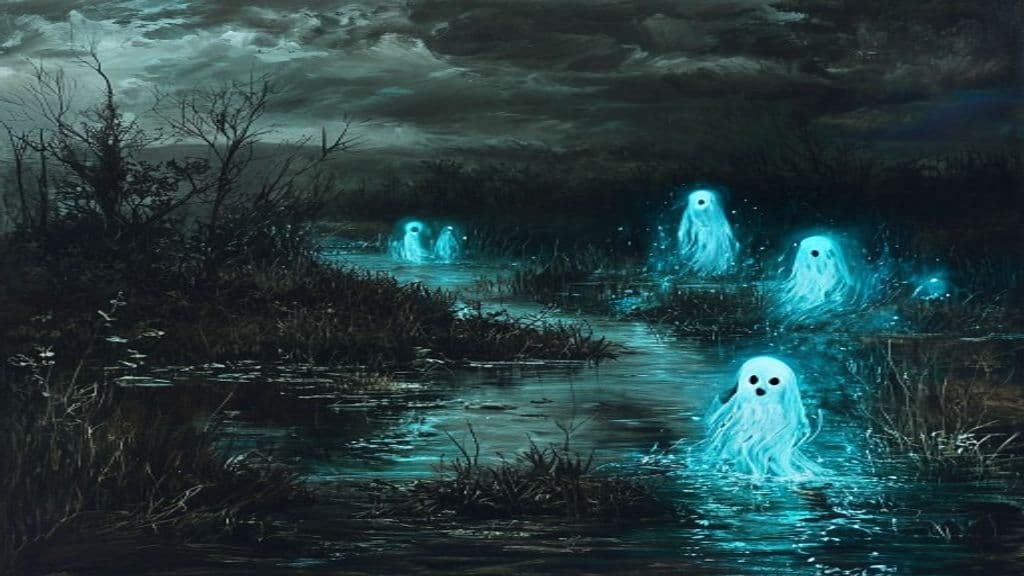
Will-o'-the-Wisp
A wandering light seen over marshy ground at night, leading travellers astray into bogs and fens. Possibly a spirit, possibly the soul of the unbaptised dead, possibly the devil himself.
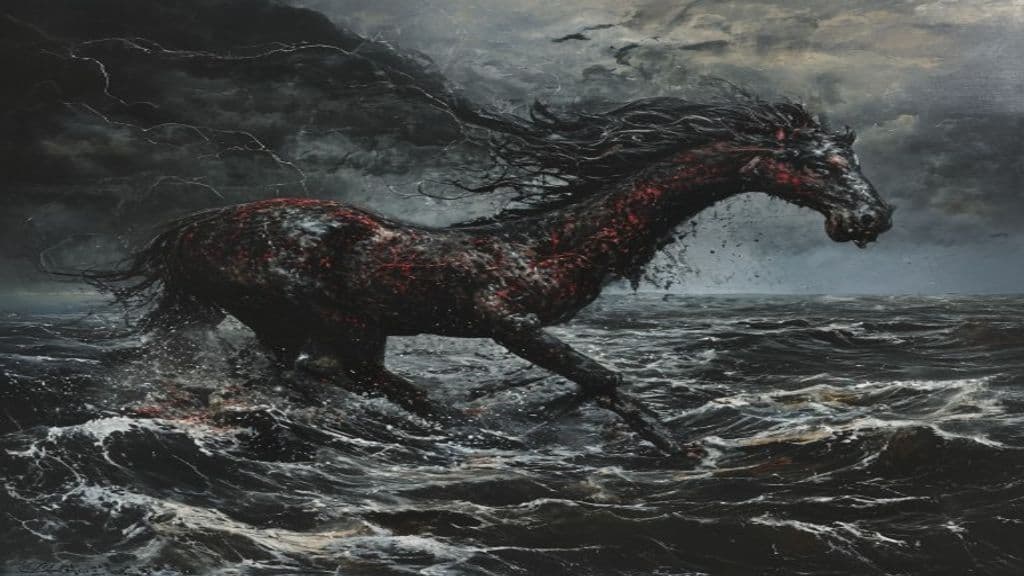
Nuckelavee
The most terrifying creature of Orcadian folklore — a skinless, horse-headed demon of the sea whose breath spreads plague and whose presence causes crops to wither. It cannot cross fresh water.

Dragon (Long)
Long (龍, "dragon") is a pervasive cultural and artistic motif that appears in Taoist sacred-geographical contexts, Chinese literature, and modern exhibitions; the provided sources treat it as part of the broader mythic imagery present around Taoist sites and ritual scenes rather than as a single, consistently described doctrinal entity.
Baba Yaga
Baba Yaga is an ambivalent female figure of East Slavic folktale tradition, depicted variously as a fearsome, child-eating crone or as a helpful, maternal donor. She is associated with the deep forest, a hut described as standing on chicken legs, and the motific accoutrements of a mortar and pestle.
Billy Blind
Billy Blind is a named household spirit from English and Lowland Scottish ballad tradition who appears as an advising helper in Child ballads, providing information, revelation, and stratagems that enable protagonists to resolve enchantment, identity, and childbirth crises. Attestations are narrative (ballads) and later literary/television adaptations draw on his advising role.
Black Arab
In Slavic mythology, the Black Arab is a malevolent chthonic demon that kidnaps women and girls. (Note: 1. Power tier should be Primordial, not Ancient (Ancient implies deity-level abilities, but the Black Arab's abilities are more limited). 2. Origin story is speculative and unsupported by source mater)
Black Dog (folklore)
A class of supernatural canine apparition in British vernacular folklore, often associated with liminal places and regarded as an omen-bearing or guardian hound. Local named forms (Black Shuck, Barghest, Gurt Dog, Gallytrot) show a range from malign, death-portending hellhounds to benevolent guide-figures.
Blunderbore
Blunderbore is a stock giant of English and Cornish folklore, appearing as a corporeal monstrous antagonist in tales such as Jack the Giant Killer and regional variants like Tom the Tinkeard. He is depicted through his actions—kidnapping, highway obstruction, and violent strength—and is typically overcome by a human folk-hero who frees captives and reasserts social order.
Brown Man of the Muirs
A moorland guardian figure from Anglo-Scottish Border folklore. In a field account he appears as a solitary dwarf who reproves hunters and claims custodianship of upland animals; in later fairy-tale literature he appears as (or is related to) a tribe—the Brown Men of the Moors and Mountains—associated with stronger, more violent motifs and a compulsion-incantation.
Bugbear
A folkloric scare-figure historically invoked to frighten disobedient children, classed among boogeyman-type beings. Medieval descriptions in English sources portray it as a creepy, bear-like lurker in woods; modern popular culture and gaming have reimagined it as a large goblinoid monster.
Cap-o'-Rushes
Cap-o'-Rushes is the title and heroine of an English folktale collected by Joseph Jacobs. The story is classed among international folktale types (principally ATU 510B) and opens with the 'Love Like Salt' motif; it tells of a daughter who disguises herself in a garment of rushes, works as a kitchen maid, attends secret balls, causes recognition by hiding a ring in a dish, and engineers reconciliation by ordering a saltless wedding feast so her father remembers his earlier words.
Church Grim
A site-bound guardian spirit in English, Scottish and Nordic/Scandinavian folklore that watches over an individual Christian church and its churchyard, defending the consecrated ground from profanation and hostile spirits. Forms and origin accounts vary by region, including a large black dog in English tradition, the bound spirit of an animal (often a lamb) in Scandinavian accounts, and in some Scottish strands the spirit of the most recently buried person acting as a temporary watcher.
Dando's Dogs
Dando's Dogs are an English folkloric pack of spectral hounds tied to the tale of a sinful huntsman named Dando. They are classed among English 'black dog' apparitions and described as taking part in the Wild Hunt; tradition reports their sounds on early Sunday mornings as they pursue game or search for their master after his abduction.
Dawn deities
A cross-cultural category of divine figures associated with dawn, morning, or the morning star; these figures personify the transition from night to day and may be integrated into local pantheons or syncretized with solar deities in some traditions.
Domovoi
The house spirit of Slavic tradition — a small, invisible guardian of the home bound to a specific dwelling and its family. Protective when respected; dangerous when insulted or forgotten.
Community Record
- [1]Firedrakes in English folklore. Wikipedia, "Firedrakes in English folklore"wiki
- [2]PS238 (comic strip referencing firedrake term usage). PS238 webcomic (2015-08-05)other
- [3]Orlando Innamorato in English | Page 12 (examples of literary dragon-language usage). Rossignol Books, Orlando Innamorato in English (reference to dragon vocabulary)literary
- [4]18 Types of Dragons You've Probably Encountered - Facts.net. Facts.net, "18 Types of Dragons" (contextualizing firedrake as a literary/folk dragon type)other
- [5]Dragons: A History | Gresham College. Gresham College lecture, "Dragons: A History" (context on dragon terminology and historic usage)other
- [6]Miscellaneous web references (contextual/echoing usages). dxld1421.txt (online text containing references to firedrake usage)other
- [7]Firedrake (folklore) — Wikipedia. Wikipedia contributors, 'Firedrake (folklore)', Wikipedia, The Free Encyclopedia.wiki
- [8]Demons & Dragons (catalog / reference copy). Demons & Dragons (catalog reference), Archive.org entry.other
- [9]Demons & Dragons (alternate archive). Demons & Dragons (alternate archive), Archive.org entry.other
- [10]Save vs. Worm blog: Firedrake entries (popular commentary). Save vs. Worm blog, 'Goin' Through the Fiend Folio Part 6'.other