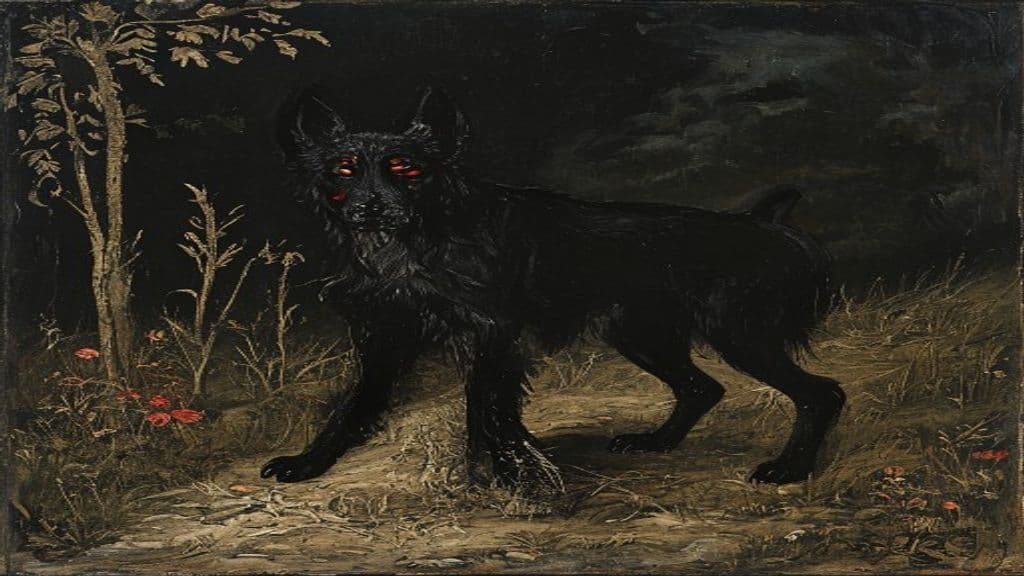
The supplied material does not record a single cohesive origin myth for the black dog. In the accounts summarized, the figure is part of popular folklore rather than a named progenitor narrative: it is presented as a longstanding uncanny presence that appears at liminal, historically charged, or dangerous places (crossroads, barrows, places of execution, ancient pathways) and in certain weather phenomena (electrical storms). In some strands, where Christian interpretive frameworks predominate, the black dog becomes associated with the Devil, folding older local uncanny motifs into a moral-cosmic schema in which such apparitions signal malign influence or divine warning. The sources emphasize geographic spread and motif continuity rather than a specific creation story or ancestral origin.
The black dog is consistently described in the available material as an unnaturally large canine, black in coloration, often with glowing red or yellow eyes. The supplied summary frames it in hellhound and spectral terms: a dog-shaped, non-human apparition rather than an ordinary animal. No further consistent morphological detail (such as tail form, coat texture, specific sounds, or precise dimensions) is recorded in the provided sources; accounts use general descriptors like ‘‘large’’ and note the striking feature of luminous eyes.
Reported behaviours vary by local tale. Commonly the black dog functions as an omen-bearer of death (for example, a Yorkshire dog said to presage death within a year). Several named variants (Barghest, Black Shuck) are recorded as directly harmful or aggressive toward passersby; the Aylesbury story records an attack after which the human was left paralysed. Conversely, other stories present benevolent or guardian behaviour: the Gurt Dog of Somerset guides travellers at night and protects them from danger, and an Isle of Man tale tells of a great black dog that blocked a skipper’s way, causing him to stay ashore and thereby avoid a deadly storm. The motif is also tied to liminal landscape features and stormy weather, and auditory phenomena such as baying or barking by unseen packs are reported in some accounts.
Weaknesses
- conditionavoidance/flight (narrative outcome)
- conditionconfrontation (recorded as coinciding with disappearance in at least one tale)
Wards
- othercompany / staying ashore (narrative protective action)
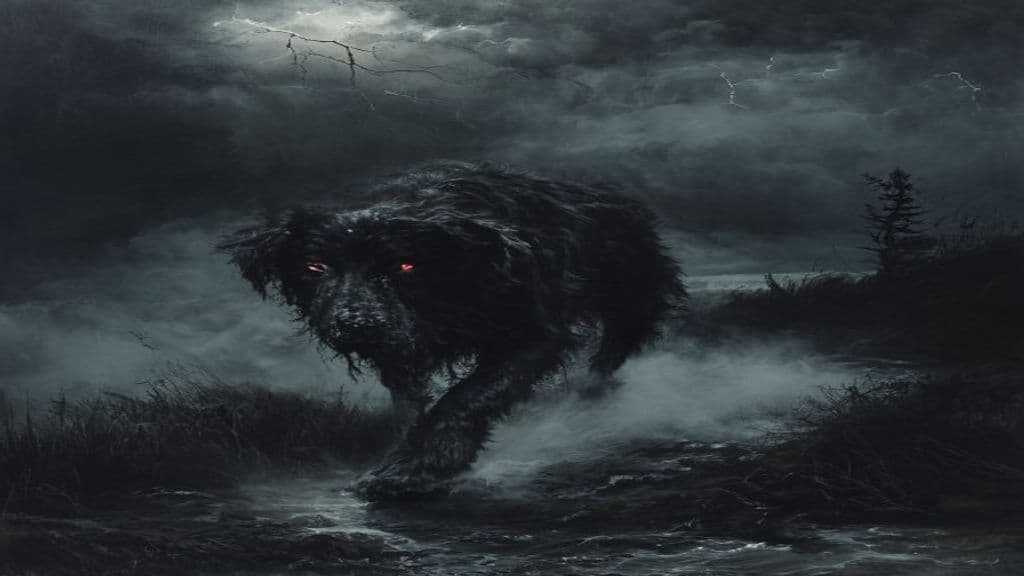
Black Shuck
A spectral black dog of East Anglian legend, with glowing red or green eyes. Its appearance is an omen of death. Its howl has been heard on clifftops during storms for centuries.
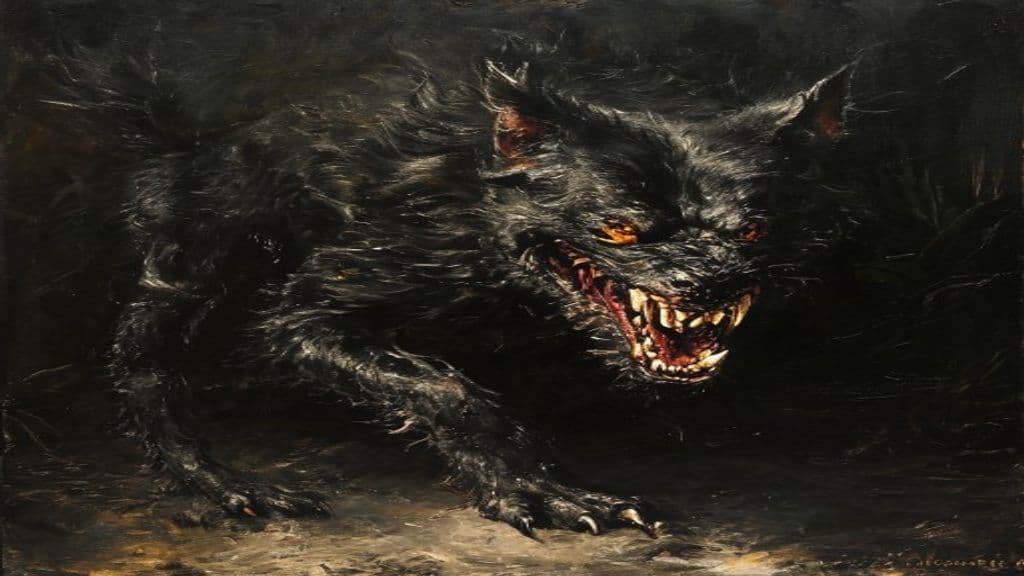
Barghest
A Northern English uncanny presence most often described as a monstrous black dog that serves as an omen of death; the term also covers variant local beings (ghosts or household elves) in some counties, making it a fluid category of liminal, threatening presences in regional folklore.
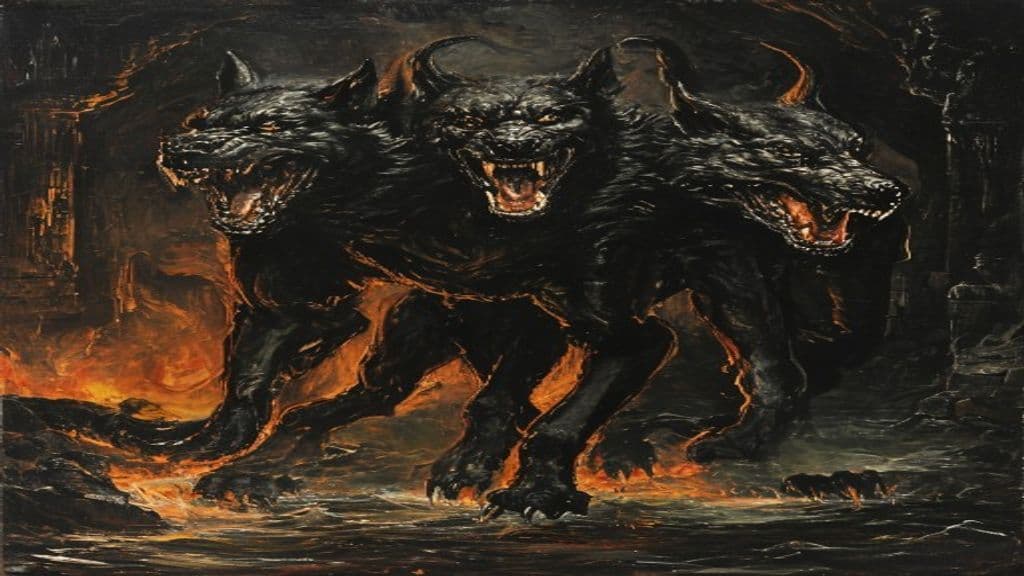
Cerberus
The three-headed hound of Hades, guardian of the underworld's gates — welcoming the dead in but allowing no shade to leave and no living mortal to enter uninvited.
Billy Blind
Billy Blind is a named household spirit from English and Lowland Scottish ballad tradition who appears as an advising helper in Child ballads, providing information, revelation, and stratagems that enable protagonists to resolve enchantment, identity, and childbirth crises. Attestations are narrative (ballads) and later literary/television adaptations draw on his advising role.
Black cat
A domestic cat with black fur that functions both as an ordinary companion animal and as a versatile folkloric symbol. In many traditions it is an omen of good or bad fortune, is associated with witches and seafaring luck, and has been repurposed in modern political and cultural symbolism.
Blunderbore
Blunderbore is a stock giant of English and Cornish folklore, appearing as a corporeal monstrous antagonist in tales such as Jack the Giant Killer and regional variants like Tom the Tinkeard. He is depicted through his actions—kidnapping, highway obstruction, and violent strength—and is typically overcome by a human folk-hero who frees captives and reasserts social order.
Brown Man of the Muirs
A moorland guardian figure from Anglo-Scottish Border folklore. In a field account he appears as a solitary dwarf who reproves hunters and claims custodianship of upland animals; in later fairy-tale literature he appears as (or is related to) a tribe—the Brown Men of the Moors and Mountains—associated with stronger, more violent motifs and a compulsion-incantation.
Bugbear
A folkloric scare-figure historically invoked to frighten disobedient children, classed among boogeyman-type beings. Medieval descriptions in English sources portray it as a creepy, bear-like lurker in woods; modern popular culture and gaming have reimagined it as a large goblinoid monster.
Cap-o'-Rushes
Cap-o'-Rushes is the title and heroine of an English folktale collected by Joseph Jacobs. The story is classed among international folktale types (principally ATU 510B) and opens with the 'Love Like Salt' motif; it tells of a daughter who disguises herself in a garment of rushes, works as a kitchen maid, attends secret balls, causes recognition by hiding a ring in a dish, and engineers reconciliation by ordering a saltless wedding feast so her father remembers his earlier words.
Changeling
A changeling is a human-like substitute left by nonhuman beings (fairies, trolls, demons, etc.) after they abduct a human—most often an infant. Found throughout much of European folklore, the changeling functions as an uncanny domestic replacement whose presence explains sickness, developmental difference, or sudden loss.
Church Grim
A site-bound guardian spirit in English, Scottish and Nordic/Scandinavian folklore that watches over an individual Christian church and its churchyard, defending the consecrated ground from profanation and hostile spirits. Forms and origin accounts vary by region, including a large black dog in English tradition, the bound spirit of an animal (often a lamb) in Scandinavian accounts, and in some Scottish strands the spirit of the most recently buried person acting as a temporary watcher.
Dando's Dogs
Dando's Dogs are an English folkloric pack of spectral hounds tied to the tale of a sinful huntsman named Dando. They are classed among English 'black dog' apparitions and described as taking part in the Wild Hunt; tradition reports their sounds on early Sunday mornings as they pursue game or search for their master after his abduction.
Devil
A cross-cultural mythic personification of evil and hostile forces, used in religious, literary, and popular contexts to explain temptation, moral corruption, disease, death, and misfortune. Its exact cosmological status varies by tradition, ranging from an independent principle of evil to a created being that became evil or a symbolic embodiment of human wickedness.
Fairies
Fairies are a category of anthropomorphic spirit-beings from European folklore, described as possessing magical or preternatural qualities and appearing across a range of traditional stories and modern cultural expressions. The motif spans cautionary folk beliefs (often concerning protection from their spite) and contemporary festival, musical, and literary uses.
Firedrake
A term in English tradition for dragon-shaped manifestations of fire observed in the sky; used both as an Old English poetic word for dragon (fyrdraca) and, from the Renaissance onward, to describe luminous aerial phenomena such as meteors or ignis fatuus. Sources treat firedrakes variously as mythic dragons, atmospheric luminous vapors, or morally charged apparitions (e.g., the Devil in dragon form).
Community Record
- [1]Black dog (folklore) — Wikipedia. Wikipedia contributors. "Black dog (folklore)." Wikipedia, The Free Encyclopedia.wiki
- [2]Wikidata: black dog. Wikidata entry Q1321618 (black dog)other
- [3]Shuckin' and jivin' : folklore from contemporary Black Americans (table of contents). Dance, D. 'Shuckin' and jivin': table of contents and references to spirit-dog tales (archive).folk
- [4]Megalithomania — Conway Hall (archive listing). Coil, Megalithomania event listing (archive); indicates contemporary retellings but adds no ritual detail.other
- [5]Episode 27: Spooky Dog Stories part 2 and 3 (podcast archive). Podcast episode listing: 'Spooky Dog Stories' (archive).other
- [6]DVD Transfer 21 (Miscellaneous from December 1995-January 1996). Archive item listing: DVD Transfer 21 (Miscellaneous from December 1995-January 1996). https://archive.org/details/dvd-transfer-21other
- [7]VOA Global English : May 26, 2020 09:00AM-10:00AM EDT. VOA Global English broadcast transcript listing. https://archive.org/details/VOA_Global_English_20200526_130000other
- [8]Worldvision Enterprises (1989) Drawing. Worldvision Enterprises (1989) drawing listing. https://archive.org/details/worldvision-enterprises-1989-drawingother
- [9]Smashing Pumpkins Live at The Orange Peel on 2007-06-26 (track listing). Archive.org audio release (track listing) — provided but not folkloric source for the black dogother
- [10]Three Catholic Reformers Of The Fifteenth Century (contents listing). Archive.org contents listing (includes chapter titles referencing devils) — provided but does not give specific rituals relating to the black dog in supplied excerptsother
- [11]Episode 79 | Lolita (1962 & 1997) (podcast listing). Archive.org podcast episode listing — provided but unrelated to black dog folkloreother