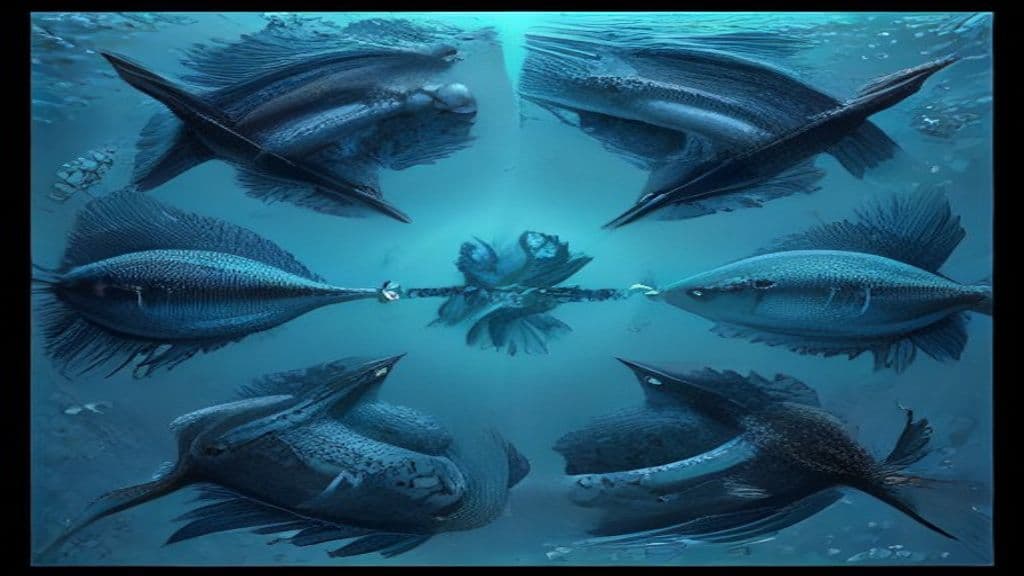
No mythological origin narrative for a distinct supernatural 'fish entity' is attested in the provided sources. The materials present fish in biological and cultural-historical terms (e.g., evolutionary history and long-standing human use as food) rather than as creatures with a mythic cosmogonic origin.
As described in scientific and summary sources, fish are aquatic vertebrates that possess gills, a cranium protecting the brain, and lack limbs with digits. They show a wide diversity of body plans (over 33,000 extant species), including jawless fish, cartilaginous fishes, and bony fishes; many have streamlined shapes adapted for movement in water. Cultural materials invoke recognizable species appearances (e.g., herring, salmon) in song and poetry.
Biologically, fish respire through gills, are mostly ectothermic (body temperature varies with surrounding water), exhibit diverse locomotory adaptations (paired fins, swim bladders in many species), and can use acoustic and other forms of communication in contexts such as courtship. Culturally, fish function as food sources, subjects of aquaculture and fisheries, motifs in religious art (e.g., loaves-and-fishes imagery), and characters or metaphors in song and literature. The sources do not attribute supernatural powers or volitional agency to fish as spirits.
Cryptid
A contemporary classificatory label for animals or other beings whose present existence is disputed or unsubstantiated by mainstream science; used in folklore, eyewitness reports, and popular culture. The term functions as a category rather than a single mythic being and is central to the subculture of cryptozoology and to popular media treatments.
Finwë and Míriel
Principal Elven figures in J. R. R. Tolkien's legendarium: Finwë, first King of the Noldor, and his first wife Míriel, famed for creative craft. Their personal choices — Míriel's voluntary relinquishment of embodied life and Finwë's remarriage and later murder — provoke adjudication by the Valar and have far-reaching legal and historical consequences in the history of the Eldar.
Fir Bolg
In medieval Irish myth the Fir Bolg are presented as a people — the fourth group to settle and rule Ireland in the traditional sequence of successive populations; in modern fantasy they have been re‑appropriated as a race of large, forest‑dwelling humanoids (often rendered 'Firbolg') in role‑playing games.
Fire-breathing monster
A cross-cultural mythic category of monster defined by the ability to expel flame (or fire-like phenomenon) from the mouth or nostrils. Appears in multiple traditions (e.g., Greco-Roman, Hebrew/Biblical, Anglo‑Saxon, Japanese, Philippine, Native American, West African, Mapuche) and in modern fantasy as a recurring trope.
Firebird (Slavic folklore)
A marvelous luminous bird from Slavic folktales, the Firebird (zhar-ptitsa) is a glowing, often fire‑colored bird whose appearance initiates quests and whose possession brings both wonder and misfortune. It functions as a coveted wonder and a dangerous omen within tale cycles.
Firedrake
A term in English tradition for dragon-shaped manifestations of fire observed in the sky; used both as an Old English poetic word for dragon (fyrdraca) and, from the Renaissance onward, to describe luminous aerial phenomena such as meteors or ignis fatuus. Sources treat firedrakes variously as mythic dragons, atmospheric luminous vapors, or morally charged apparitions (e.g., the Devil in dragon form).
First Humans in Slavic Mythology
Central concept in the narrative of human creation, reflecting a worldview that values ancestry and tradition. (Note: 1. Power tier should be changed to Lesser or Minor Spirit (there's no indication that they have primordial power). 2. Summary is accurate but could be more specific about what makes them central to th)
Fish-man of Liérganes (El hombre pez)
A Cantabrian popular‑tradition account of an amphibious, human‑shaped being identified with a missing man (Francisco de la Vega Casar) who was captured at sea, exhibited to clerics, returned to his village of Liérganes, lived in altered condition for years, and ultimately went back to the sea. The story is known primarily from Benito Jerónimo Feijoo's reporting of contemporary testimonies and later encyclopedic summaries.
Fisher King
A figure in the Arthurian Grail cycle who serves as the hereditary guardian of the Holy Grail and whose bodily wound is symbolically linked to the barrenness of his realm. He is often depicted as incapacitated and 'fishing' while awaiting a questing hero whose question or deed will heal him and restore the land.
Five Poisons (五毒, wǔ dú)
A culturally defined set of five hazardous animals in Chinese (and related Vietnamese) folk belief associated with the Dragon Boat Festival/Duanwu (the fifth day of the fifth lunar month). The term names a seasonal cluster of perceived dangers (snakes, scorpions, centipedes, toads, spiders) and denotes traditional prophylactic and talismanic responses; in modern usage the phrase is also repurposed as a political metaphor for five perceived threats to state security.
Five Wisdom Kings
A class of wrathful, mantric protector-deities in East Asian Mahāyāna (notably Japanese) Buddhism, identified with the Sanskrit Vidyārāja and Japanese Myō-ō and described in sources as guardians of the cosmic Buddha Dainichi (Vairocana) and of esoteric teachings.
Fjalar (rooster)
Fjalar (Old Norse: Fjalarr) is a named red rooster in the Poetic Edda (Völuspá) whose crowing is portrayed as heralding the onset of Ragnarök. The figure appears as a portentous, performative signal in the eschatological sequence, with no cultic rituals or protective practices attested in the supplied sources.
Community Record
- [1]Fish — Wikipedia. Fish. Wikipedia. https://en.wikipedia.org/wiki/Fishwiki
- [2]Fish — Wikiversity. Fish. Wikiversity. https://en.wikiversity.org/wiki/Fishwiki
- [3]Tennessee Wildlife Resources Agency — Fish. Fish. Tennessee Wildlife Resources Agency. https://www.tn.gov/twra/wildlife/fish/other
- [4]Fishes Lamentation (Windy Old Weather) — lyrics archive. Fishes Lamentation or Windy Old Weather. Archive lyrics. http://sniff.numachi.com/pages/tiWINDYWE2%3BttWINDYWE2.htmlliterary
- [5]Holy Land: Cross stolen from Church of Loaves and Fishes — ICN. Holy Land: Cross stolen from Church of Loaves and Fishes. Independent Catholic News. https://www.indcatholicnews.com/news/42923other
- [6]Fish (singer) — Wikipedia. Fish (singer). Wikipedia. https://en.wikipedia.org/wiki/Fish_%28singer%29wiki
- [7]Archive: APG 308 - Fish Urine (podcast title). APG 308 - Fish Urine. Archive.org. https://archive.org/details/szaivpxdvghzihmhh6javeijvopidns56z9rdr2jother
- [8]Happy Welcome x (archive item referencing 'the fish would suggest...'). Happy Welcome x. Archive.org. https://archive.org/details/avjoeraqtygfy7gs2n70j8m02brexscyjpvesqnbother
- [9]EFSA report (fish disease vector/species reference). POSSIBLE VECTOR SPECIES AND LIVE STAGES OF SUSCEPTIBLE SPECIES NOT TRANSMITTING DISEASE AS REGARDS CERTAIN FISH DISEASES1. EFSA. https://efsa.onlinelibrary.wiley.com/doi/pdfdirect/10.2903/j.efsa.2007.584academic
- [10]Rambles.NET: Fous de la Mer, Stars & Fishes. Fous de la Mer, Stars & Fishes. Rambles.net. https://www.rambles.net/~ramblesn/fous_stars04.htmlliterary