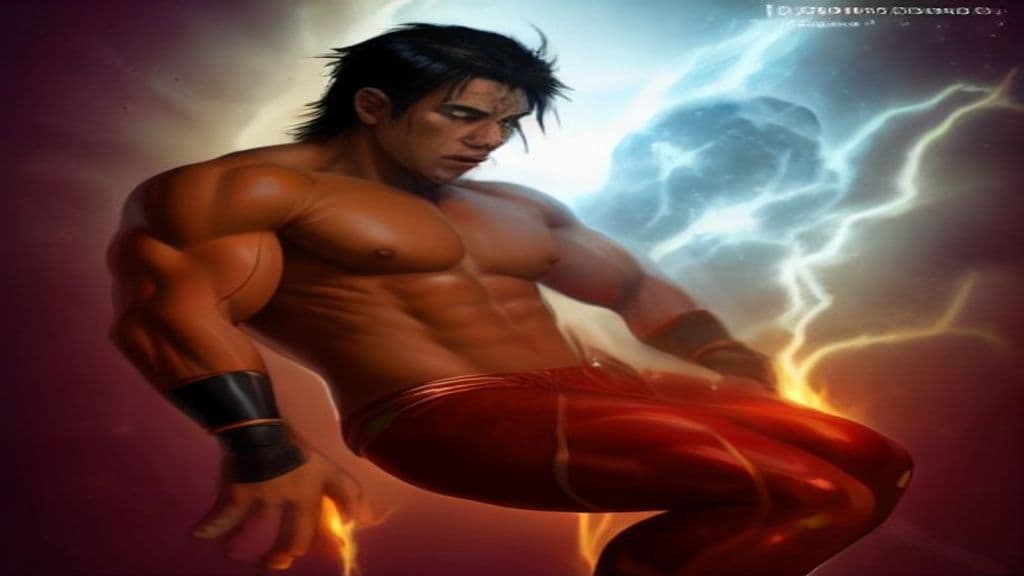
Paul Lester Sison is presented in the komiks as a man who lost the use of his legs in an accident and trained his upper body to exceptional athletic ability. Hearing a rumour about a Tikbalang — described as a mythological creature with the body of a man and the head of a horse — he arranged a contest, setting a time and place for a battle with the creature. After defeating the Tikbalang in this arranged duel, the creature granted him powers and gave him its magic hair, a talisman identified in sources as an agimat or anting-anting. This magic hair functions in the narrative as the device enabling Sison to transform into the super-powered Flash Bomba.
As Paul Lester Sison, the character is depicted as a man who has lost the use of his legs and who has developed exceptional upper-body strength through training. In his super-powered form Flash Bomba, the transformation granted by the Tikbalang's magic hair produces a being notable for enlarged hands and feet and a physically imposing, superhuman aspect. Sources emphasize the large extremities—hands and feet—while noting that he remains skillful rather than clumsy. Visually, the character appears in Mars Ravelo's komiks and was adapted for television (Komiks Presents: Flash Bomba, 2009), where costumes and logo work were modernized for the ABS-CBN series.
Sources credit Flash Bomba with superhuman strength, the ability to walk up walls, and the use of very large hands to generate 'thunderclaps' or to block almost anything; he is also portrayed as a skilled unarmed fighter despite enlarged extremities. Some summaries additionally note an ability to mystically summon 'devil horses' to create a stampede, a power mentioned in certain overviews but not uniformly detailed across all sources. In the narrative, these abilities are granted by the Tikbalang via its magic hair (agimat/anting-anting) following the arranged duel.

Five Wisdom Kings
A class of wrathful, mantric protector-deities in East Asian Mahāyāna (notably Japanese) Buddhism, identified with the Sanskrit Vidyārāja and Japanese Myō-ō and described in sources as guardians of the cosmic Buddha Dainichi (Vairocana) and of esoteric teachings.
Fjalar (rooster)
Fjalar (Old Norse: Fjalarr) is a named red rooster in the Poetic Edda (Völuspá) whose crowing is portrayed as heralding the onset of Ragnarök. The figure appears as a portentous, performative signal in the eschatological sequence, with no cultic rituals or protective practices attested in the supplied sources.
Fjalar and Galar
Fjalar and Galar are two named dwarf brothers in Old Norse myth who murdered the wise being Kvasir and transformed his blood into the mead of poetry; they also killed the jötunn Gilling and his wife, an act that led Suttungr to take possession of the mead. Their actions set in motion the canonical mythic sequence recorded in Skáldskaparmál/Prose Edda linking dwarfs, giants, gods, and the origin of poetic inspiration.
Fjölvar
Fjölvar is a named supernatural companion attested once in the Poetic Edda poem Hárbardsljóð: Odin (in disguise as Hárbarð) says he spent five winters with Fjölvar on the isle Algrœn, where they fought, proved perils, and "indulged in love." Scholarly commentary infers a jötunn classification by analogy with the þulur name‑form Fjölvör, but the primary attestation is brief and gives no physical description or explicit powers.
Fjörgyn / Fjörgynn
Fjörgyn (feminine) and Fjörgynn (masculine) are Old Norse name-forms functioning as earth/land personifications and as genealogical names in Norse myth: Fjörgyn is attested as the mother of Thor and poetic synonym for 'earth', while Fjörgynn is named as the father of the goddess Frigg. Their attestations are brief and primarily poetic or genealogical, and scholars have proposed (but not definitively proven) that the two forms reflect related or complementary divine concepts.
Flame Emperor (Yan Emperor / Yandi)
A legendary pre‑dynastic Chinese ruler later remembered and venerated in some traditions as a fire‑associated ancestral figure or deity. He appears in early Chinese origin myths and is paired with other foundational legendary rulers such as the Yellow Emperor in accounts of archaic conflicts.
Flash Thompson
Eugene "Flash" Thompson is a fictional human character from American comic books published by Marvel Comics. Introduced as a star high-school football player and bully of Peter Parker, he later serves in the U.S. Army, loses both legs in the Iraq War, and becomes host to the alien Venom symbiote, operating for a time as the costumed figure Agent Venom (and later Agent Anti‑Venom) in Marvel storylines.
Flatwoods Monster
A creature reported in Flatwoods, Braxton County, West Virginia, on September 12, 1952, seen on the ground after witnesses observed a bright light cross the night sky. Treated in sources as an anomalous terrestrial/extra‑terrestrial apparition recorded in mid‑20th‑century American popular anomalistics and later reinterpreted by investigators with natural explanations (meteor + barn owl + perceptual factors).
Flauros
Flauros (also attested as Haures / Hauras in variant spellings) is a named high-ranking spirit in Western grimoires, notably the Ars Goetia (Lesser Key of Solomon). Described as a 'Great Duke' who initially appears as a leopard and later assumes a human form with flaming eyes, he is invoked for truthful revelation about past, present, and future and for destructive aid against enemies, but must be constrained by ritual to prevent deception.
Flidais
Flidais (also Flidas; modern Fliodhas/Fliodhais) is a named female figure in medieval Irish narrative tradition associated with a prodigious herd and exceptional milking; she appears in Ulster-Cycle and related cattle-raid tales as a woman of high status whose favored cow and herd can provision large numbers of people.
Flogdrake
A Scandinavian firedrake or "fly‑dragon" associated with evening streaks of light in the sky and with tunnelling mountain lairs that hide ore and treasure. Primarily attested in Swedish folklore, it participates in a pan‑European motif of fiery serpents and is sometimes linked with household or earth spirits in nearby traditions.
Flora
Flora is the Roman divine personification associated with flowers, spring, and vegetative fertility. She functioned as a named cultic figure within Roman religion, attested in sources that link her to a priestly office and to temple dedication(s), and her name later supplied the Latin root for the modern term 'flora' denoting plant-life.
Community Record
- [1]Flash Bomba - Wikipedia. Wikipedia, 'Flash Bomba'wiki
- [2]Komiks Presents: Flash Bomba - Wikipedia. Wikipedia, 'Komiks Presents: Flash Bomba' (2009 ABS-CBN adaptation)wiki
- [3]Flash Bomba (internationalhero.co.uk). InternationalHero entry on Flash Bombaother
- [4]Mars Ravelo’s Flash Bomba tv series teaser trailer « Komiks News Now Philippines. Komiks News Now Philippines, coverage of 2009 TV adaptationother
- [5]Flash Bomba | Goblin Mercantile Exchange. Fan/reference blog post summarizing Flash Bombaother
- [6]Wikidata: Flash Bomba. Wikidata entry for Flash Bombawiki