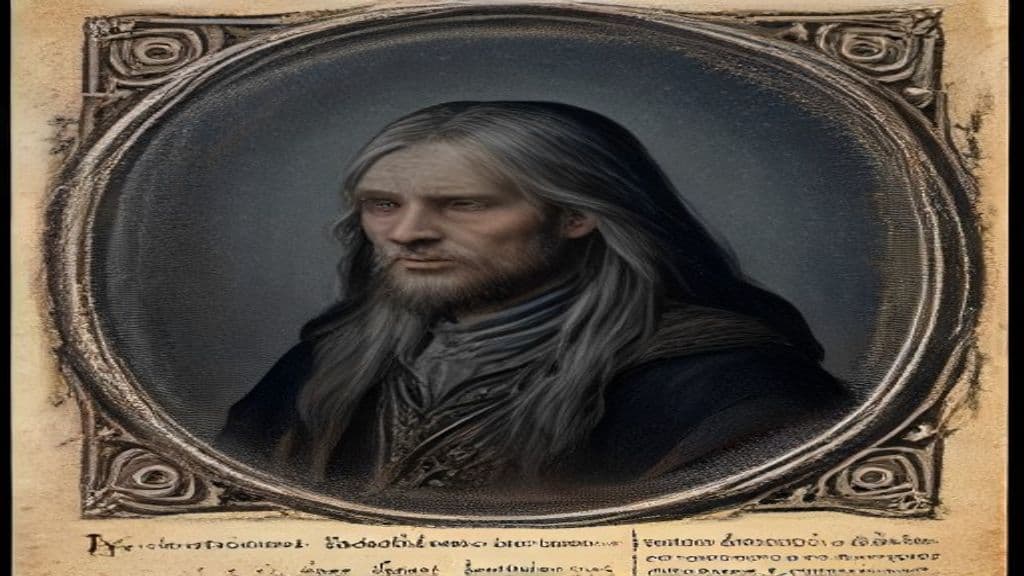
In Snorri Sturluson's Prose Edda Forseti is named the son of Baldr and Nanna and is attested as the presiding god of a hall called Glitnir, described as the seat of justice where disputants leave reconciled. Continental medieval legend and hagiography record a Frisian figure called Fosite associated with an island and a sacred spring; a late-legendary tale tells of a stranger who produced a spring, taught laws, and disappeared—later tradition often identifies that stranger with Fosite, though scholars note this identification and its interpretation are contested.
Medieval sources preserved in the provided materials give no surviving physical description of Forseti as a bodily form; the accounts emphasize his parentage, juridical function, and his hall Glitnir rather than any anthropomorphic depiction.
Primary attested function is juridical: Snorri reports Forseti's hall as 'the best of courts' and that 'all those who come before him leave reconciled,' attributing to him effective mediation and adjudication. Continental accounts associate Fosite with a sacred spring whose observance required ritual propriety (water drawn 'in silence') and with legends of a figure who taught laws to people. Scholarly commentary cautions that Forseti's juridical role rests largely on Snorri's report and on name-derivation; some etymological proposals connect the name to streams or to a Frisian cult-site, while others treat linguistic links as unresolved, so the scope of any cultic powers beyond adjudication is uncertain.
Forbush Man
Forbush Man is a satirical comic-book character and mascot created by Stan Lee for Marvel's parody imprint (Not Brand Echh). Presented as the alter-ego Irving Forbush, he is a deliberately inept 'wannabe superhero' whose comic role is parody and editorial in-joke rather than a supernatural agent; later alternate-continuity appearances sometimes grant him story-specific abilities.
Forese Donati
Forese Donati is a historical Florentine who appears as an individualized penitent soul in Dante Alighieri's Purgatorio (Canto 23). In the poem he is encountered on the sixth terrace of Purgatory, where he converses with the pilgrim Dante about personal history, other souls, and the efficacy of intercessory prayer.
Forest Bull
A marvelous bovine attested in ancient natural-history and medieval bestiary traditions, the Forest Bull (Aethiopian or Ethiopian Forest Bull) is described by classical authors as an extraordinary, dangerous breed of cattle reported from Ethiopia and depicted with hyperbolic size, strength, and near-invulnerability.
Forneus
Forneus is a named spirit in the grimoire tradition of The Lesser Key of Solomon (the Ars Goetia), described there as a Great Marquis of Hell who commands twenty-nine legions and is said to teach rhetoric and languages while making men beloved and giving them a good name. Sources depict him as able to take many forms — described as a great sea monster but said to mainly prefer human form — and note that he is "partly of the Order of Thrones, and partly of that of Angels."
Fornjót
Fornjót is a jötunn in Norse genealogical-mythic material, presented as the father of personified elemental powers (Hlér/sea, Logi/fire, Kári/wind) and as an ancestral figure connected to the Yngling royal dynasty and mythic northern lands such as Finnland and Kvenland.
Fornjótr
Fornjótr (Old Norse Fornjótr) is an Old Norse mythic jötunn presented in medieval sources as the father of the personified forces Hlér (sea), Logi (fire) and Kári (wind). In saga and genealogical material he is also portrayed in some manuscripts as a legendary ruler of northern lands (Finnland/Kvenland) and appears as an ancestral figure in certain royal genealogies.
Fortuna
Fortuna is the Roman divine personification of fortune, chance, and the capricious turning of events. Worshiped in multiple local and functional aspects, she could bestow prosperity or withdraw it; her action was read both as arbitrary caprice and as connected to civic virtue.
Foruhal
The provided source material only links the name Foruhal to the corpus surrounding the Shahnameh (specifically a page referencing Davāzdah Rokh) but contains no description, role, or contextual information about Foruhal. No attributes, stories, or cultural placement are given in the supplied excerpt.
Fossegrim
A water spirit or troll in Scandinavian folklore, associated with music and enchantment. (Note: 1. Power tier: Lowered from Greater to Lesser, as it's described as a local spirit. 2. Origins story: Clarify that it's rooted in Scandinavian cultural values, but more specifically mention the Old No)
Founding of Rome
The collective process of gradual union and formation of settlements on hilltops in ancient Rome. (Note: - Power tier: Primordial (not Lesser, as it's a historical process rather than a supernatural entity) - Abilities: Remove "The exact nature of this process is unclear" and replace with something accur)
Foundling-Bird (Fundevogel)
Fundevogel (Foundling-Bird) is a proper-name character and origin-motif from the Brothers Grimm tale “Fundevogel,” describing a human boy found in a bird's nest and raised by a forester. Within the ATU 313A transformation‑chase context, the character participates in a sequence of metamorphoses used to evade pursuers rather than representing a distinct supernatural race.
Four Holy Beasts
A set of four sacred animals in Chinese and broader East Asian cultural and astronomical tradition, mapped to the four cardinal directions and used as auspicious, protective, and cosmological symbols in literature, architecture, and material culture.
Community Record
- [1]Forseti — Wikipedia. Wikipedia: Forseti (summary of Prose Edda, medieval accounts, and scholarly discussion)wiki
- [2]Prose Edda (Snorri Sturluson) — summary as cited. Snorri Sturluson, Prose Edda (as summarized in secondary sources): Forseti named son of Baldr and Nanna; Glitnir 'seat of justice'; 'His is the best of courts; all those who come before him leave reconciled.'literary
- [3]Medieval continental sources on Fosite (Alcuin, Altfrid, Adam of Bremen) — summarized. Summaries of Alcuin's Life of St. Willebrord, Altfrid, and Adam of Bremen describing a sacred spring on an island (Fositesland/Heiligland) where water 'had to be drawn in silence' and later legends identifying a stranger who created a spring and taught laws with Fosite.literary
- [4]Etymological discussion (Grimm, Hans Kuhn, Wolfgang Laur) — summarized. Summary of scholarly hypotheses: Grimm's proposals (earlier presiding-name, later association with 'whirling stream'), Hans Kuhn's contested Poseidon equation, and Wolfgang Laur's critique noting the name remains largely unexplained.academic
- [5]Mythus: 'Priests of Forseti' (modern role-playing casting — cited as modern reception). Modern secondary reception describing a speculative priesthood and role-playing reconstructions; identified in the research notes as modern reconstruction and marked uncertain.other