
The sources place Gamayun within a class of East Slavic mythic birds that derive ultimately from Greek siren mythology and related Mediterranean motifs. Like the Sirin and the Alkonost, Gamayun is a bird‑woman figure whose role was adapted into Russian cosmology; she is located on an island in the mythical east close to paradise, a placement that links her to otherworldly repositories of sacred knowledge rather than to ordinary human landscapes. This syncretic positioning—Greek siren morphology reworked into a liminal, paradisal eastern locus—is the basis for her attributed function as a revealer of divine and heroic knowledge (Wikipedia; USC Digital Folklore Archives).
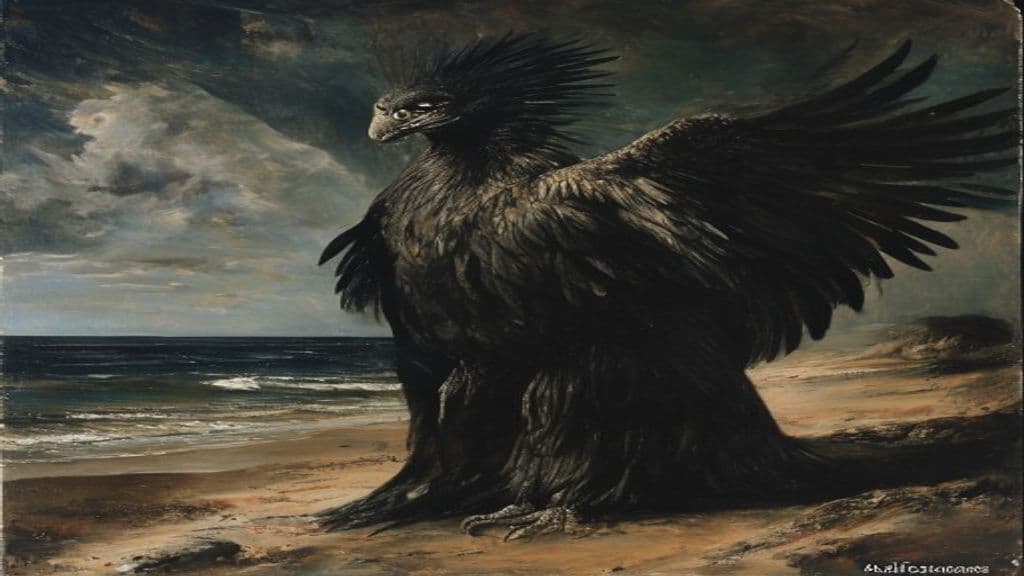
Gamayun is normally depicted as a large bird with a woman's head, the canonical bird‑woman morphology shared with Sirin and Alkonost (Wikipedia; USC Digital Folklore Archives). A variant reported in 17th–19th‑century books describes her paradoxically as legless and wingless yet "ever‑flying with the help of a tail," a detail recorded in textual traditions of that period and interpreted symbolically (Wikipedia). Her image has also been used in civic iconography, notably appearing on the coat of arms of Smolensk, confirming an established visual identity in regional symbolic imagery (Coat of arms of Smolensk; Wikipedia).
The primary attributed abilities of Gamayun are encyclopedic knowledge and prophetic speech: she "spreads divine messages and prophecies" and is said to "know everything of all creation, gods, heroes, and man," making her a repository and announcer of sacred or divine information (Wikipedia). The 17th–19th‑century variant that is legless and wingless carries an interpretive behavioral motif: her fall is read as foreshadowing the death of statesmen, showing that aspects of her condition can be used as political omens in textual commentary (Wikipedia). Sources do not specify technical mechanics of her communication (song, riddles, speech forms) beyond general prophetic dissemination (Wikipedia; USC Digital Folklore Archives).
Alatyr
A sacred world-stone in East Slavic and wider Slavic folklore, described as the "father to all stones" and the "navel of the earth." Located at the world's center (often on Buyan island), it is associated with a miraculous spring, sacred letters, healing properties, and liminality between the human world and other realms.
Alkonost
The Alkonost is a legendary woman-headed bird of East Slavic folklore, depicted as an individual mythic avian figure who lives in the underworld alongside her counterpart Sirin. Her song enchants listeners into forgetfulness or bliss, she is said to bless fruit during the Apple Feast of the Saviour, and her reproductive actions are causally linked in lore to sudden storms at sea.
Baba Yaga
Baba Yaga is an ambivalent female figure of East Slavic folktale tradition, depicted variously as a fearsome, child-eating crone or as a helpful, maternal donor. She is associated with the deep forest, a hut described as standing on chicken legs, and the motific accoutrements of a mortar and pestle.
Chernava
Chernava is a water spirit in East Slavic (Russian) folklore portrayed as a mermaid and the personification of the river Chernava; in the Sadko bylina she is presented as one of the Sea Tsar's daughters (in some versions, his niece) who aids the hero by transforming into the river Chernava and returning him to the human world.
Dobrynya Nikitich
A Slavic bogatyr (heroic warrior) based on a historical warlord, reflecting medieval ideals of chivalry and nobility. (Note: - Power tier: Primordial (no supernatural abilities are mentioned, but he is a bogatyr, which implies a higher power tier) - Sensory cues: not present in source material - Weaknesses: not present in s)
Gagana
Gagana is a miraculous bird of Russian folklore said to live on the mythic island Buyan. Described as guardian of the Alatyr alongside the snake Garafena, she performs miracles and can aid petitioners if properly invoked.
Indrik (Indrik-zver')
A singular marvelous beast in Russian folklore, the Indrik (Indrik-zver') is described in medieval compilations such as the Dove Book as the "king of all animals" who dwells on a sacral "Holy Mountain"; the creature is gigantic and horned and is said to make the earth tremble when it stirs.
Koschei the Deathless
Koschei (also Koshchei, Kashchei), commonly called "the Deathless" or "the Immortal," is an archetypal male antagonist in Russian and wider Slavic folklore. He functions in folk narratives as a legendary villain whose name and legend persist into modern cultural works and references.
Leshy
A tutelary forest being in Slavic folklore; an embodied, territorial power of the woods that can protect, mislead, or punish humans depending on their behaviour toward the forest. Highly variable in form and described across many regional variants and names.
Meduza
Meduza (also Meluza, Meluzina) is a hybrid sea monster attested in Russian popular print culture (a 17th–18th‑century lubok) described as half-woman and half‑serpentine/sea creature, located in remote oceanic waters and explicitly labeled in one source as a 'deity of deception.'
Shishiga
Shishiga (Russian: шиши́га), also called leshenka in one account, is a female swamp or forest spirit in Russian and Komi traditional belief. Presented as a place-bound nature-being, she is associated with marshes, riverbanks and wooded margins and is said to harass people (particularly intoxicated persons) and, in Komi tradition, to be an omen or cause of drowning and death for those who see her.
Volga Svyatoslavich
Epic hero from medieval Russian folklore, a legendary warrior and bogatyr in Slavic mythology. (Note: * Power tier: Lower to "Greater" (deity-level powers are associated with Ancient entities, and bogatyrs are typically considered powerful regional beings) * Appearance: Remove statement about lack of )
Community Record
- [1]Gamayun. Wikipedia, 'Gamayun' article (accessed via provided research notes).wiki
- [2]Sirin, Alkanost, and Gamayun | USC Digital Folklore Archives. USC Digital Folklore Archives entry grouping Sirin, Alkonost, and Gamayun (provided in research notes).folk
- [3]Coat of arms of Smolensk. Wikipedia, 'Coat of arms of Smolensk' (noting Gamayun's appearance in civic heraldry).wiki
- [4]Wikidata: Gamayun. Wikidata entry labeling Gamayun as a Russian mythical bird (provided in research notes).other