
In the Sadko bylina and related East Slavic materials Chernava appears as a member of the Sea Tsar's household: described in sources as his daughter (in some variants a niece) and simultaneously as the personification of the river bearing the same name. The folkloric framing treats named natural features and members of the Sea Tsar's retinue as overlapping categories: the river Chernava and the youthful mermaid Chernava are the same entity within the narrative cycle represented in the Sadko epic.
Chernava is depicted as a mermaid: with a human head and upper body and a fish's tail for her lower body. In the Sadko bylina she is specifically described as a small, scrawny, young girl who works as a servant in the Sea Tsar's palace and is counted among the 900 mermaids offered to the hero. Sources emphasize her diminutive, servant-like status rather than an idealized bridal form.
Narrative material in the Sadko bylina attributes to Chernava the capacity to transform into her river-name-sake: while Sadko sleeps on the wedding night she becomes the river Chernava and thereby conveys him back to the human world (Sadko wakes on the river's shore and rejoins his first wife). The tale also presents a behavioral constraint: she lies beside Sadko but does not permit consummation, and it is precisely this non-consummation plus her transformation that enable the hero's return. Beyond this episode, sources do not ascribe additional powers, specific hostile behaviors, or a broader catalog of magical actions.
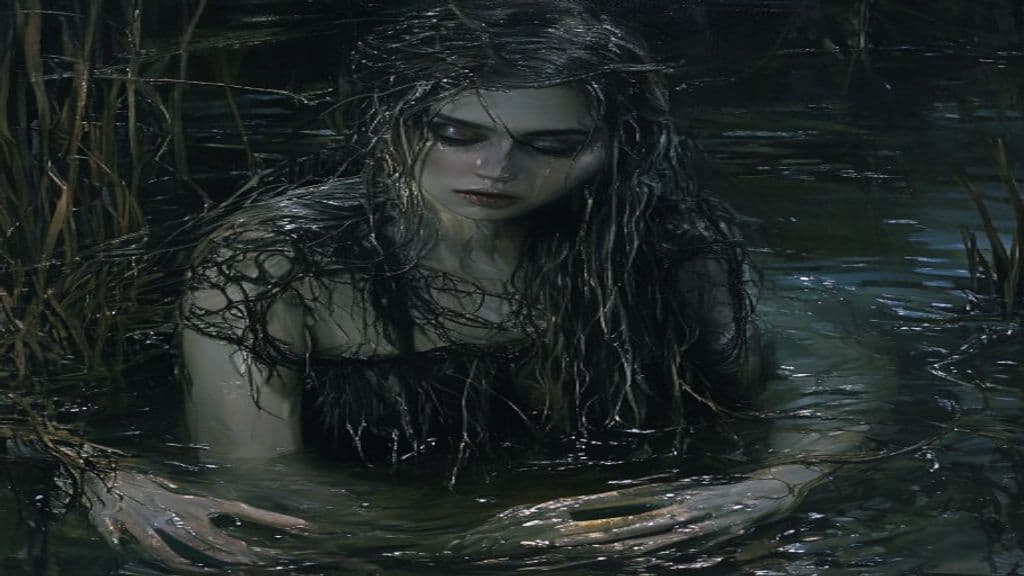
Rusalka
Water spirits in Slavic folklore — the spirits of young women who died by drowning or suicide, bound to rivers and lakes. Beautiful and dangerous, they can bewitch men to their deaths.

Sea Tsar
A titled supernatural sovereign of the sea realms in East Slavic narrative tradition, the Sea Tsar appears in bylinas and fairy tales (notably Sadko and variants of The Sea Tsar and Vasilisa the Wise) as a ruler who influences underwater fortunes and events encountered by human protagonists.
Alatyr
A sacred world-stone in East Slavic and wider Slavic folklore, described as the "father to all stones" and the "navel of the earth." Located at the world's center (often on Buyan island), it is associated with a miraculous spring, sacred letters, healing properties, and liminality between the human world and other realms.
Alkonost
The Alkonost is a legendary woman-headed bird of East Slavic folklore, depicted as an individual mythic avian figure who lives in the underworld alongside her counterpart Sirin. Her song enchants listeners into forgetfulness or bliss, she is said to bless fruit during the Apple Feast of the Saviour, and her reproductive actions are causally linked in lore to sudden storms at sea.
Baba Yaga
Baba Yaga is an ambivalent female figure of East Slavic folktale tradition, depicted variously as a fearsome, child-eating crone or as a helpful, maternal donor. She is associated with the deep forest, a hut described as standing on chicken legs, and the motific accoutrements of a mortar and pestle.
Gamayun
Gamayun (Russian: Гамаю́н) is a prophetic, wisdom-bearing bird of Russian folklore, normally depicted as a large bird with a woman's head that "spreads divine messages and prophecies" and "knows everything of all creation, gods, heroes, and man." She is placed in the mythic geography on an island in the east near paradise and is presented as a symbol of wisdom rather than a hostile creature.
Chenghuangshen (City God)
Chenghuangshen (城隍神), commonly called the City God, is a tutelary deity in Chinese folk religion tied to a specific settlement. Historically associated with a city's walls and moat, the deity functions as protector of local affairs and as a local official in the postmortem ordering of souls for that place.
Cheonyeo Gwishin (Virgin Ghost)
Cheonyeo gwishin is a subtype within the Korean category of gwisin: spirits/ghosts of humans who have died. The available sources identify gwisin as human-derived spirits distinct from non-human folkloric beings (e.g., dokkaebi) and note that contemporary media often depicts such ghosts as liminal, socially isolated figures.
Cherchen (Chercheny)
No folkloric entity named 'Cherchen' or 'chercheny' is described in the supplied sources. The term appears only as the toponym for the oasis town Qiemo (Cherchen) in Xinjiang and as a travel-route waypoint in 19th–20th century European travel literature and Cold War-era documents.
Cherin
Cherin is attested in medieval pseudo-history as a legendary king of the Britons in Geoffrey of Monmouth's Historia Regum Britanniae; later the string appears as a modern given name and surname in various secular contexts. The available sources record genealogical placement and modern name usages but do not present Cherin as a supernatural being.
Chernobog and Belobog
A pair of opposing divine names recorded by medieval and early modern Christian chroniclers for West Slavic contexts: Chernobog ('Black God') associated with adverse fortune and harm, and Belobog ('White God') presented as a beneficent counterpart. Their historicity and status in pre-Christian Slavic religion are disputed; Chernobog is attested earliest (12th c.), while Belobog appears in much later sources and may be a later contraposition.
Chernoglav
Chernoglav (Old Icelandic Tjarnaglófi; Polish Chernogłów/Chernoglov) is a sparsely attested local war or victory deity reported in medieval Old Icelandic accounts of Rügen (Jasmund). The Knýtlinga saga describes him as a god of victory who 'went with them on military campaigns' and records that his cult resisted Christianization longer than some others before being taken years later.
Cherub
In Abrahamic religious literatures a cherub (Hebrew kərūḇ, pl. kərūḇīm; English cherub/cherubim) is a class of exalted celestial being associated with the divine presence, guardianship of sacred space, and service near God. Descriptions range from the composite, winged hybrid creatures of prophetic visions and Near Eastern art to later Western artistic renderings as chubby winged putti; their rank and appearance vary across Jewish, Christian, and Islamic traditions.
Cherubim
Cherubim are a class of non-human, winged supernatural beings in the Abrahamic religious corpus and related traditions. They function primarily as guardians and attendants of a divine presence—appearing around thrones, the Ark, sacred trees, and in liturgical representation—and the term has been adopted in various devotional and modern cultural contexts.
Community Record
- [1]Chernava — Wikipedia. Wikipedia contributors, 'Chernava,' Wikipedia, The Free Encyclopedia, https://en.wikipedia.org/wiki/Chernavawiki
- [2]Wikidata: Q4513283 (Chernava). Wikidata entry Q4513283 for Chernava, http://www.wikidata.org/entity/Q4513283other
- [3]CIA archive — OZHERELYE-VORONEZH PORTION, TULA-VORONEZH PORTION OF SOVIET MICROWAVE RELAY LINKS U.S.S.R. CIA Reading Room document 'OZHERELYE-VORONEZH PORTION, TULA-VORONEZH PORTION OF SOVIET MICROWAVE RELAY LINKS U.S.S.R,' Archive.org, https://archive.org/details/cia-readingroom-document-cia-rdp78t04759a009300010030-2other