
The only origin given in the supplied sources is the film premise: in Ghost Child (2013) the spirit arrives when Na, a new wife, brings an urn into the widower Choon's household; the urn 'contains the eponymous "Ghost Child", otherwise known as a toyol.' The sources do not provide a traditional mythological origin for the toyol beyond this narrative device in the film.
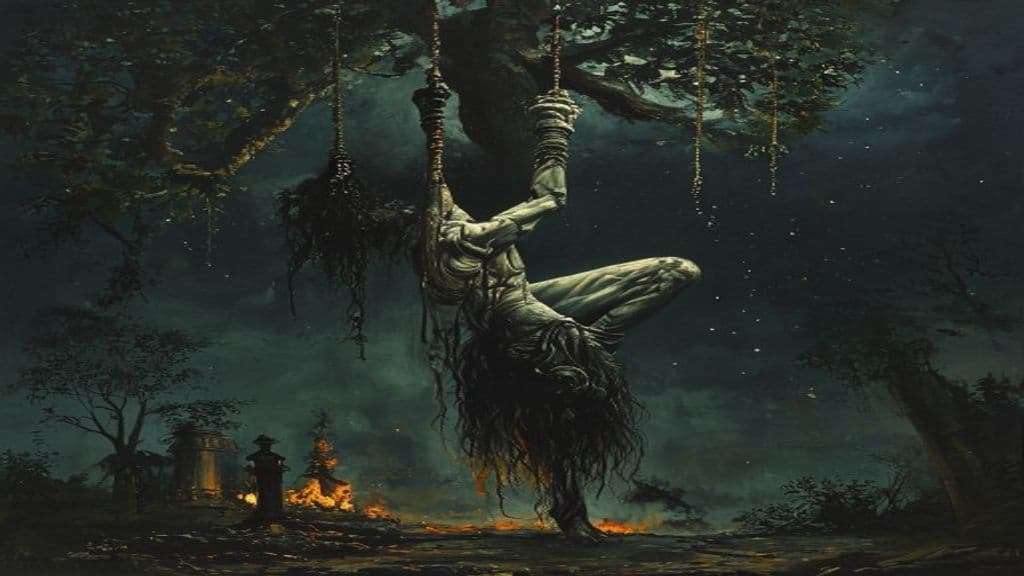
The supplied film synopsis names the entity as the 'Ghost Child' (Chinese title 鬼仔) and equates it with a toyol contained in an urn, but provides no detailed physical description (size, clothing, facial features). The available material therefore describes its locus (an urn) and its label (ghost child / toyol) while explicitly lacking visual detail.
Within the film synopsis the Ghost Child/toyol causes persistent domestic harm: family photographs are torn, Kim's grandmother is injured for no apparent reason, and unspecified 'supernatural happenings' create distress for household members; Kim's attempts to rid the family of the toyol 'are to no avail.' The sources do not enumerate additional powers or wider-ranging abilities beyond these household-scale disturbances.
Weaknesses
- otherNo documented weaknesses in supplied sources
Wards
- otherNo documented wards or protective practices in supplied sources
Geryon
Geryon is a monstrous, martial figure from Greek heroic-age mythology who dwells on the far-western island Erytheia and guards a valuable herd of red cattle; he is best known as the opponent slain by Heracles in the Tenth Labour. Classical sources present multiple, conflicting physical descriptions; later reception (notably Dante) recasts the name as an allegorical composite monster.
Geshtinanna
Geshtinanna is a Sumerian goddess functioning as the underworld's chief scribe and a specialist in scribal arts and dream interpretation; mythically she is the sister of Dumuzi and participates in his death‑and‑return cycle, once residing in the netherworld for part of the year in his stead.
Gevurah
Gevurah (Hebrew: גְּבוּרָה, Găḇūrā) is the fifth sephirah on the Kabbalistic Tree of Life, an emanation representing the divine principles of judgment, limitation, and disciplined strength. It functions as a structural attribute within Jewish mystical cosmology rather than an individual personal spirit.
Ghatotkacha
Ghatotkacha (Sanskrit: घटोत्कच, IAST: Ghaṭotkaca) is a singular mytho-heroic figure in the Indian epic Mahabharata, born to the Pandava Bhima and the rakshasi Hidimbi. He is portrayed as a powerful rakshasa-warrior allied to the Pandavas, famed for night-effective magic, illusions, great size, and a climactic death that cost the Kaurava side a large-scale loss.
Ghoshayatra Parva
Episode from the Hindu epic Mahabharata where Kauravas are captured by gandharvas and released by the Pandavas. (Note: - Power tier: Ancient (deity-level abilities would fit better with the described events in the source material) - Appearance: Should be added as per source material does not describe but one can infer)
Ghost
A ghost is, in folklore, the soul or spirit of a dead person or non-human animal believed by some to be able to appear to the living. The concept functions across many cultures as an afterlife manifestation tied to ancestor belief, animism, and rituals intended to rest or manage the dead, while modern scientific accounts treat reported phenomena as lacking proof and often propose physiological or environmental explanations.
Ghost Rider
Ghost Rider is a Marvel Comics mantle borne by multiple human hosts who transform into a flaming-skulled, skeletal superhuman bonded to a supernatural agency variously described as a demon (Zarathos), a Spirit of Vengeance, or an incarnation of Death/Judgment. The figure functions in-universe as an avenger/antihero who enacts retributive justice and is associated with hellfire and a supernatural vehicle (motorcycle or, in some incarnations, a muscle car).
Ghost Ship (Phantom Ship)
A ghost ship (or phantom ship) denotes either a physical vessel found adrift with no living crew or a spectral vessel apparition reported in maritime folklore. The motif functions across maritime cultures as omen, memory of catastrophe, and a narrative way to confront unexplained loss at sea.
Ghost Shirt (Lakota Tradition)
A spiritualized object imbued with powers to protect its wearer from harm or possession by malevolent spirits. (Note: 1. Power tier: Primordial (given its association with spiritual visions from the founder, it's reasonable to assume a higher power level) 2. Abilities: The source material doesn't explicitly mention p)
Ghost Sickness (Navajo Tradition)
A cultural and psychological concept describing a state of being consumed by grief or preoccupation with the deceased. (Note: - Power tier: Primordial (Ghost Sickness is not an entity with concrete abilities, but rather a psychological state that affects individuals) - Appearance: No description needed, as it's a psychologic)
Ghost Train
A folkloric apparition whose visible form is an entire train or rail vehicle rather than a single disembodied human spirit. Reported in multiple regions where railways have been significant, it appears variously as omen, commemorative phantom, or an imitation created by animal tricksters in local tales.
Ghost of Kyiv
A modern wartime legend and morale symbol that emerged in the first 30 hours of the Russian invasion of Ukraine (24 February 2022). Presented as a mythical MiG-29 ace credited in social media with multiple shoot-downs, the persona was later acknowledged by Ukrainian officials as a constructed 'superhero-legend' embodying collective pilot spirit rather than a verified individual or literal supernatural being.
Community Record
- [1]Ghost Child (Wikipedia). Wikipedia, article 'Ghost Child' (film), accessed via provided source listwiki
- [2]Ghost Child (Wikidata). Wikidata entry Q17050320 for Ghost Child (film), accessed via provided source listother
- [3]Ghost Children (poetry collection blurb). Ghost Children (poetry collection) blurb noting use of 'ghost children' as metaphor for Holocaust losses; cited to clarify unrelated literary uses of the phraseliterary