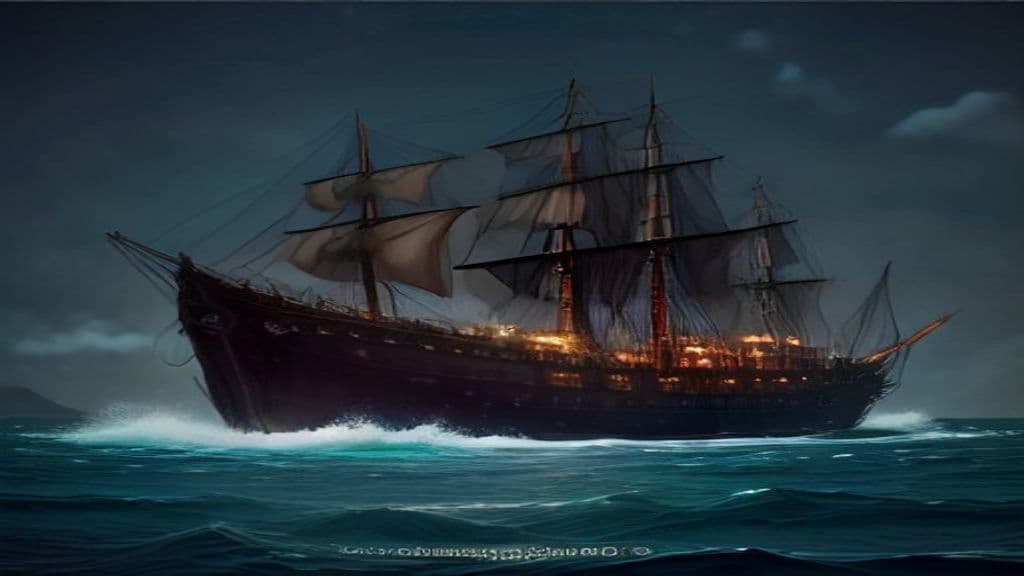
There is no single canonical origin story for the ghost ship motif; rather, the category unites (a) reports of real derelict vessels discovered with crew missing or dead (e.g., Mary Celeste, SS Baychimo) and (b) culturally specific legends of spectral vessels (e.g., the Flying Dutchman, the Caleuche, the waka wairua of Lake Rotomahana). In many traditions the apparition is understood as the lingering trace of catastrophe, a vessel condemned to reappear, or a spirit-craft belonging to an unseen world. Source summaries emphasize that the English label conflates material derelicts and supernatural apparitions, while named local examples (Caleuche, waka wairua, Chasse-galerie) indicate distinct cultural framings of the phenomenon (Wikipedia: Ghost ship; Phantom Canoe of Lake Rotomahana entry).
Descriptions in the collected sources divide into two primary modes. First, physical derelicts: intact or badly damaged vessels found adrift with missing or dead crews (Mary Celeste–type cases, SS Baychimo, Governor Parr, Rouse Simmons), sometimes with tattered sails or derelict rigging. Second, spectral apparitions: luminous or fully formed phantom vessels—examples include flaming or burning-ship apparitions (Eliza Battle, Teazer Light, Fireship of Baie des Chaleurs), fully visible phantom galleons or three-mast galley apparitions (Chapel Cove, Flying Dutchman), and spirit canoes (waka wairua of Rotomahana). Sources note reports of both fully corporeal-seeming ships and transient, luminous, or semi-transparent outlines (Wikipedia: Ghost ship; Phantom Canoe of Lake Rotomahana; entries on regional lights and fireships).
Across traditions ghost ships are reported to reappear or recur (Lady Lovibond said to reappear every fifty years; Eliza Battle reported to reappear aflame before disaster), serve as omens or portents of impending catastrophe (Eliza Battle, Teazer Light), and in some legends carry the motif of eternal sailing or condemnation (Flying Dutchman). Accounts also include sensational reported finds—lifeboats with skeletons or blood-smeared decks—presented in maritime lore but often unverified (stories tied to Octavius, Duc de Dantzig, SS Valencia reports). In modern usage the term also extends to non-supernatural practices (e.g., vessels operating with AIS turned off) but these are pragmatic uses rather than folkloric powers (Wikipedia: Ghost ship; related legend listings).
Flying Dutchman
A legendary phantom vessel in maritime folklore, said to be unable to make port and condemned to sail the oceans forever. Appearing to sailors as a full-rigged ship—sometimes ghostly-luminous, sometimes dark—its sighting functions as an omen of doom and is tied in many versions to a past crime or penance.
Gevurah
Gevurah (Hebrew: גְּבוּרָה, Găḇūrā) is the fifth sephirah on the Kabbalistic Tree of Life, an emanation representing the divine principles of judgment, limitation, and disciplined strength. It functions as a structural attribute within Jewish mystical cosmology rather than an individual personal spirit.
Ghatotkacha
Ghatotkacha (Sanskrit: घटोत्कच, IAST: Ghaṭotkaca) is a singular mytho-heroic figure in the Indian epic Mahabharata, born to the Pandava Bhima and the rakshasi Hidimbi. He is portrayed as a powerful rakshasa-warrior allied to the Pandavas, famed for night-effective magic, illusions, great size, and a climactic death that cost the Kaurava side a large-scale loss.
Ghoshayatra Parva
Episode from the Hindu epic Mahabharata where Kauravas are captured by gandharvas and released by the Pandavas. (Note: - Power tier: Ancient (deity-level abilities would fit better with the described events in the source material) - Appearance: Should be added as per source material does not describe but one can infer)
Ghost
A ghost is, in folklore, the soul or spirit of a dead person or non-human animal believed by some to be able to appear to the living. The concept functions across many cultures as an afterlife manifestation tied to ancestor belief, animism, and rituals intended to rest or manage the dead, while modern scientific accounts treat reported phenomena as lacking proof and often propose physiological or environmental explanations.
Ghost Child (toyol, urn)
A named supernatural figure appearing in the 2013 Singaporean horror film Ghost Child (Chinese: 鬼仔), identified in the film as a toyol kept within an urn that brings malicious domestic disturbances to a household. The film is the only supplied source that presents this discrete spirit as an agent in a folk-derived domestic narrative.
Ghost Rider
Ghost Rider is a Marvel Comics mantle borne by multiple human hosts who transform into a flaming-skulled, skeletal superhuman bonded to a supernatural agency variously described as a demon (Zarathos), a Spirit of Vengeance, or an incarnation of Death/Judgment. The figure functions in-universe as an avenger/antihero who enacts retributive justice and is associated with hellfire and a supernatural vehicle (motorcycle or, in some incarnations, a muscle car).
Ghost Shirt (Lakota Tradition)
A spiritualized object imbued with powers to protect its wearer from harm or possession by malevolent spirits. (Note: 1. Power tier: Primordial (given its association with spiritual visions from the founder, it's reasonable to assume a higher power level) 2. Abilities: The source material doesn't explicitly mention p)
Ghost Sickness (Navajo Tradition)
A cultural and psychological concept describing a state of being consumed by grief or preoccupation with the deceased. (Note: - Power tier: Primordial (Ghost Sickness is not an entity with concrete abilities, but rather a psychological state that affects individuals) - Appearance: No description needed, as it's a psychologic)
Ghost Train
A folkloric apparition whose visible form is an entire train or rail vehicle rather than a single disembodied human spirit. Reported in multiple regions where railways have been significant, it appears variously as omen, commemorative phantom, or an imitation created by animal tricksters in local tales.
Ghost of Kyiv
A modern wartime legend and morale symbol that emerged in the first 30 hours of the Russian invasion of Ukraine (24 February 2022). Presented as a mythical MiG-29 ace credited in social media with multiple shoot-downs, the persona was later acknowledged by Ukrainian officials as a constructed 'superhero-legend' embodying collective pilot spirit rather than a verified individual or literal supernatural being.
Ghoul
A ghoul is a demon-like or monstrous humanoid originating in pre-Islamic Arabian religion, traditionally associated with graveyards and the consumption of human flesh. The concept later entered broader folklore and has been widely reused and transformed in modern fiction and popular culture.
Community Record
- [1]Ghost ship — Wikipedia. Wikipedia contributors. 'Ghost ship.' Wikipedia, The Free Encyclopedia. https://en.wikipedia.org/wiki/Ghost_shipwiki
- [2]Wikidata: Ghost Ship (Q54806928). Wikidata entry Q54806928, 'Ghost Ship'. http://www.wikidata.org/entity/Q54806928other
- [3]Phantom Canoe of Lake Rotomahana (summary reference in compiled notes). Summary entry referencing the Phantom Canoe (waka wairua) for Lake Rotomahana as presented in the compiled sources (see Ghost ship article).wiki
- [4]Miscellaneous archive and web references to regional legends and modern usage (compiled list). Compiled research notes drawing examples from encyclopedic listings and archived web references cited in the assembled notes (see provided source list pointing to regional legends such as Caleuche, Lady Lovibond, Eliza Battle, Teazer Light, Rouse Simmons, Mary Celeste, SS Baychimo, Octavius, Duc de Dantzig, SS Valencia).other