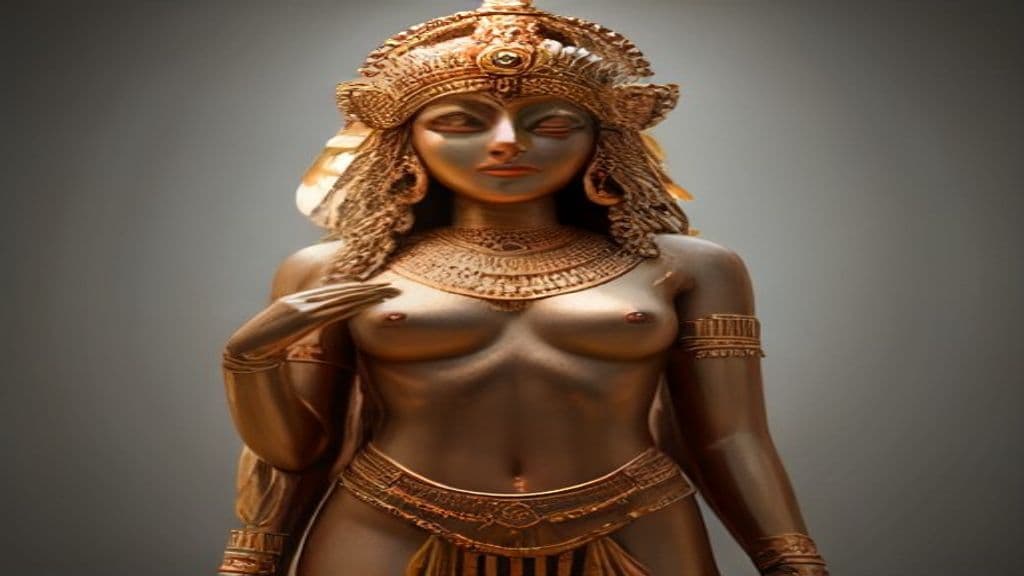
As a class, goddesses do not share a single origin story; rather, each named goddess has her own mythic origins within her cultural tradition. Sources describe certain traditions in which a goddess occupies foundational cosmological roles: for example, in Shaktism the Supreme Goddess (Mahamaya) is regarded as the ultimate deity and source of reality, and in some Tantric Shaivism formulations the female principle (Shakti) is the active, creative power paired with Shiva. Vajrayana Buddhism represents ultimate reality as two principles in union (yab yum), with the female principle embodying perfect wisdom. These examples illustrate that within their respective cosmologies goddesses can be conceived as origins of creative power or as discrete divine persons with genealogies and cultic histories.
No single, uniform physical appearance is attributed to 'a goddess' in the surveyed sources; appearance is culturally specific and varies with each named deity. The sources list many named goddesses from different eras and regions rather than prescribing a generic form. The modern example of the Goddess of Democracy (a 10-metre-tall statue created during the 1989 Tiananmen Square protests) shows that goddess imagery can be embodied in large-scale public sculpture to symbolize civic ideals, but traditional iconography for individual goddesses (e.g., Shakti, Isis, Demeter) is distinct to each tradition and not summarized in the provided excerpts.
Across traditions goddesses are ascribed a wide range of powers and roles. They may function as metaphysical principles (creative/active power such as Shakti; Mahamaya as the source of reality), as embodiments of wisdom (female principle in Vajrayana), or as patrons of concrete domains such as fertility, motherhood, sexuality, weaving, agriculture, hunting, war, law, magic, fate, earth, and sky. They are commonly central objects of worship with cults, shrines, and local patronage (for instance Arinniti, Cybele, Uzzā). In modern contexts goddess figures are also repurposed as political symbols or therapeutic archetypes.
'Ain Samiya Goblet
Silver cup from the Middle Bronze Age I, discovered in a tomb at Ain Samiya. (Note: 1. Power tier should be "None", but add a note explaining that historical artifacts don't fit into the typical power tier classification. 2. Add a description of its appearance based on it being a sil)
*Péh₂usōn (reconstructed)
Péh₂usōn is a hypothetical Proto‑Indo‑European pastoral guardian reconstructed by comparative scholars from parallels in Greek and Vedic traditions. Proposed as a Graeco‑Aryan ancestor‑figure, the reconstruction describes a protector of flocks, roads, and travellers rather than an attested historical cultic personality.
Acalanātha (Acala / Achala)
Acalanātha (also Acala or Achala) is a wrathful deity and dharmapāla — a protector of the Dharma — prominent in Vajrayana and East Asian Mahayana Buddhist contexts. Presented as a fierce, non‑human or semi‑divine protector-figure, Acalanātha functions to defend the teaching and practitioners by removing obstacles and confronting threats to the transmission and practice of Buddhism.
Acestes
Acestes is a Roman/Greek founder-hero associated with the Sicilian city Segesta (Aegesta/Acesta). Presented as son of a Trojan woman and, in one tradition, the Sicilian river-god Crinisus (in animal form), he hospitably receives Aeneas and the Trojans, participates in the funeral games in Virgil's Aeneid (Book V), and functions as an eponymous culture-founder and local ruler.
Adder Stone (Egyptian Tradition)
A type of stone with specific physical characteristics, typically glassy and containing a naturally occurring hole, primarily made of flint. Not considered supernatural in Egyptian tradition. (Note: - Remove "primarily made of flint" from Appearance section, as it is not a characteristic unique to Adder stones. - Power tier should be "None" based on the source material, but clarify that this refe)
Aetnaeus
An epithet associated with gods and mythical beings connected to Mount Etna. (Note: - Power tier: Primordial (due to association with major gods like Zeus) - Weaknesses: Needs to be filled - Wards: Needs to be filled - Sensory cues: Needs to be filled - The summary should be revised )
Alalu
Alalu (also Alala/Alal) is a primordial, ancestral god attested in Mesopotamian, Hurrian and Hittite sources. He appears in genealogical lists as an early progenitor of later sky-gods and in Hurrian myth (the Kumarbi Cycle) as a former 'king in heaven' overthrown and forced to flee to the underworld.
Alexander the Great (legend)
A pan-cultural legendary hero-king whose historical career was transformed into a body of miraculous and etiological tales (the Alexander Romance). In these traditions he is alternately a divinely sanctioned conqueror, boundary-builder credited with the Gates of Alexander, and a questing culture-hero associated with oracles, votive dedications, and tests of loyalty.
Almo
Almo is attested in the provided sources as a river-deity named for the ancient River Almone near Rome. The supplied material identifies Almo only by name and by association with that river; no detailed myths, rites, iconography, or powers are recorded in the provided documents.
Amoghasiddhi
Amoghasiddhi is one of the Five Tathāgatas (Five Wisdom Buddhas) in Mahayana and Vajrayana/Esoteric Buddhism, representing the Karma family and the quality of "unfailing accomplishment". He functions as an archetypal, protective, and contemplative buddha-body within tantric mandalas, presiding over the northern quarter and invoked in mantras and ritual iconography.
Ancile
The Ancile is a sacred shield in Roman tradition, said to have fallen from heaven and perpetuating Rome's sovereignty. (Note: 1. Power tier should be Ancient (deity-level) instead of Primordial. 2. Origin story should note that it is said to have "fallen from heaven" but does not imply direct supernatural or divine origin. )
Apsu (Abzu)
Apsu (Sumerian Abzû; Akkadian Apsu) is the primeval freshwater principle in Mesopotamian cosmology, conceived both as the subterranean freshwater ocean/aquifer and as a hypostatic divine presence. Paired with the saltwater Tiamat, Apsu is a progenitor of earlier divine generations and the source of lakes, springs, rivers, rain and floodwaters; in Enūma Eliš he is slain by the younger god Ea and his domain becomes Ea's dwelling.
Community Record
- [1]Goddess — Wikipedia. Wikipedia: 'A goddess is a female deity.'; discussion of Shaktism, Mahamaya, Shakti, yab yum and lists of named goddesses.wiki
- [2]Deity — Wikidata. Wikidata entry for the class 'deity' as a natural or supernatural god or goddess.wiki
- [3]Goddess of Democracy — Wikipedia. Article noting the 10-metre-tall statue created during the 1989 Tiananmen Square protests.wiki
- [4]Episode 42: Healing Your Inner Critic (archive listing). Archive entry referencing contemporary spiritual use of goddess archetypes in therapeutic contexts (as cited in the research notes).other
- [5]Global Us : DW (archive listing). Archive listing among provided source fragments indicating modern cultural usage of the term 'goddess'.other