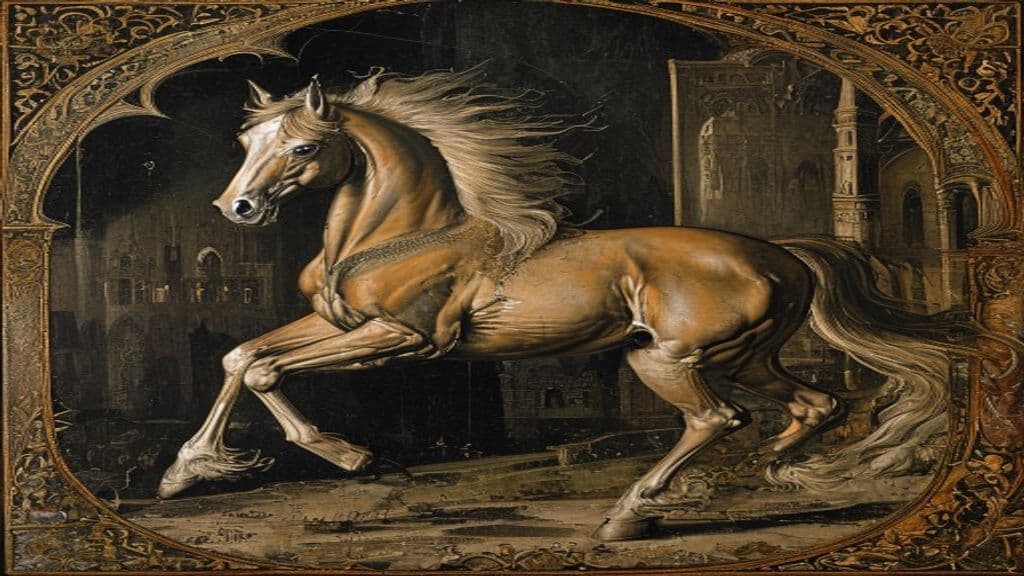
The Grant is named and described in a single medieval compendium of marvels, Gervase of Tilbury's Otia Imperialia. In that source it is presented as "a kind of demon" that "runs through towns as a warning of fire." There is no earlier origin narrative recorded in the cited materials; later writers have attempted to relate the brief Otia account to wider vernacular motifs of horse-shaped bogies or to interpret it as an embellished record of animal-omens, but those are modern interpretive proposals rather than original origin stories.
In the sole medieval attestation (Gervase of Tilbury's Otia Imperialia) the Grant is described as resembling "a yearling colt, prancing on its hind-legs, with sparkling eyes." That equid-like image is the only direct physical description in the cited sources; later commentators have proposed alternative identifications (e.g., hare, water-spirit) but these are interpretive and not part of the original medieval wording.
The only recorded behaviour in the primary medieval account is that the Grant "runs through towns as a warning of fire," functioning as a portent. Modern scholars have proposed interpretive frameworks—linking it to a motif of horse-like bogies encountered on roads (púca, kelpie, shagfoal) or suggesting the report may reflect a hare-as-omen—these are presented in the secondary literature as hypotheses and not additional recorded powers.
Weaknesses
- othernone recorded in primary source
Wards
- othernone recorded in primary source
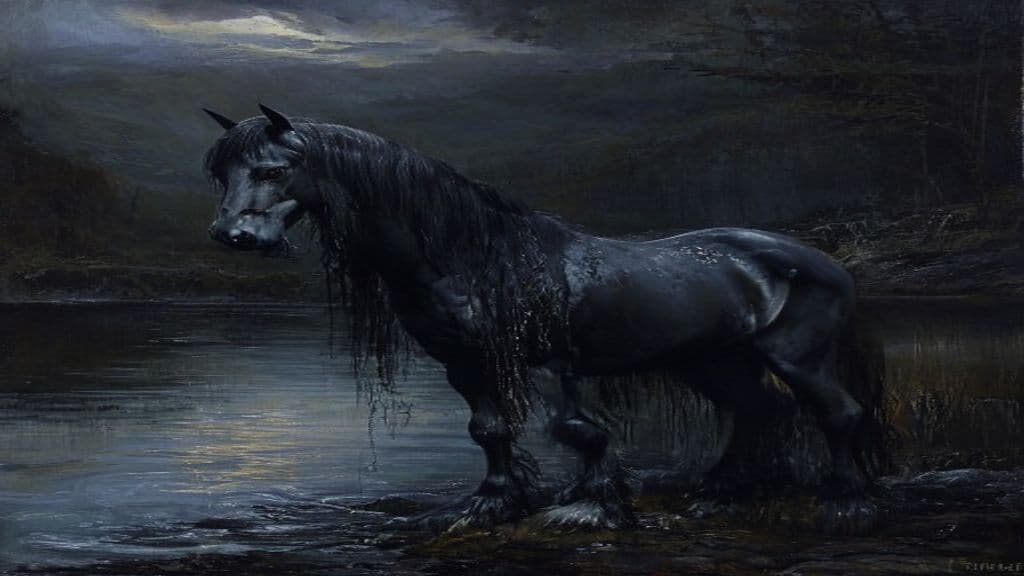
Grafton Monster
A modern local cryptid from Grafton, Taylor County, West Virginia, first publicized after a cluster of roadside sightings in June 1964. Commonly described in secondary sources as a very tall (7–9 ft), pale, smooth-skinned, apparently headless biped that produced an unusual sound and became a local media sensation and later tourist/entertainment motif.
Grahana
In Hindu tradition, a Grahana refers to an eclipse, a celestial event of significant importance in Hindu cosmology. (Note: 1. Summary: While accurate, it could be more concise and clear. 2. Power tier: Primordial (as a celestial phenomenon with significant importance in Hindu cosmology) 3. Abilities: Note the absence of s)
Gramadevata
A gramadevata (Sanskrit: grāmadevatā) is the tutelary or guardian deity of a specific locality—most commonly a village—in South Asian Hindu practice. Gramadevatas function as territorial, communal divinities responsible for the wellbeing, boundaries and fortune of the settlement; they are propitiated in local shrines and festivals and may be benevolent when honored or feared as causes of calamity if neglected.
Grani
Grani is the named horse of the hero Sigurðr (Sigurd) in the Old Norse Völsunga saga. Presented as descended from Odin's steed Sleipnir, Grani is an exceptional, singular heroic mount attested in the saga narrative and in later Norse iconography and kennings.
Granmar
Granmar is a legendary-historical king of Södermanland in Old Norse literary tradition. He appears in Snorri Sturluson's Heimskringla and in Eddaic and saga material (notably the Helgi Hundingsbane poems and the Volsunga saga) as a political actor whose marriage alliances, feasting, and military resistance intersect with wider heroic cycles; in Heimskringla he is ultimately burned to death in a treacherous hall-burning arranged by King Ingjald.
Granny Weatherwax
Esmerelda "Esme" Weatherwax, commonly called Granny Weatherwax or Mistress Weatherwax, is a human witch and the leading figure among the Ramtops witches in Terry Pratchett's Discworld novels. She is a practicing herbalist and folk-psychologist ('headology') who serves as a pragmatic guardian of the Kingdom of Lancre and its people.
Grass snake (Natrix natrix)
A Eurasian semi‑aquatic, non‑venomous colubrid snake (primarily Natrix natrix and closely related taxa) commonly found near water, compost heaps and field edges. Treated in the provided sources as a biological species with well‑documented natural history rather than a mythic or supernatural being.
Gration
Gration (Greek: Γρατίων) is attested in modern reference databases as a named member of the Giants (Gigantes) of Greek mythology. The supplied sources give only a brief indexical identification and no ancient narrative, description, or ritual material for this figure.
Gravekeeper (modern usage)
A modern English-language title or name used in diverse contemporary media (music production credits, videogame title, and tabletop/fantasy character name) rather than a coherently documented traditional folkloric entity. The supplied sources show the term functioning as branding or a character title with grave-related connotations but do not record a folk belief, origin myth, or ritual tradition tied to a specific culture.
Grayven
Grayven is a DC Comics supervillain and New God, described as a son of Darkseid who functions as a warlike, planet‑destroying commander in multiple comic crossover storylines. He appears across DC continuity (comics and animated adaptations) as an antagonistic, near‑immortal combatant whose arcs include being banished, incapacitated, killed, and later resurrected in continuity relaunches.
Great Duke
A classificatory title used in Christian demonological systems to denote a high-ranking demon, analogous to earthly and angelic offices. The term functions as a rank within hierarchical taxonomies of infernal beings rather than a single, individuated monster in the provided sources.
Great Spirit
A supreme, often-immanent life force or creator-being present in the traditional spiritual beliefs of many Indigenous peoples of what is today Canada and the United States; concepts and names vary by nation and may refer to a single creator, a pervasive sacred power, or a collective of mysterious sacred forces.
Community Record
- [1]Grant (folklore) — Wikipedia. Wikipedia entry 'Grant (folklore)' summarising Gervase of Tilbury and subsequent scholarshipwiki
- [2]The Emperor's New Clothes (collection including Otia Imperialia commentary). Archive item cited in research notes (secondary material referencing Otia Imperialia)other
- [3]Stop the Press : BBC Radio Scotland FM : September 02, 2017 11:30AM-12:00PM BST. Archive item listed among research notes (contextual material)other