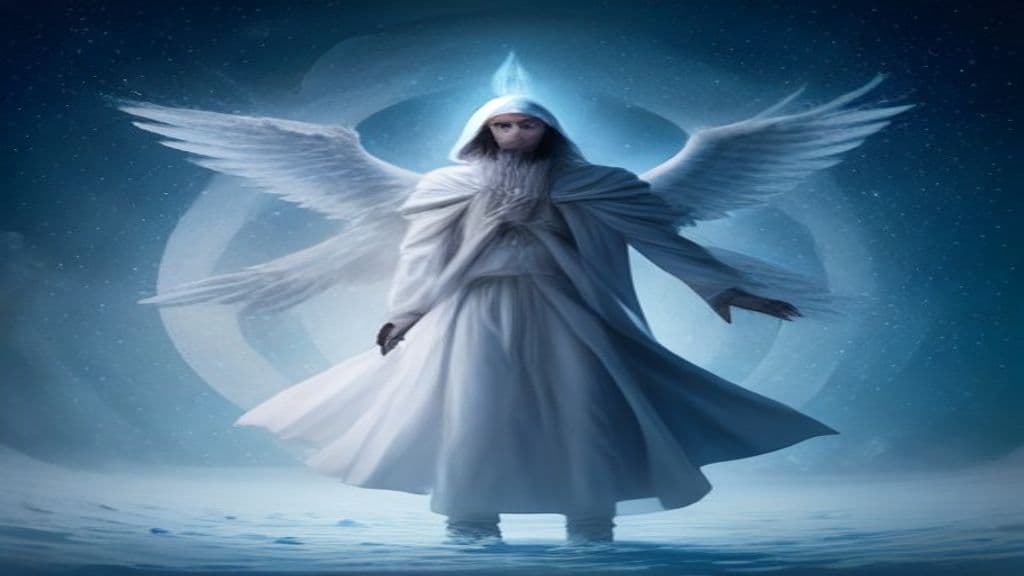
Ḥabīb appears within accounts of the Prophet Muḥammad’s Night Journey (Miʿrāj) as preserved in early Islamic narrative cycles. The tradition of an angel so described is attested to early commentators (summarized as reaching back to the 8th-century scholar Muqātil ibn Sulaymān) and was present in codified Mirāj narratives by the 9th–10th centuries CE; later Sufi exegesis incorporated the imagery into devotional commentary on unity and reconciliation (sources summarized from modern reference accounts, including the cited Wikipedia entry and linked data).
Classical accounts describe Ḥabīb as miraculously composed of both fire and ice (or snow) such that the fire does not melt the ice and the ice does not extinguish the fire. Later Sufi-influenced descriptions extend this motif to a host of similar angels described as half-fire and half-snow.
The primary characteristic attributed to Ḥabīb is the paradoxical coexistence of opposites (fire and ice) without mutual destruction; this is presented in the literature as a theological sign demonstrating God's power to create the impossible and harmonize estranged forces. In later Sufi-influenced writings the similar angelic host is said to continuously pray for the reconciliation and unity of believers, assigning them an intercessory or liturgical function in devotional discourse. The sources do not describe transactional interactions with humans or a catalogue of combative powers.
Bhoot (bhoota)
A bhoot (also bhoota, bhoot, bhut) is the culturally specific term across parts of the Indian subcontinent for a perturbed, restless spirit generally understood to be the ghost of a deceased person. Sources describe bhoots as arising when a person's death or post-death circumstances prevent them from moving on — for example violent death, unresolved affairs, or failures in funerary rites — and the term appears frequently in modern South Asian media and discussions.
Churel (Chudail)
A South Asian female revenant or vengeful ghost associated with women who die cruelly or unpurified; often said to target male relatives and sometimes described as latching onto trees, producing a tree‑attached tree‑spirit variant in local tales.
Djinn
The class of supernatural beings created from smokeless fire in Islamic cosmology — a parallel civilization to humanity, capable of belief or unbelief, with their own prophets, society, and judgment before God.
Elisha
Elisha is a Hebrew Bible prophet, successor and disciple of Elijah, portrayed as a divinely appointed intermediary who performs miracles, advises rulers in narrative episodes, and acts within a prophetic guild known as the "sons of the prophets." His story appears in 1 Kings 19 and 2 Kings 2–14 and he is venerated in Jewish, Christian, and Islamic traditions.
Fatimah
Fatimah (also spelled Fatima) in the provided sources is presented as a female personal name and as the historical figure Fatima bint Muhammad (Fatima al‑Zahra), daughter of the Islamic prophet Muhammad, wife of Ali, and mother of Hasan and Husayn. The corpus contains biographical and onomastic information only and does not treat Fatimah as a supernatural entity.
Ghoul
A ghoul is a demon-like or monstrous humanoid originating in pre-Islamic Arabian religion, traditionally associated with graveyards and the consumption of human flesh. The concept later entered broader folklore and has been widely reused and transformed in modern fiction and popular culture.
Iblis
The primordial deceiver in Islamic theology; a jinn who refused God's command to bow before Adam and was expelled from heaven. The source of all temptation and whispered suggestion.
Ifrit
One of the most powerful classes of jinn in Islamic and pre-Islamic Arab tradition — a fire-born being of immense strength and cunning, capable of great works of engineering and terrible violence.
Jann
The weakest class of djinn in Islamic tradition, associated with desert winds and taking the form of snakes or whirlwinds, dwelling in empty wilderness and posing little threat to those who know the proper invocations.
Marid
The most powerful class of jinn in Islamic tradition — beings of the sea, associated with the deep ocean, storms, and the granting of wishes at terrible cost. The classic genie of the Arabian Nights.
Mellified Man
A medicinal substance created by steeping a human cadaver in honey. (Note: * Power tier should be Lesser (given it's a medicinal substance created by humans) rather than Primordial. * Abilities should reflect that Mellified Man has no supernatural or paranormal abilities, bu)
Nasnas
A half-human djinn creature of Arab folklore — possessing only half a face, one arm, one leg, and half a torso — descended from the union of a shaitan and a human, moving by leaping and highly dangerous to encounter.
Community Record
- [1]Habib (angel) — Wikipedia. Wikipedia, article 'Habib (angel)' (accessed via provided research notes)wiki
- [2]Wikidata: Habib. Wikidata entry Q131394665 (referenced in research notes)other
- [3]Summary notes referencing Muqātil ibn Sulaymān, al-Qushayrī, and Apocalypse of Moses parallels. Compiled research summary (provided), noting early attestation to Muqātil ibn Sulaymān, Sufi-era commentary by al-Qushayrī (d. 1072 CE) describing a host praying for unity, and a thematic parallel to the Jewish pseudepigraphal Apocalypse of Moses (the ʾĪšīm).other