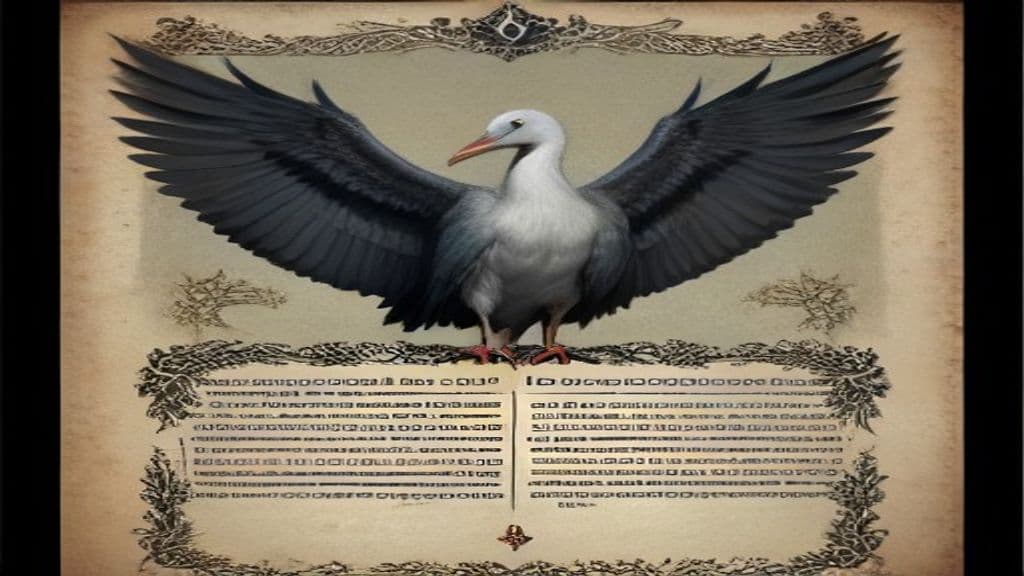
Halphas appears in the corpus of Renaissance and early modern grimoire material cataloguing spirits for ritual magic (notably the Ars Goetia / Lesser Key of Solomon tradition and related demonological works). These texts record Halphas as an office within an infernal hierarchy — an earl who commands 26 legions — but they do not provide a mythic birth narrative or folkloric life‑story. Later demonological compilations (e.g., Weyer, Collin de Plancy) reproduce or variantly describe the figure; modern editions and commentators (e.g., Skinner & Rankine) annotate the entry with correspondences such as an opposing Shemhamphorasch angel.
Goetic manuscripts most commonly depict Halphas in avian form: "a hoarse‑voiced stock dove" in most manuscripts, while some authorities (Johann Weyer and Collin de Plancy's Dictionnaire Infernal) describe him as a stork. Sources thus record two distinct avian images as manuscript variants. The vocal quality "hoarse‑voiced" is specifically noted in the Goetic descriptions.
Canonical Goetic attributes assign Halphas military and logistical functions: supplying weapons and ammunition for towers (rendered as "towns" or "villes" in some manuscript variants), sending men to war, and commanding 26 legions of spirits. Modern usages of the name in music, gaming and fiction draw on this martial/infernal resonance but do not contribute additional canonical powers in the provided sources. Skinner & Rankine record that the Shemhamphorasch angel Haamiah opposes Halphas in angelic correspondence systems.
Weaknesses
None recorded.
Wards
- otheropposing Shemhamphorasch angel Haamiah (not a documented ritual in provided sources)
Forneus
Forneus is a named spirit in the grimoire tradition of The Lesser Key of Solomon (the Ars Goetia), described there as a Great Marquis of Hell who commands twenty-nine legions and is said to teach rhetoric and languages while making men beloved and giving them a good name. Sources depict him as able to take many forms — described as a great sea monster but said to mainly prefer human form — and note that he is "partly of the Order of Thrones, and partly of that of Angels."
Hakuzōsu
Hakuzōsu (白蔵主) is a named kitsune character in Japanese folklore who adopts the social role of a Buddhist priest or uncle in multiple local legends and theatrical versions. As a concrete fox-spirit tied to Inari-associated cultic contexts and village life, Hakuzōsu appears in narratives that emphasize shapeshifting, impersonation, and interaction with hunters and temple communities.
Halaesus
Halaesus (also Halesus; Latin Alesi) is a named figure in Greek and Roman mytho-historical tradition, portrayed as a mortal hero/warrior. He appears in two main strands: as an Emathian Lapith killed at the wedding of Pirithous and Hippodamia, and as a companion (sometimes called an illegitimate son) of Agamemnon who, after escaping the slaughter at Mycenae, travels to Italy and is credited with founding Falerii; in Roman epic tradition he fights against Aeneas and is slain by Pallas.
Halahala
A powerful poison in Hindu mythology, created during the churning of the Ocean of Milk. (Note: 1. Power tier should be Primordial, not Greater, as it can kill gods. 2. Add sensory cue: "A presence that threatens all life". 3. Add weakness: "None mentioned, but Amrita is a countermeasure" 4. Sum)
Half-elf
A being born of a union between an elf and a human; across sources the category functions as a genealogical/hybrid personage whose significance ranges from a locus of metaphysical choice (Tolkien) to narratively potent, sometimes dangerous figures in Norse sagas, and to a flexible playable race in modern fantasy gaming.
Halitherses
Halitherses (Ancient Greek: Ἁλιθέρσης) is an Ithacan seer and elder in the Homeric Odyssey cycle, named as the son of Mastor. He interprets signs from Zeus, pronounces their meaning publicly, and counsels restraint and deference to the gods; his warnings are often disregarded by the suitors and portions of the community.
Halius
Halius is not a single supernatural being but an Ancient Greek personal name borne by several distinct mortal characters in epic tradition. The name (Ancient Greek Ἅλιόν / Ἅλιός, 'of the sea') appears for different individuals in Homeric and Virgilian narrative cycles — warriors, princes, suitors, and companions — each treated as a human actor within heroic-era stories.
Haltija
In Finnish mythology, a Haltija is a supernatural guardian that protects specific locations and species, embodying a spirit of preservation within the natural world. (Note: * Power tier: should be "Lesser" instead of "Greater", as Haltijas are described as solitary creatures protecting specific places or species. * Abilities: added information about Haltijas being able t)
Hamadryad
In Greek myth a hamadryad is a tree-associated nymph whose life is bound to a single tree; if that tree dies, the hamadryad dies. They function as localized rural deities enforcing reciprocal human conduct toward trees and may be propitiated by sacrifice when offended.
Hamadryas baboon (tradition)
The hamadryas baboon (Papio hamadryas) is an Old World primate native to the Horn of Africa and southwestern Arabian Peninsula. In ancient Egyptian religious and archaeological contexts baboons are attested as sacred animals kept in temple precincts and represented in votive statuary and funerary catacombs (the Sacred Animal Necropolis at North Saqqara included baboons among its interments and monuments). The cited materials document the species' biological ecology and its institutional cultic treatment in temple and necropolis contexts but do not supply mythic origin narratives or ritual liturgies specific to the species.
Haman
Haman is the chief antagonist of the Book of Esther: a high Persian court official who secures a royal decree to annihilate the Jews and is ultimately executed on the very gallows he prepared for his enemy. In later rabbinic tradition he is expanded into a symbol of pride, idolatry, divinatory practice, and ancestral enmity linked to Agag/Amalek.
Hamet (Hamut)
The name Hamet (variant Hamut) appears in modern reference sources as a personal name and in several toponyms. The provided sources do not document any folkloric or supernatural entity called Hamet/Hamut, so no reliable ethnographic or mythological description is available from the supplied material.
Community Record
- [1]Halphas (Wikipedia). Wikipedia entry summarizing Goetic material on Halphas, noting rank as earl, 26 legions, avian appearance variants, military functions, and Skinner & Rankine's opposition by angel Haamiah.wiki
- [2]Wikidata: Malthus. Wikidata item listing variant name label 'Malthus'.other
- [3]SatanArt #1 (archive). Archive item showing modern cultural/artistic reuse of infernal iconography where Goetic names like Halphas appear in cultural artifacts.other
- [4]The Upstairs Room EP 376 King Pest (archive). Radio playlist item where 'Halphas - bones and dust' is listed, evidencing modern musical usage of the name.other
- [5]Metal Warehouse 03-11-2017 (archive). Set list entry 'Halphas - Call from the depths' showing modern metal music usage.other
- [6]The Wings of Halphas — Review / page. Album review/title using Halphas as an evocative motif in modern ambient/metal contexts.other
- [7]Angry Metal Guy — album review: Halphas: Dawn of a Crimson Empire. Modern musical use of the name Halphas in metal album titles and reviews.other
- [8]Destiny transcript — Proving Ground (Ishtar Collective). Uses the name 'Halphas' in fictional lore: 'This is the Halphas Electus, the digger of graves...'.literary
- [9]GGH-001 Halphas Gundam (Gundam fandom). Fandom page noting the Gundam named 'Halphas' and summarizing Goetic background ('also Malthus... is an Earl of Hell commanding 26 legions... often depicted as a stork').other