
The haṃsa appears early in South Asian textual history: Rigvedic hymns attribute to the bird the mytho‑poetic capacity to separate Soma from water, and later literature transfers the image to the bird separating milk from water when mixed. The motif recurs in Buddhist Jataka narratives (the Hamsa Jataka) and is well attested in early Buddhist art dated to ca. 3rd century BCE–5th century CE (Ajanta, Sanchi). Over time the haṃsa became invested with philosophical meanings in classical Indian thought, identified with the individual soul (jīva) and with the Universal Soul (Brahman), and adopted as the vahana of deities associated with creation, mantra, and knowledge. Scholarly debate recorded in the sources treats the Sanskrit term haṃsa as denoting an Anatidae-like migratory water‑bird but does not conclusively fix it to a single modern species (swan, goose, or flamingo), a disagreement that emerges from varying regional ecologies, textual descriptions, and later artistic stylizations (sources: Rigveda and later Sanskrit literature; Jataka texts and Ajanta/Sanchi art; modern summaries in the cited Wikipedia entry).
In scripture and early art the haṃsa is commonly depicted as white and graceful; Jataka texts and Ajanta paintings describe white swans “like clouds in a blue sky.” Early Indian reliefs and paintings (Ajanta, Sanchi) show swan‑like birds and panels of swans. In later temple art and textiles the motif is often highly stylized into a plump‑bodied, short‑necked bird with a flowery beak and tail—an appearance closer to a goose in regional iconographic traditions. Sources note regional and temporal variation: northern/early traditions favor elongated‑necked swan imagery, while southern and later stylizations yield plumper, goose‑like forms (sources: Ajanta/Sanchi/Jataka descriptions; Wikipedia summary).
Mytho‑poetically the haṃsa is famed for discriminative extraction: the Rigveda describes the bird separating Soma from water when mixed, and later texts tell of its separating milk from water—an emblematic, not literal, ability used to signify viveka (discrimination). The bird is also described as migratory and aquatic in habit in the natural‑world register, with references to flight, migratory routes (invoked in comparative ornithological arguments), plumage, calls, and courtship that connect the symbolic image to Anatidae species. Philosophically, the haṃsa’s flight symbolizes moksha (release from samsara), and some commentators interpret its breath as the natural mantra 'ham‑sa'—a philological reading that links the bird’s breathing to the meditational syllable and to the formulaic sense of 'I am That' (this interpretation is attested in archival commentary rather than presented as a universal scriptural statement). The milk/Soma‑separation motif and breath‑mantra reading function primarily as metaphors for discriminative awareness and the soul’s recognition of ultimate reality (sources: Rigveda and later literature; Jataka; archive commentary on Brahma and the ham‑sa mantra; Wikipedia).
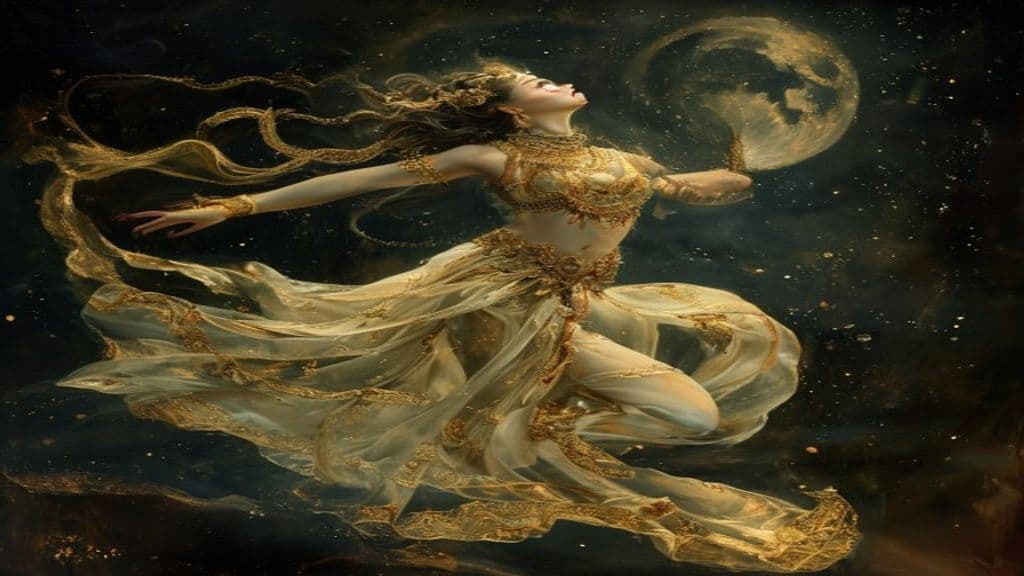
Apsara
Celestial dancers and water nymphs of Hindu cosmology — beautiful semi-divine beings who dance at the court of Indra and, by his command, descend to earth to distract sages from excessive asceticism.

Will-o'-the-Wisp
A wandering light seen over marshy ground at night, leading travellers astray into bogs and fens. Possibly a spirit, possibly the soul of the unbaptised dead, possibly the devil himself.
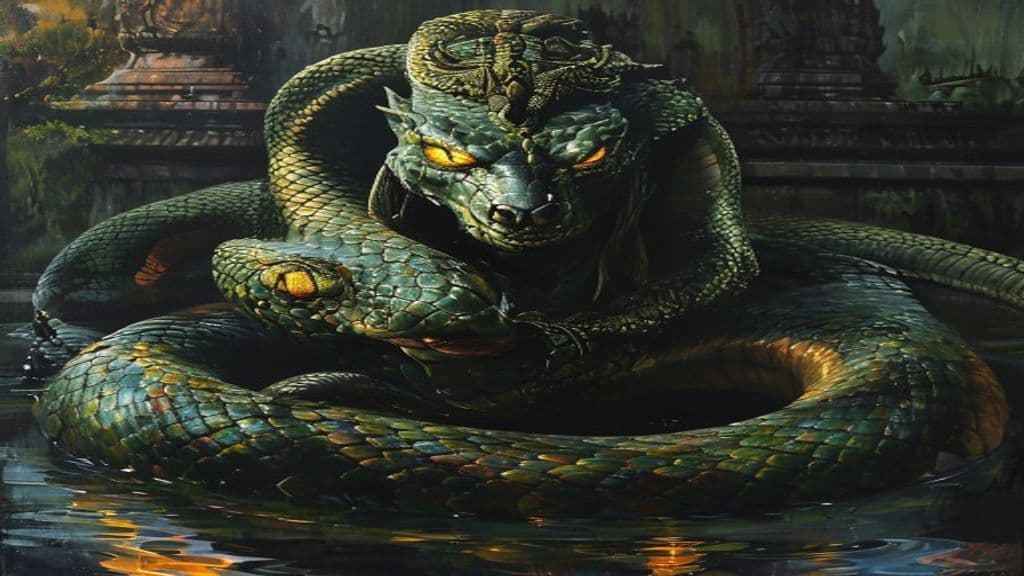
Naga
Divine serpent beings of Hindu, Buddhist, and Jain cosmology — powerful guardians of water, earth, and underground treasures. Revered as deities in South and Southeast Asia.

Rusalka
Water spirits in Slavic folklore — the spirits of young women who died by drowning or suicide, bound to rivers and lakes. Beautiful and dangerous, they can bewitch men to their deaths.
Adi (asura)
Adi is attested in modern reference works as the name of an Asura who 'appears in the Matsya Purāṇa.' Beyond this single-line citation in secondary sources, no descriptive material about the figure is provided in the supplied research notes.
Adi Shakti
Adi Shakti (also Adi Parashakti, Mahadevi, Adya Shakti) is the primordial feminine power in Hindu/Shakta theology, regarded as the ultimate reality (Para Brahman) and the source from which all goddesses and gods manifest. She is both an impersonal cosmic principle (Mulaprakriti) and a focus of devotional invocation in temples, mantras, and pilgrimage sites such as Shakti Peethas.
Adi Vinayaka
Adi Vinayaka (Ādi Vināyaka; also called Nara Mukha Vinayaka) is a named iconographic and devotional form of the Hindu god Ganesha portraying the deity with a human head, described in sources as the form before the episode of decapitation by Shiva. It is rarely worshipped and appears in a small number of South Indian shrines and in devotional/musical repertoires.
Aditi
Aditi is a major Vedic goddess in Hindu tradition who personifies the boundless, infinite cosmic principle and functions as the maternal matrix from which many celestial deities (the Ādityas and other groups) are born. In the Vedic hymns she is invoked as a protective liberator who guards petitioners, provides wealth and safety, and frees devotees from hindrances such as sin and sickness.
Agni
Agni is the Vedic personification of fire in Hindu tradition: a sacred, mediating principle that manifests as terrestrial fire, atmospheric lightning, and celestial sun, and that receives and conveys sacrificial offerings. Prominent in the Rigvedic corpus, Agni functions as sanctifier, witness of rites of passage, and a transformational inner principle in later Upanishadic literature.
Ahalya
Ahalya is a mytho-legendary woman of South Asian (primarily Hindu) narrative tradition, described as created by the god Brahma, married to the sage Gautama, seduced (or tricked) by Indra, cursed by her husband, and ultimately redeemed by Rama. Her tale is a locus for themes of creation, desire, curse/penance, and redemption and she is counted among the ritual-mnemonic panchakanya.
Aindri (Indrani / Shachi / Paulomi)
Aindri (commonly rendered in sources as Indrani, also called Shachi or Paulomi) is a Hindu goddess presented as the queen-consort of Indra. She is depicted in the available material as a courtly queen associated with beauty, pride and kindness who also appears in at least one account as an active martial participant in the devas' battles with asuras.
Akshayavata
In Hindu mythology, Akshayavata is a sacred banyan tree and/or lake that symbolizes eternal life. It is mentioned in both Hindu and Jain traditions and associated with the Puranas. (Note: - The power tier should be "Greater" or at least "Ancient", as it is associated with the Puranas, which are considered ancient texts. - No specific physical description is provided, but that doesn't m)
Alakshmi
Alakshmi is an inauspicious female supernatural figure in Hindu tradition, presented as the negation or shadow-counterpart of the prosperity-goddess Lakshmi. She personifies poverty, grief, jealousy and social discord and is managed in domestic ritual and festival practice.
Alamelu
Alamelu (also Alamelu Manga / Alarmel Mangai) is a South Indian devotional name for the goddess Padmavati, identified in sources as an avatar of Lakshmi and the consort of Venkateswara; the name is also used widely as a female personal name and in titles of cultural works in Tamil and Telugu contexts.
Amrita (Buddhist tradition)
In the context of Indian religions, particularly within Hinduism and Buddhism, Amrita is a divine elixir that grants immortality and eternal life. (Note: - Power tier should be Ancient (deity-level), not Primordial. - Origin story appears accurate but lacks specificity on when Amrita was first mentioned in the Rigveda; add more detail. - Abilities are )
Ananta (Infinite)
Ananta (Sanskrit: अनन्त, 'without end') is primarily an epithet of Vishnu and a symbolic principle of infinity that is personified as the cosmic serpent Shesha. In Puranic imagery Ananta/Shesha forms the multi‑headed couch and canopy for Vishnu as he rests on the cosmic waters between cycles of creation (pralaya), and thus underwrites cyclical cosmogenesis.
Community Record
- [1]Hamsa (bird) — Wikipedia. Wikipedia contributors, 'Hamsa (bird),' Wikipedia, The Free Encyclopedia.wiki
- [2]Brahma: meaning (archive excerpt). Archive.org, 'Brahma meaning' (archival excerpt discussing hamsa as vehicle and the ham‑sa breath/mantra).other
- [3]Ajanta paintings, Sanchi reliefs, and Hamsa Jataka (scholarly/art historical references summarized in source materials). Summarized references to Ajanta, Sanchi, and the Hamsa Jataka as noted in the supplied materials (see Wikipedia entry and provided archive excerpts).literary