
Classical sources present variant genealogies. Hesiod names the Harpyiai as daughters of Thaumas and the Oceanid Electra and groups them with other storm/sea-related figures (making them kin to the messenger Iris). Other authors and traditions offer alternate parentages linking them to sea or monstrous figures (e.g., Pontus, Gaea, Poseidon, or Typhon/Typhoeus), reflecting multiple local and literary traditions that situate harpies among wind- and chthonic-related beings.
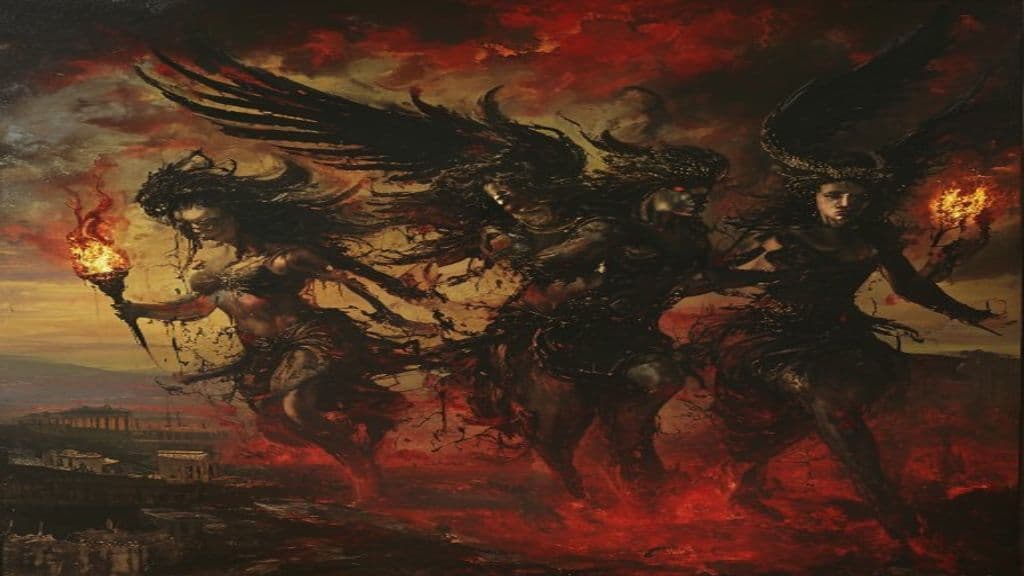
Descriptions vary across classical authors and periods. Early portrayals (e.g., Hesiodic tradition as transmitted in later summaries) may present them as lovely-haired winged maidens; later Roman and Hellenistic-era writers emphasize a grotesque composite: bird-bodied with the heads or faces of maidens, pale and emaciated from hunger, long taloned legs or hands, and sometimes described as 'human-vultures.' Hyginus, for example, records a hybrid anatomy with feathers, cocks' heads, wings, human arms, great claws, and human female breasts and bellies. Iconography and literary taste produce a spectrum from attractive winged women to repulsive, taloned snatchers.
Classical sources attribute to harpies swift flight and a nature as personified storm-winds; they 'keep pace with the blowing winds.' Their characteristic actions are seizing and snatching (their name is glossed as 'snatchers' or 'swift robbers'), stealing or defiling food, abducting and tormenting individuals, and acting as instruments of divine retribution — described as 'the hounds of mighty Zeus' or 'ministers of the Thunderer' who may carry evildoers to the Erinyes or to Tartarus. Accounts emphasize speed, aerial mobility, and the power to make sustenance unfit by foul contamination or to remove people suddenly from the human realm.
Weaknesses
- conditionvulnerable to pursuit and driving off by equal-or-greater flying beings (mythic precedent: the Boreads)
Wards
- otherintervention by divine or semi-divine aerial allies (example: the Boreads, sons of Boreas, who in the Phineus/Argonauts episode drive off harpies)
Aborigines (mythology)
A mytho-historical label used in Roman and general reference sources to denote the oldest inhabitants of a region (specifically central Italy in the cited Roman context). The term functions as an identity/category for original human populations rather than as a characterized supernatural being in the provided sources.
Aceso
Aceso (Ancient Greek: Ἀκεσώ, Akesó) is an ancient Greek goddess who personifies the process of healing and convalescence. She is attested as a daughter of Asclepius and Epione and was worshipped in healing centers such as Athens and Epidauros, appearing in sculptural reliefs alongside her family.
Achelous
Achelous is the personified river-divinity of the Achelous River in ancient Greek religion and mythology. Regarded among the potamoi (river-gods), he is portrayed as a shape-changing elemental deity associated with springs, naiads, and the production of abundance (the horn/cornucopia motif); he appears in myths chiefly as suitor to Deianeira and as Heracles' opponent.
Actia
Actia (Ancient Greek: Ἄκτια) is attested in the supplied sources not as a supernatural being but as (a) the ancient festival and epithet of Apollo Actius associated with Actium and Nicopolis, and (b) a modern taxonomic and commercial name (genus of flies; company and product names). No folkloric or mythic entity named Actia is documented in the provided materials.
Adikia
Adikia (Ancient Greek: Ἀδικία) is the personification and embodiment of injustice and wrongdoing in ancient Greek religious and visual culture, typically portrayed as the opposite and vanquished counterpart of the goddess Dike (Justice). She appears chiefly in archaic vase-paintings and emblematic visual programs where Justice punishes or restrains her.
Adonis
Adonis is a mythic mortal youth in ancient Greek tradition, beloved by goddesses (notably Aphrodite and Persephone) whose death and seasonal return are the focus of the women’s midsummer festival Adonia. The cultic practices—planting short-lived 'gardens of Adonis' on rooftops, ritual lamentation, and casting an effigy and withered plants into the sea—symbolically link him to vegetation cycles and Near Eastern dying-and-regenerating god traditions.
Adrasteia
Adrasteia is an ancient Anatolian/Greek goddess associated with mountain-mother cults and later identified with the Greek notion of inescapable fate and retributive necessity. She appears in Phrygian contexts as a mountain goddess connected to Cybele, in Cretan myth as a nurse of the infant Zeus, and by the fifth century BC is often equated or associated with Nemesis and other personifications of necessity.
Adrestia (Adrasteia)
Adrasteia (also Adrestia and multiple orthographic variants) is a figure in classical Greek tradition whose roles shift from a Phrygian mountain/mother-goddess probably associated with Cybele, to a Cretan nymph entrusted with nursing the infant Zeus, and by the fifth century BC identified with Nemesis as a deity/personification of divine retribution and balance.
Aeacus
Aeacus is a mythic king of the island of Aegina in Greek tradition, famed for his justice and piety. After death he is accorded a permanent office in Hades as one of the three judges of the dead alongside Minos and Rhadamanthus, and he is the eponymous ancestor of the Aeacidae.
Aegina
Aegina is an eponymous nymph of Greek mythology who personifies the island of Aegina in the Saronic Gulf. She is remembered primarily as the mother of the hero-king Aeacus and as the island’s mythical ancestress, anchoring local civic identity and cultic landscape.
Aeneads
A collective term in Roman myth for the friends, family, and companions of the Trojan hero Aeneas who fled Troy and wandered before settling in Italy; treated as a retinue and ancestral cohort rather than independent supernatural beings.
Aergia
Aergia (Ancient Greek: Ἀεργία) is the personification/goddess of sloth, idleness, indolence and laziness in Greco-Roman mythic thought. She appears in literary sources as a named personified quality and as an attendant or guardian in the household of Sleep (Hypnos/Somnus); Roman equivalents include Socordia and Ignavia.
Community Record
- [1]Harpy. Wikipedia article 'Harpy' (summary of classical sources, incl. Hesiod, Ovid, Virgil, Hyginus)wiki
- [2]Wikidata entry for harpies. Wikidata: Q181360 (harpies)other
- [3]Archive items (contextual/non-scholarly). Archive.org item referenced in research notes (not a primary classical source)other
- [4]Archive: CIA Reading Room NEAR EAST AND SOUTH ASIA REVIEW. Archive.org item referenced in research notes (not a primary classical source)other
- [5]Archive: CBS This Morning (KCCI). Archive.org broadcast referenced in research notes (not a primary classical source)other