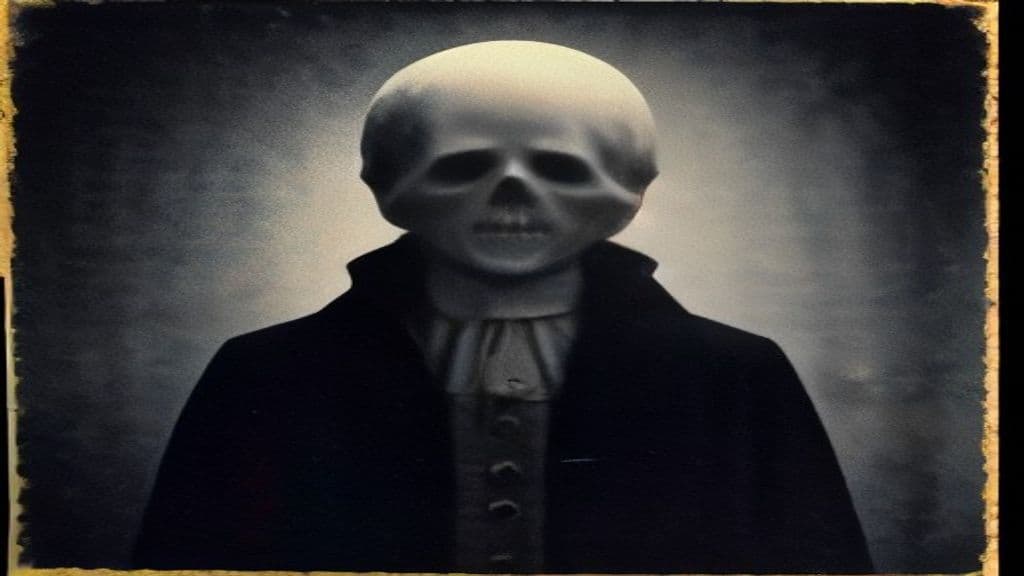
There is no single traditional origin preserved in the supplied sources. Folkloric accounts tie particular headless apparitions to violent or incomplete deaths at specific places—examples cited include the Headless Ghost of Faringdon Churchyard (linked in one local account to the death of Hamilton Tighe) and an account of a headless ghost seen in a Wiltshire lane. Separately, fictional treatments supply narrative origins: the 1959 film The Headless Ghost frames the spirit as wandering headless for 600 years until characters reunite its head and body, ending the haunting. The sources do not support a universal origin story for the motif.
The defining and consistent characteristic in the supplied material is the absence of a head. Other physical details vary by account and medium: a claimed photograph is described as showing "a headless ghost in an army coat," local retellings identify a headless apparition at a churchyard, and the 1959 film depicts a separable head and body that can be reunited. Clothing, posture and scale are inconsistent across sources and not standardized in the available documentation.
Documented behaviors in the sources are limited to haunting and wandering. Folkloric examples are place-bound hauntings tied to specific locations (churchyard, lane) and include reported sightings; the film depicts an extended period of wandering (explicitly "600 years of wandering about headless"). There is no detailed catalogue of supernatural powers (possession, offensive harm, speech) in the provided material. The film’s reunification of head and body functions as a narrative intervention rather than an attested folkloric power or weakness.
Weaknesses
- ritualreunification of head and body (fictional)
Wards
None recorded.
Hayagrīva
Hayagrīva (Sanskrit: हयग्रीव, IAST hayagrīva, lit. 'horse-necked one') is an avatāra of the Hindu preserver deity Viṣṇu, depicted with a human body and a horse head. In Vaishnava traditions he is chiefly venerated as the divine patron and restorer of sacred knowledge (the Vedas) and as a bestower of learning and intelligence; in some epic passages he also appears in a martial, cosmic form to vanquish demonic forces.
Hayk
Legendary patriarch and founder of the Armenian nation, considered an ancestral figure without supernatural powers. (Note: 1. Power tier should be set to "Primordial" since Hayk is considered an ancestral figure and a central part of Armenian mythology, implying a cosmic or foundational significance. 2. Sensory cues and w)
Haymon
A giant from Germanic folklore associated with the founding of Stift Wilten, a premonstratensian abbey. (Note: 1. The power tier should be Primordial, as it is described as a "giant" from Germanic folklore and associated with founding an abbey, implying a significant level of cosmic influence. 2. Add origin st)
Hayyi Rabbi
Hayyi Rabbi (Hiia Rbia, "The Great Life") is the supreme, singular divine Principle in Mandaean religion — the First Life and ultimate source of the Worlds of Light from which emanations, souls, and salvific guidance proceed. In Mandaean cosmology Hayyi is transcendent yet the origin of the Great Mana (over-soul) and presides as sovereign over lesser emanations who may act under delegation (e.g., Ptahil) in the formation of the material world.
Haʼ Kʼin Xook
Haʼ Kʼin Xook was an historical ajaw (ruler) of Piedras Negras in the Classic Maya period who reigned from 14 February 767 AD to 24 March 780 AD. He is known from monument inscriptions and stelae (noted for an accession monument and an image of the king dispersing incense) and is treated in the sources as a political-ritual figure rather than a supernatural being.
Haṃsa (Hamsa)
The haṃsa is a paradigmatic aquatic migratory bird in South Asian religious and philosophical literature, functioning both as an observed Anatidae-like bird (variously rendered as swan, goose, or flamingo) and as a metaphysical symbol of the soul, discriminative awareness, and liberation (moksha). It appears across Vedic hymns, Buddhist Jataka tales, Puranic and later Hindu iconography as a sacred, white bird and as the vahana (vehicle) of several deities.
Headless Priest
A restless apparition in Central American and Philippine popular belief: the decapitated Catholic cleric who returns as a night-haunting spirit tied to specific local histories, churches, roads, or buried goods. Stories function as moral warnings about sacrilege, clerical guilt, and improper handling of sacred matters.
Headless Rider (Kubinashi Rider)
A modern urban-legend revenant of a motorcyclist who suffered a decapitating accident and is said to reappear along the route or at the time of death, often riding a motorcycle without a head. The cycle adapts older headless‑rider motifs to motorized roadways and functions as a contemporary cautionary and liminal apparition.
Healfdene (Halfdan)
Healfdene (Old English) / Halfdan (Old Norse) is a legendary human king of the Scylding/Skjöldung lineage appearing in Old English and Old Norse sources. He functions as an ancestral ruler whose descendants (notably Hrothgar/Hróarr and Halga/Helgi) and the feuds around his succession structure later narrative events such as Beowulf and several Norse sagas.
Heardred
Heardred is a youthful Geatish prince who briefly becomes king of the Geats in the Old English epic Beowulf and related narrative traditions. He succeeds Hygelac after the latter's death, grants asylum to exiled Swedish princes, and is killed when King Onela of Sweden attacks to settle dynastic scores, leaving Beowulf to succeed him.
Heavenly Executioner Chiwoo
Heavenly Executioner Chiwoo is a fictional human protagonist of a Korean manhwa (comic) series titled 치우천하, presented as an action-fantasy story set in an imagined ancient-Korean milieu. The character is a streetwise youth who discovers his father was a mangnani (executioner) and adopts that stigmatized social role amid imperial persecution of executioners; the series is partly inspired by legends of the mythic figure Chiyou but treats Chiwoo as a literary/fictional character rather than a pre-modern supernatural being.
Heavenly host
A collective category in Abrahamic and Near Eastern texts naming an ordered assembly associated with the divine realm. The term can refer to the stars and other celestial bodies, to organized spiritual beings (angels) serving God, and is often described with military vocabulary (hosts, armies, commanders) that places the group within divine governance and occasional cosmic or earthly conflicts.
Community Record
- [1]The Headless Ghost of Hamilton Tighe. "The Headless Ghost of Faringdon Churchyard." Dark Oxfordshire.folk
- [2]Headless ghost | Ghostly photographs from Hauntings. Photographic claim described as "a headless ghost in an army coat." scienceofghosts.wordpress.comfolk
- [3]Mrs Stone and the Headless Ghost. "A headless ghost seen in a Wiltshire lane." Haunted Ohio Books (Mrs Stone and the Headless Ghost).folk
- [4]The Headless Ghost (film). "they reunite the head of the Headless Ghost with its body, thus ending its 600 years of wandering about headless." Wikipedia: The Headless Ghost.wiki
- [5]Headless ghost references in Halloween/graveyard media. Archive listings and playlists including headless/ghostly popular-culture material.other