
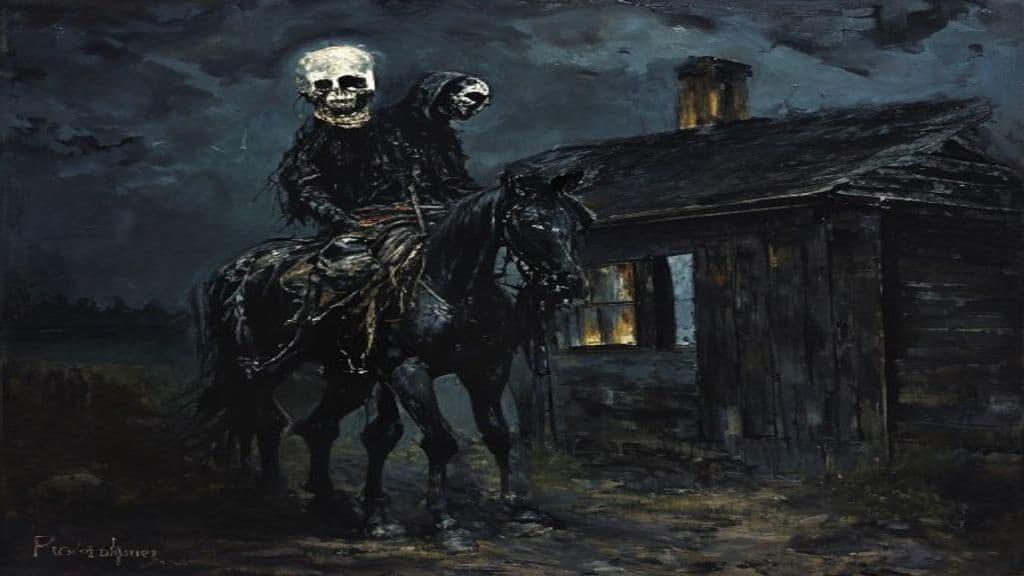
Accounts treat the Headless Rider as a post‑industrial transposition of older headless rider motifs: a motorcyclist who suffers a violent decapitation (in some tellings caused by a rope or piano wire stretched across a road) and whose body and machine continue to move for a time. Sources record competing origin theories circulating in the tradition — some attribute the spread of the motorcycle version to influence from the film Stone (reported in rumor histories), others to a stylized retelling of a real obstruction/accident — but these are presented by collectors and commentators as origin theories rather than established historical fact (Source citations: urban‑legend article and archive collections).
Core images in the cycle depict a motorcycle and rider continuing forward after a decapitating injury: the rider is described as lacking a head or neck (首なし kubinashi) and sometimes appearing without a helmet; archive testimony notes an archetypal sight of 'everything, it seems, but a helmet and head.' Variants include single headless riders, a 'headless biker gang,' or severed heads flying separately from bikes. Collectors also record skeptical explanations for some sightings, including misidentification of dark full‑face helmets and low, racing riding posture on supersport motorcycles (sources distinguish these perceptual variants from overtly supernatural descriptions).
The legend emphasizes repetition and localization: the Headless Rider reappears along the route or at the precise time/anniversary of the fatal accident, sometimes nightly. A central motif is the motorbike continuing to travel for a time after decapitation. Some tellings ascribe agentive motives — the apparition searches for a murderer or for the missing head — while comparative material from European headless horseman traditions adds motifs of seeking peace or vengeance. The being functions primarily as an episodic, localized revenant and as an omenic apparition tied to roads, bridges, and liminal travel spaces.
Weaknesses
- conditiondaylight / skeptical re‑interpretation
- otherperceptual explanations (dark full‑face helmets, riding posture, pranks)
- otherrational investigation and awareness (preventing misidentification)
Wards
- conditionawareness / skeptical explanation
Black‑Eyed Children
A modern American urban‑legend phenomenon describing childlike figures with completely black eyes who are reported to request entry to homes or rides. Presented in contemporary paranormal media and internet storytelling, accounts characterize them as allegedly nonhuman (undead, demonic, alien, or otherwise) but provide no empirical verification.
HMS Friday
HMS Friday is an urban myth — a contemporary maritime legend that purports to tell of a Royal Navy ship deliberately commissioned and sailed on Fridays to disprove the superstition that beginning a voyage on a Friday is unlucky. The story is false: there was never a Royal Navy ship named HMS Friday, and the tale functions as a folkloric cautionary anecdote rather than a historical event.
Phantom kangaroo
A modern folkloric and cryptozoological label applied to reports of kangaroos, wallabies, or their tracks appearing in places outside their native range. Accounts range from documented feral/introduced populations and escaped captive animals to sensational, apparitional, or misidentified sightings discussed in urban‑legend and Fortean contexts.
Hayyi Rabbi
Hayyi Rabbi (Hiia Rbia, "The Great Life") is the supreme, singular divine Principle in Mandaean religion — the First Life and ultimate source of the Worlds of Light from which emanations, souls, and salvific guidance proceed. In Mandaean cosmology Hayyi is transcendent yet the origin of the Great Mana (over-soul) and presides as sovereign over lesser emanations who may act under delegation (e.g., Ptahil) in the formation of the material world.
Haʼ Kʼin Xook
Haʼ Kʼin Xook was an historical ajaw (ruler) of Piedras Negras in the Classic Maya period who reigned from 14 February 767 AD to 24 March 780 AD. He is known from monument inscriptions and stelae (noted for an accession monument and an image of the king dispersing incense) and is treated in the sources as a political-ritual figure rather than a supernatural being.
Haṃsa (Hamsa)
The haṃsa is a paradigmatic aquatic migratory bird in South Asian religious and philosophical literature, functioning both as an observed Anatidae-like bird (variously rendered as swan, goose, or flamingo) and as a metaphysical symbol of the soul, discriminative awareness, and liberation (moksha). It appears across Vedic hymns, Buddhist Jataka tales, Puranic and later Hindu iconography as a sacred, white bird and as the vahana (vehicle) of several deities.
Headless Ghost
An apparition motif in modern folklore and popular media in which a once-living person manifests in the world of the living without a head. Attestations in the supplied sources include localized English hauntings (e.g., Faringdon churchyard, a Wiltshire lane), a claimed photograph, and a 1959 fictional film in which the spirit's head is reunited with its body.
Headless Priest
A restless apparition in Central American and Philippine popular belief: the decapitated Catholic cleric who returns as a night-haunting spirit tied to specific local histories, churches, roads, or buried goods. Stories function as moral warnings about sacrilege, clerical guilt, and improper handling of sacred matters.
Healfdene (Halfdan)
Healfdene (Old English) / Halfdan (Old Norse) is a legendary human king of the Scylding/Skjöldung lineage appearing in Old English and Old Norse sources. He functions as an ancestral ruler whose descendants (notably Hrothgar/Hróarr and Halga/Helgi) and the feuds around his succession structure later narrative events such as Beowulf and several Norse sagas.
Heardred
Heardred is a youthful Geatish prince who briefly becomes king of the Geats in the Old English epic Beowulf and related narrative traditions. He succeeds Hygelac after the latter's death, grants asylum to exiled Swedish princes, and is killed when King Onela of Sweden attacks to settle dynastic scores, leaving Beowulf to succeed him.
Heavenly Executioner Chiwoo
Heavenly Executioner Chiwoo is a fictional human protagonist of a Korean manhwa (comic) series titled 치우천하, presented as an action-fantasy story set in an imagined ancient-Korean milieu. The character is a streetwise youth who discovers his father was a mangnani (executioner) and adopts that stigmatized social role amid imperial persecution of executioners; the series is partly inspired by legends of the mythic figure Chiyou but treats Chiwoo as a literary/fictional character rather than a pre-modern supernatural being.
Heavenly host
A collective category in Abrahamic and Near Eastern texts naming an ordered assembly associated with the divine realm. The term can refer to the stars and other celestial bodies, to organized spiritual beings (angels) serving God, and is often described with military vocabulary (hosts, armies, commanders) that places the group within divine governance and occasional cosmic or earthly conflicts.
Community Record
- [1]Headless Rider urban legend (Wikipedia). Wikipedia, 'Headless Rider urban legend' (entries on kubinashi raidā, piano‑wire origin theory, film Stone influence, helmet misidentification, and 'see also' links to Dullahan and headless horseman motifs).wiki
- [2]Urban Legends (archive video testimony). Archive collection of urban‑legend testimony (includes the archetype quote 'everything, it seems, but a helmet and head' and discussion of anniversary bridge apparition).other
- [3]The Entities of Hirschsprung Gorge (archive). Archive on local headless horseman traditions at Hirschsprung Gorge; comparative material describing a nobleman cursed and 'seeking the peace and forgiveness he denied to others.'other
- [4]The Monsters of the Black Forest (archive). Archive recordings discussing regional headless rider traditions and comparative motifs in gorges and liminal travel sites.other
- [5]List of urban legends (Wikipedia). Wikipedia list classifying the Headless Rider as an urban legend and situating it in modern rumor cycles.wiki
- [6]Headless Rider (Megami Tensei Wiki). Fandom entry noting fictional/modern adaptations of the headless motorcycle rider motif in the Megami Tensei franchise.other
- [7]Durarara!! Vol. 1 review (UK Anime Network). Notes the use of a headless motorcycle rider as a major character in the Japanese light‑novel/anime Durarara!!; cited as an example of the motif's presence in popular media.other
- [8]Mythoi: Out Ride the Headless!. Modern commentary on headless rider motifs and their adaptation to motorcycles; used as contextual background on motif modernization and media influence.other