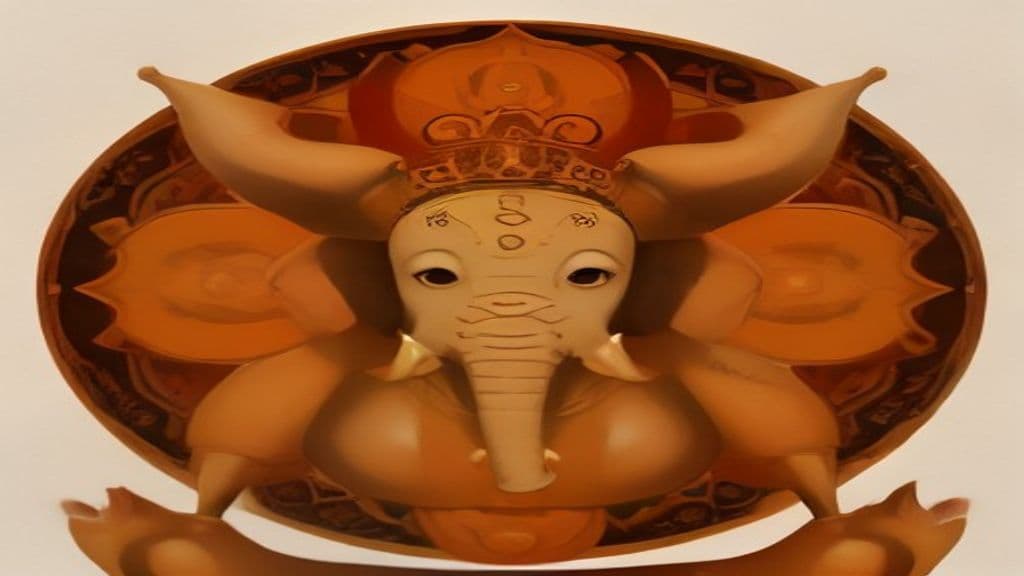
Heramba is not a separate being but an iconographic and sectarian manifestation of Ganesha (Ganapati) attested in Puranic and Ganapatya lists (e.g., Mudgala Purana, Brahma Vaivarta Purana, Padma Purana, Skanda Purana, Ganesha Purana, Cintyagama). The Brahma Vaivarta Purana provides an etymological gloss: the syllable he indicates helplessness or weakness and ramba protection, rendering Heramba the 'protector of the weak and good people.' He appears in canonical enumerations of Ganapati forms and in Tantric sectarian contexts rather than as an independent origin-mythic personality.
Heramba is described as a five-headed elephant-headed form of Ganesha — four heads facing the four cardinal directions and a fifth head above looking upward. He is said to be golden-yellow in color in standard descriptions, sometimes described as white. Iconography commonly renders him with ten arms holding attributes including a pasha (noose), his broken tusk (danta), an akshamala (prayer-rosary), a parashu (battle-axe), a three-headed mudgara (mallet), and a sweet (modak); two hands make Varadamudra and Abhayamudra. He rides a lion (his vahana); regional variants sometimes include Ganesha's rat (Dinka) alongside or beneath him, and occasional depictions show a consort seated on his lap or a garland/fruit among his held items.
Textual summaries and sectarian descriptions present Heramba as a protector of the weak who confers fearlessness and can bring defeat or destruction to enemies. In Tantric contexts he is associated with powerful ritual capacities; sources note an association between Heramba and the so-called six 'fearful abhichara rites' (abhichara) without supplying procedural details. Iconographically, his five heads are linked to the five aspects of Shiva (Ishana, Tatpurusha, Aghora, Vamadeva, Sadyojata), suggesting an integrative potency across those aspects in devotional and tantric interpretation.
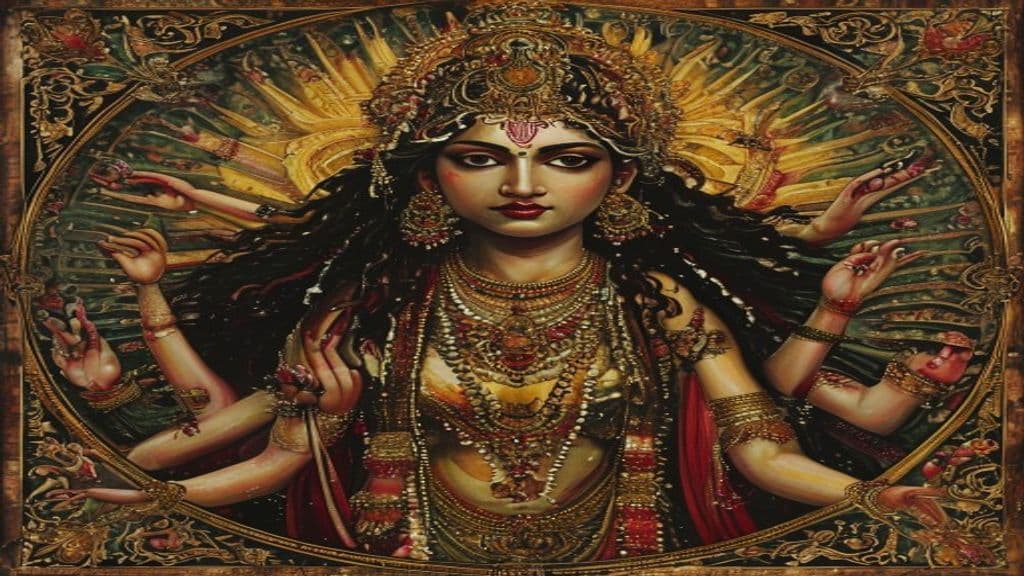
Parvati
Parvati is a principal goddess in Hindu tradition, worshipped as the consort of Shiva and as his shakti (divine power). She embodies a range of roles — devoted wife and mother, fertility and nourishment-giver, and in other manifestations a ferocious protector who destroys evil.
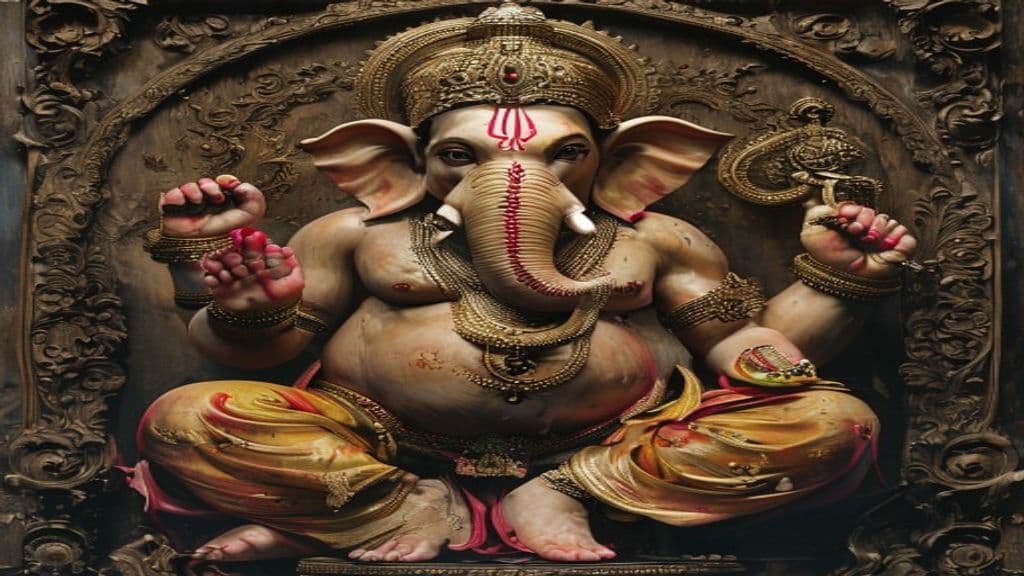
Ganesha
Ganesha (Gaṇeśa), also called Ganapati or Vinayaka, is a widely revered Hindu deity identified by an elephant head who functions as remover of obstacles, patron of arts and learning, and god of beginnings; he is son of Shiva and Parvati and head of the gaṇas in many traditional accounts.
Adi (asura)
Adi is attested in modern reference works as the name of an Asura who 'appears in the Matsya Purāṇa.' Beyond this single-line citation in secondary sources, no descriptive material about the figure is provided in the supplied research notes.
Adi Shakti
Adi Shakti (also Adi Parashakti, Mahadevi, Adya Shakti) is the primordial feminine power in Hindu/Shakta theology, regarded as the ultimate reality (Para Brahman) and the source from which all goddesses and gods manifest. She is both an impersonal cosmic principle (Mulaprakriti) and a focus of devotional invocation in temples, mantras, and pilgrimage sites such as Shakti Peethas.
Adi Vinayaka
Adi Vinayaka (Ādi Vināyaka; also called Nara Mukha Vinayaka) is a named iconographic and devotional form of the Hindu god Ganesha portraying the deity with a human head, described in sources as the form before the episode of decapitation by Shiva. It is rarely worshipped and appears in a small number of South Indian shrines and in devotional/musical repertoires.
Aditi
Aditi is a major Vedic goddess in Hindu tradition who personifies the boundless, infinite cosmic principle and functions as the maternal matrix from which many celestial deities (the Ādityas and other groups) are born. In the Vedic hymns she is invoked as a protective liberator who guards petitioners, provides wealth and safety, and frees devotees from hindrances such as sin and sickness.
Agni
Agni is the Vedic personification of fire in Hindu tradition: a sacred, mediating principle that manifests as terrestrial fire, atmospheric lightning, and celestial sun, and that receives and conveys sacrificial offerings. Prominent in the Rigvedic corpus, Agni functions as sanctifier, witness of rites of passage, and a transformational inner principle in later Upanishadic literature.
Ahalya
Ahalya is a mytho-legendary woman of South Asian (primarily Hindu) narrative tradition, described as created by the god Brahma, married to the sage Gautama, seduced (or tricked) by Indra, cursed by her husband, and ultimately redeemed by Rama. Her tale is a locus for themes of creation, desire, curse/penance, and redemption and she is counted among the ritual-mnemonic panchakanya.
Aindri (Indrani / Shachi / Paulomi)
Aindri (commonly rendered in sources as Indrani, also called Shachi or Paulomi) is a Hindu goddess presented as the queen-consort of Indra. She is depicted in the available material as a courtly queen associated with beauty, pride and kindness who also appears in at least one account as an active martial participant in the devas' battles with asuras.
Akshayavata
In Hindu mythology, Akshayavata is a sacred banyan tree and/or lake that symbolizes eternal life. It is mentioned in both Hindu and Jain traditions and associated with the Puranas. (Note: - The power tier should be "Greater" or at least "Ancient", as it is associated with the Puranas, which are considered ancient texts. - No specific physical description is provided, but that doesn't m)
Alakshmi
Alakshmi is an inauspicious female supernatural figure in Hindu tradition, presented as the negation or shadow-counterpart of the prosperity-goddess Lakshmi. She personifies poverty, grief, jealousy and social discord and is managed in domestic ritual and festival practice.
Alamelu
Alamelu (also Alamelu Manga / Alarmel Mangai) is a South Indian devotional name for the goddess Padmavati, identified in sources as an avatar of Lakshmi and the consort of Venkateswara; the name is also used widely as a female personal name and in titles of cultural works in Tamil and Telugu contexts.
Amrita (Buddhist tradition)
In the context of Indian religions, particularly within Hinduism and Buddhism, Amrita is a divine elixir that grants immortality and eternal life. (Note: - Power tier should be Ancient (deity-level), not Primordial. - Origin story appears accurate but lacks specificity on when Amrita was first mentioned in the Rigveda; add more detail. - Abilities are )
Ananta (Infinite)
Ananta (Sanskrit: अनन्त, 'without end') is primarily an epithet of Vishnu and a symbolic principle of infinity that is personified as the cosmic serpent Shesha. In Puranic imagery Ananta/Shesha forms the multi‑headed couch and canopy for Vishnu as he rests on the cosmic waters between cycles of creation (pralaya), and thus underwrites cyclical cosmogenesis.
Community Record
- [1]Heramba — Wikipedia. Heramba — Wikipedia article summarizing Puranic attestations, iconography, and worship context.wiki
- [2]Ganesha — Wikidata. Wikidata entry for Ganesha providing general attestations of Ganesha's identity as son of Shiva and Parvati and his functions.wiki
- [3]Heramba Ganesa — Mona (Nepal) artwork listing. Regional/art reference indicating continued artistic and votive interest in Heramba in Nepal.other