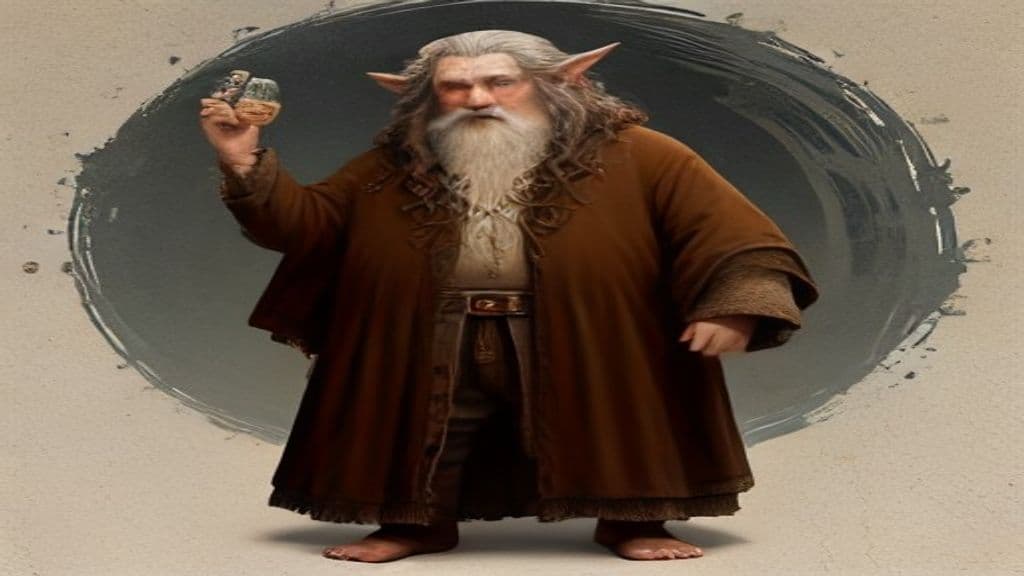
In Tolkien's invented-historical framework the name Hobbit is glossed as derived from Old English-style holbytla (plural holbytlan), meaning "hole-builder"; Tolkien used philological framing to situate them as a distinct people within his legendarium. Literary antecedents and possible inspirations (e.g., Edward Wyke Smith's Snergs, incidental earlier uses of the word in 19th-century sources, and contemporary literature) have been discussed by scholars, but Tolkien's published works present hobbits as his invented race rather than a recovered real-world folk entity.
Hobbits are described as between two and four feet tall (average about three feet six inches), generally stout though less stocky than dwarves, with slightly pointed ears. Most hobbits cannot grow beards (though some Stoors could), and their feet are covered with curly hair and leathery soles so they rarely wear shoes. They commonly dress in bright colours (favoring yellow and green) and many live in comfortable underground houses built into hillsides.
Hobbits are ordinary, corporeal people rather than supernatural beings: culturally skilled at domestic life, gardening, and homely crafts; described as adept at throwing stones and capable of stealth, endurance, practical resourcefulness, and unexpected courage or resilience when circumstances demand. They use commonplace items anachronistic to epic settings (e.g., umbrellas, matches, clocks, pipeweed). The supplied sources do not ascribe magical powers to hobbits.
Hitotsume-kozō
A class of Japanese yōkai depicted as a bald child or young monk with a single central eye; typically a mischievous, comparatively harmless apparition that startles people and appears in Edo-period picture-books, local tales, and calendar-based folk practices.
Hitotsume-nyūdō
A Japanese yōkai appearing as a one‑eyed ōnyūdō (large monk). Found in roadside and procession narratives, it is variously explained as an autonomous monkish spirit, a transformed or admonishing monk figure from Mount Hiei, or as a kitsune/tanuki disguise in local traditions.
Hiyang Athouba
A Meitei folkloric phenomenon in which a human corpse is said to transform into a demon-like, monstrous or vampire-like being. Described in folktales as arising from unattended or improperly tended deaths and usually reverted by daybreak or ended by proper funerary action.
Hiʻiaka
In Hawaiian religion, Hiʻiaka is a minor goddess and daughter of Haumea and Kāne. She is associated with the natural world and has sacred connections. (Note: * Power tier should be Minor Spirit (correct) * Origin story needs to be more specific, as the source only mentions parentage but not her role in ancient Hawaiian cosmology * Appearance and Abilities )
Hoaki
The supplied sources do not document Hoaki as a folkloric supernatural being. Most occurrences of the string "Hoaki" in the corpus are modern commercial or publishing names (e.g., Hoaki Books, imprint hoaki); one fragmentary Hocąk (Ho-Chunk) language text contains the sequence "Hoaki" but is unglossed and too incomplete to establish a mythic referent.
Hob
A household and local helpful spirit in northern English / northern Britain folklore, the hob is a capricious but essentially kindly presence associated with farms, households, and named local sites (e.g., 'hob-holes'). Hobs assist with domestic labour and healing when kept on good terms, but may withdraw their help if offended by particular actions (notably the gift of clothing).
Hod (Kabbalah)
Hod (Hebrew הוֹד, Hōḏ) is the eighth sephira on the Kabbalistic Tree of Life, traditionally rendered as 'majesty, splendour, glory'. In classical and later Kabbalistic schemata it functions as an abstract divine emanation or attribute concerned with form, order, and the structuring of intellect; later occult writers add correspondences such as Mercury and tarot links.
Hoderi (Umisachi-hiko)
Hoderi, also called Umisachi-hiko in some accounts, is a figure from the Kojiki and Nihon Shoki presented as a kami of the sea’s bounty and an enchanted fisherman. Son of Ninigi and Konohanasakuya-hime, he is associated with a magic fishing hook, a quarrel with his brother Hoori over exchanged sacred gifts, and is recorded as ancestor of the Hayato people.
Hodites
Hodites is a proper name attested in ancient Greek mythic sources and modern secondary summaries for a small number of distinct individuals: a centaur named among those at the wedding of Pirithous and Hippodamia (killed by Mopsus), a named combatant slain by Clymenus in the Perseus–Phineus conflict, and an alternative reading in a genealogical list where Diodorus Siculus (in citation) uses the name for one of the sons of Heracles and Deianeira. The name functions as an onomastic item in lists and episodes rather than as a recurring supernatural class.
Hodja Nasreddin’s evil twin (Ayna-Adam / Leylek) — Unverified
The supplied source contains no attested information about an evil twin of Hodja Nasreddin called Ayna-Adam or Leylek. The only material provided is a brief personal portrait of Hodja Nasreddin; therefore the existence, attributes, and rituals regarding an alleged evil twin are unverified in this source.
Hojir
Hojir (هُژیر) is a human heroic figure in the Persian epic Shahnameh: castellan of Dez-e Sepid, son of Goudarz, and participant in key Iran–Turan conflicts (notably the Rostam–Sohrab episode and the Davazdah Rokh). He is presented as a martial nobleman of a notable heroic family; no consistent supernatural attributes or cultic practices are attested in the supplied sources.
Holy Guardian Angel
In Christian theological and devotional contexts, the Holy Guardian Angel is an individually assigned angelic being appointed to protect and guide a particular person, group, or nation. The idea is embedded in the Christian angelic worldview and is commemorated liturgically (Memorial of the Holy Guardian Angels, 2 October).
Community Record
- [1]Hobbit (Wikipedia). Wikipedia contributors, "Hobbit," Wikipedia, The Free Encyclopediawiki
- [2]Hobbit (Wikidata). Wikidata item Q74359, 'Hobbit'other
- [3]Archive: 145. Hobbit on Hobbit. Archive.org item referencing 'Hobbit' materialsother
- [4]The Hobbit - book listings and related references. Online book listing referencing Tolkien's The Hobbitother
- [5]Various web references noting cultural and technical uses of 'Hobbit'. Wikipedia and associated web pages referenced in research notesother