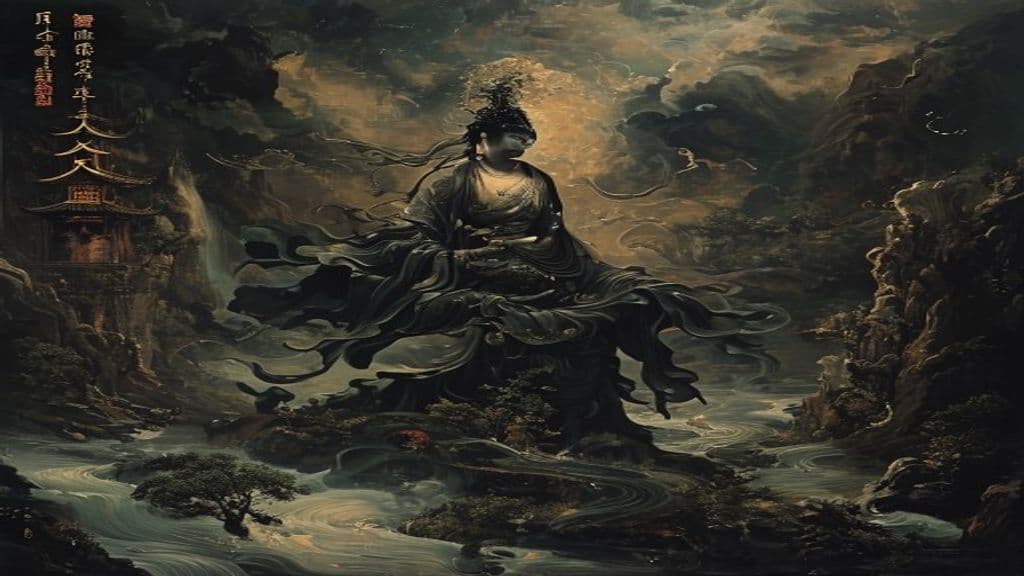
Huangmei Dawang is a powerful being mentioned in the 16th-century Chinese classic novel Journey to the West. Its connection to the future Buddha Maitreya implies significant spiritual authority and power.
No physical description available from reliable sources.
According to Journey to the West, Huangmei Dawang is capable of defeating high-level celestial beings due to its connection to the future Buddha Maitreya. This suggests a level of cosmic/world-altering power.
Weaknesses
- unknown
Wards
- unknown
Amida Nyorai
Amida Nyorai (Amitābha / Amitāyus) is a principal Mahayana Buddha venerated across East Asia as the embodiment of Infinite Light and Infinite Life who presides over a Western Pure Land and is invoked as the savior who receives the dying into rebirth there.
Amitābha
Amitābha is a central celestial Buddha of Mahayana Buddhism who presides over the western Pure Land called Sukhāvatī. Devotional practices invoking his 'measureless' light and life (nianfo/nembutsu) are presented in Pure Land traditions as a path by which beings may be reborn in his buddhafield and quickly attain Buddhahood.
Amoghasiddhi
Amoghasiddhi is one of the Five Tathāgatas (Five Wisdom Buddhas) in Mahayana and Vajrayana/Esoteric Buddhism, representing the Karma family and the quality of "unfailing accomplishment". He functions as an archetypal, protective, and contemplative buddha-body within tantric mandalas, presiding over the northern quarter and invoked in mantras and ritual iconography.
Aparajita (Wisdom King)
Aparajita is named in secondary sources as a member of the broad class of East Asian Buddhist 'wisdom kings'—wrathful protective emanations associated with Buddhas and bodhisattvas. The supplied materials do not provide a focused, primary textual profile for an individual Aparajita; most attestations address the wisdom-king category and the protective powers of dharani/mantra (notably the Shurangama Mantra).
Bhagavatī
Bhagavatī is an honorific Sanskrit epithet applied to revered female divinities in Hinduism and Mahayana Buddhism rather than a single individualized spirit. The title functions as a respectful form of address for goddesses such as Sarasvati, Lakshmi, Parvati and certain Buddhist female deities (e.g., Cundā) and is the feminine counterpart to Bhagavān.
Chang'e
Chang'e (嫦娥), originally attested as Heng'e and linked to the older name Chang Xi, is the female lunar immortal of Chinese myth who resides in the Moon Palace (廣寒宮). Best known from the elixir-of-immortality tale in which she ascends to the Moon and is accompanied there by the Jade Rabbit, she functions across religious and literary contexts as a lunar goddess/immortal and a poetic symbol of solitude and longing.
Chinese guardian lions (shī, 石獅)
Stone or metal sculptural guardian lions (Chinese: shī, often 石獅 shíshī "stone lion") placed in male–female pairs at thresholds to protect buildings and occupants. Originating in Chinese Buddhist and imperial symbolism, they function as apotropaic architectural emblems believed to ward off harmful spiritual influences and hostile humans when correctly placed.
Cintāmaṇi
A wish-fulfilling jewel in Hindu and Mahayana Buddhist traditions, described as a pearl-like object. (Note: 1. Power tier: "Primordial" may be too strong; the source describes it as a "wish-fulfilling jewel", which suggests deity-level power (Ancient) rather than cosmic. 2. Origin story: None provided, shou)
Diting
Diting (Chinese: 谛听; pinyin: Dìtīng) is a divine mythical creature in Chinese Buddhist hagiography traditionally described as the steed and attendant guardian of the bodhisattva Kṣitigarbha (Dizang). Described as a composite beast with extraordinary hearing and discernment, Diting is associated in legend with guarding hell and distinguishing truth from falsehood in support of Kṣitigarbha's salvific activities.
Hungry ghost (E gui)
Listed in a compiled catalogue of supernatural beings from Chinese folk culture and contemporary literature, 'hungry ghost (E gui)' appears as an itemized class of supernatural being in the provided sources. The supplied materials contain the name but do not give further descriptive or ritual detail.
Kalaviṅka
A Buddhist fantastical creature described as a human-headed, bird-bodied being famed for its exquisite, Dharma-preaching voice; represented across South, East, and Southeast Asian Buddhist art and liturgical contexts with regional iconographic variation.
Mahāsthāmaprāpta
Mahāsthāmaprāpta is a Mahāyāna bodhisattva associated with the Pure Land devotional tradition, commonly represented alongside Amitābha and Avalokiteśvara. His name is glossed in sources as 'arrival of the great strength' or 'one who has attained great power' and he is understood as embodying or representing the power of wisdom.
Community Record
- [1]