
Bhagavatī is not presented in the sources as a singular mythic originating personality but as the feminine honorific form of Bhagavān. The term is used interchangeably with other feminine divine titles such as Devi and Īśvarī and is applied to established goddesses in local and sectarian contexts; there is no single origin narrative recorded for 'Bhagavatī' as a unitary being in the provided material.
The sources do not record a consistent, unitary iconography for Bhagavatī. Appearance and forms vary by locality and the particular goddess to whom the epithet is applied: for example, in parts of Goa Bhagavatī is often worshipped in the form of Mahishasuramardini; Nepalese usages include forms such as Chinnamasta Bhagawati and Bhadrakali; Kerala temples refer to shrines as Bhagavati Kshetram. No single physical description is given in the supplied sources.
The supplied material does not attribute a standardized set of supernatural abilities to Bhagavatī as a single entity. Powers and behaviors depend on the specific goddess-form invoked under the title (e.g., knowledge-bestowing traits when applied to Sarasvati, wealth-aspect when applied to Lakshmi, martial/protective aspects when applied to forms like Mahishasuramardini). The sources do not enumerate abilities intrinsic to the honorific itself.

Apsara
Celestial dancers and water nymphs of Hindu cosmology — beautiful semi-divine beings who dance at the court of Indra and, by his command, descend to earth to distract sages from excessive asceticism.

Naga
Divine serpent beings of Hindu, Buddhist, and Jain cosmology — powerful guardians of water, earth, and underground treasures. Revered as deities in South and Southeast Asia.
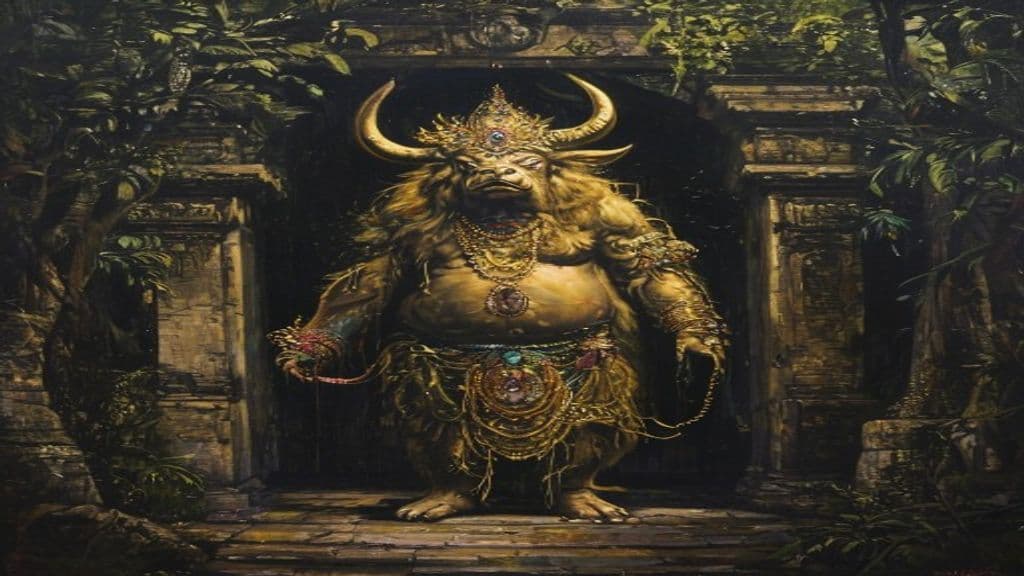
Yaksha
Nature spirits of Hindu, Buddhist, and Jain cosmology — guardians of forests, treasures, and wilderness. Ambivalent beings, capable of great benevolence to the respectful and terrible harm to the greedy.
Adi (asura)
Adi is attested in modern reference works as the name of an Asura who 'appears in the Matsya Purāṇa.' Beyond this single-line citation in secondary sources, no descriptive material about the figure is provided in the supplied research notes.
Adi Shakti
Adi Shakti (also Adi Parashakti, Mahadevi, Adya Shakti) is the primordial feminine power in Hindu/Shakta theology, regarded as the ultimate reality (Para Brahman) and the source from which all goddesses and gods manifest. She is both an impersonal cosmic principle (Mulaprakriti) and a focus of devotional invocation in temples, mantras, and pilgrimage sites such as Shakti Peethas.
Adi Vinayaka
Adi Vinayaka (Ādi Vināyaka; also called Nara Mukha Vinayaka) is a named iconographic and devotional form of the Hindu god Ganesha portraying the deity with a human head, described in sources as the form before the episode of decapitation by Shiva. It is rarely worshipped and appears in a small number of South Indian shrines and in devotional/musical repertoires.
Aditi
Aditi is a major Vedic goddess in Hindu tradition who personifies the boundless, infinite cosmic principle and functions as the maternal matrix from which many celestial deities (the Ādityas and other groups) are born. In the Vedic hymns she is invoked as a protective liberator who guards petitioners, provides wealth and safety, and frees devotees from hindrances such as sin and sickness.
Agni
Agni is the Vedic personification of fire in Hindu tradition: a sacred, mediating principle that manifests as terrestrial fire, atmospheric lightning, and celestial sun, and that receives and conveys sacrificial offerings. Prominent in the Rigvedic corpus, Agni functions as sanctifier, witness of rites of passage, and a transformational inner principle in later Upanishadic literature.
Ahalya
Ahalya is a mytho-legendary woman of South Asian (primarily Hindu) narrative tradition, described as created by the god Brahma, married to the sage Gautama, seduced (or tricked) by Indra, cursed by her husband, and ultimately redeemed by Rama. Her tale is a locus for themes of creation, desire, curse/penance, and redemption and she is counted among the ritual-mnemonic panchakanya.
Aindri (Indrani / Shachi / Paulomi)
Aindri (commonly rendered in sources as Indrani, also called Shachi or Paulomi) is a Hindu goddess presented as the queen-consort of Indra. She is depicted in the available material as a courtly queen associated with beauty, pride and kindness who also appears in at least one account as an active martial participant in the devas' battles with asuras.
Akshayavata
In Hindu mythology, Akshayavata is a sacred banyan tree and/or lake that symbolizes eternal life. It is mentioned in both Hindu and Jain traditions and associated with the Puranas. (Note: - The power tier should be "Greater" or at least "Ancient", as it is associated with the Puranas, which are considered ancient texts. - No specific physical description is provided, but that doesn't m)
Alakshmi
Alakshmi is an inauspicious female supernatural figure in Hindu tradition, presented as the negation or shadow-counterpart of the prosperity-goddess Lakshmi. She personifies poverty, grief, jealousy and social discord and is managed in domestic ritual and festival practice.
Alamelu
Alamelu (also Alamelu Manga / Alarmel Mangai) is a South Indian devotional name for the goddess Padmavati, identified in sources as an avatar of Lakshmi and the consort of Venkateswara; the name is also used widely as a female personal name and in titles of cultural works in Tamil and Telugu contexts.
Amida Nyorai
Amida Nyorai (Amitābha / Amitāyus) is a principal Mahayana Buddha venerated across East Asia as the embodiment of Infinite Light and Infinite Life who presides over a Western Pure Land and is invoked as the savior who receives the dying into rebirth there.
Amitābha
Amitābha is a central celestial Buddha of Mahayana Buddhism who presides over the western Pure Land called Sukhāvatī. Devotional practices invoking his 'measureless' light and life (nianfo/nembutsu) are presented in Pure Land traditions as a path by which beings may be reborn in his buddhafield and quickly attain Buddhahood.
Community Record
- [1]Bhagavati - Wikipedia. Wikipedia contributors, 'Bhagavati', Wikipedia, The Free Encyclopediawiki
- [2]Bhagavatī (Wikidata). Wikidata entry Q1939506, 'Bhagavatī'wiki
- [3]Adhunik Veer Kavya By Bhagavati Prasad Vajpeyi. Archive.org listing for Adhunik Veer Kavya by Bhagavati Prasad Vajpeyiother
- [4]Sri Govinda Lilamrita by Srila Krishnadas Kaviraj Goswami. Archive.org listing for Sri Govinda Lilamritaother
- [5]Akhand Jyoti Pragya Yoga Adhyatma Vigyan (Sept 1982) edited by Bhagavati Devi Sharma. Archive.org listing for Akhand Jyoti Pragya Yoga Adhyatma Vigyan, Issue 6, Volume 45 (Sept 1982)other