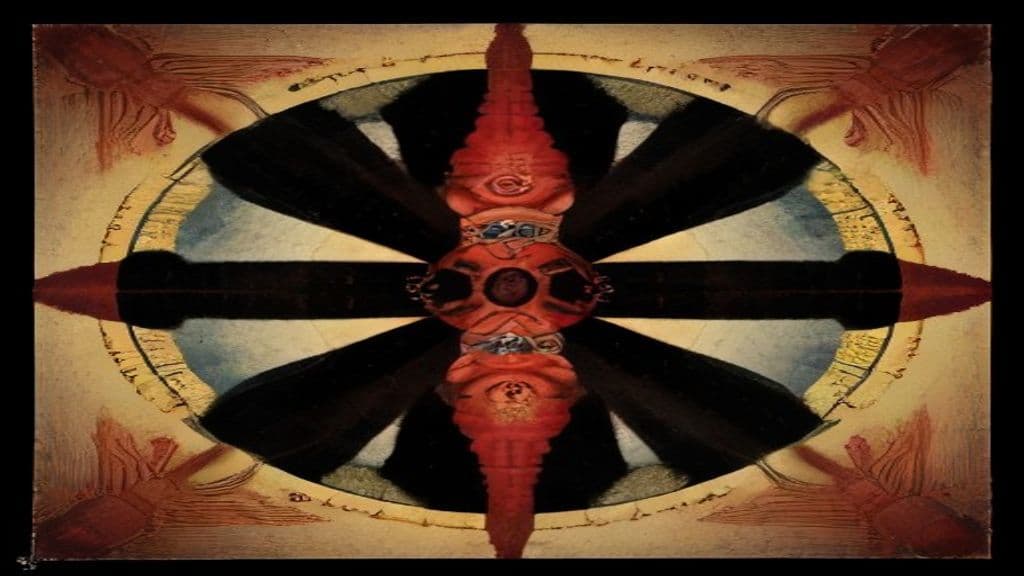
Sources present Itzamná as an upper god and creative figure in Maya cosmology. In various traditions he is credited with creative acts — including, in some accounts, creation of humankind — and with instituting priestly arts such as writing. Early‑colonial authors and the codices treat him as an elevated celestial resident seated on a throne and as a foundational patron of priestly and calendrical authority; colonial summaries sometimes associate him with invisible supreme figures (Hunab Ku) or sun aspects (Kinich Ahau), indicating flexible identifications in post‑contact texts.
Iconography and codical imagery show multiple, overlapping appearances rather than a single fixed form. He is attested as an aged, tonsured maize‑god aspect; as a Principal Bird Deity (an avian manifestation sometimes called Yaxcocahmut) whose wings bear signs for daylight and night and which may hold a two‑headed snake; and as the head placed within the maw of a two‑headed caiman (Dresden Codex New Year pages) linking him to an earth/caiman figure (Itzam Cab Ain). He is also depicted dressed as a high priest and seated on a celestial throne in codices and Classic monuments. Classic narrative scenes sometimes show him in ambivalent positions (e.g., grasping game, prepared for sacrifice, or in his bird aspect being shot), indicating a range of visual roles.
Documented roles and functions include creator acts, invention or patronage of priestly arts (including writing), governance over agricultural and hunting concerns, and patronage of ritual time (involvement in specific ritual months and a four‑year cycle year). Iconographic and codical evidence shows him identified with multiple domains (sky, maize, bird, caiman/earth) and with calendrical and medical ritual invocation (e.g., invoked as one of the gods of medicine). Sources record human appropriation of his name and regalia by rulers and priests — an institutional identification rather than literal shapeshifting. Modern popular sources sometimes ascribe extensive superhuman powers, but such modern claims are not corroborated by the cited primary codical and early‑colonial material.

Howler Monkey Gods
Paired supernatural patrons in Classic and Postclassic Maya religion who oversee scribal arts, sculpture, music, and related ritual knowledge; personifications of the day-sign Batz in calendrical/divinatory contexts and remembered in colonial-era narratives such as the Popol Vuh and accounts by Bartolomé de las Casas.
Kʼinich Ahau
Kʼinich Ahau is the Classic and post‑Classic Maya sun deity — a personified solar force associated with the day, calendrical patronage, rulership/apotheosis, and a set of iconographic types (monumental stucco masks, codex imagery of 'God G', and aquatic/eastern sunrise scenes). He appears in epigraphic, colonial, and modern Lacandon traditions with overlapping cosmological roles rather than a single fixed persona.
Way (wayob)
Way (plural wayob) is a Yucatec Maya term denoting a human-linked animal-being tied to sleep; it can mean a person who transforms into an animal while asleep (a Mesoamerican nagual) or the animal transformation/companion itself. Wayob appear in Classic Maya iconography (marked by a special hieroglyph) and are recorded in later Yucatec usage and museum interpretation as both harmful nocturnal agents and as ritual companions for rulers on journeys to the Otherworld.
Istämi
Istämi was a 6th-century Turkic ruler who governed the western portion of the Göktürk realm as a yabghu and is retrospectively referred to as a khagan. He exercised de facto sovereignty in the west, dominated Sogdian subjects there, defeated the Hephthalites, and engaged in high-level diplomacy with Sassanid Persia and Byzantium (including sanctioning a Sogdian embassy to Constantinople in 568).
It! The Living Colossus
It! The Living Colossus is a fictional 100-foot stone humanoid statue from Marvel Comics (originally Atlas) that becomes animate when inhabited or controlled by transferred minds (a stranded alien Kigor or human Bob O'Bryan). Functioning as a monumental constructed object rather than an indigenous supernatural being, it has been used alternately as a rampaging weapon and as a vehicle of human agency across multiple comic-storyline revivals.
Itonus
Itonus is an eponymous figure in Greek myth, appearing in two distinct genealogical traditions as a king and ancestor tied to the settlement Iton in Phthiotis and to a local sanctuary of Athena. The name is glossed in modern summaries as Ἴτωνος (romanized Itonos / Itonus) and has been interpreted as having willow associations in some scholarly reconstructions, but classical sources present him primarily as a mortal founder/ancestor rather than an independent supernatural spirit.
Ittan-momen
Ittan-momen (一反木綿, "one bolt of cotton") are Japanese yōkai traditionally described in Kagoshima folklore as a white, flying strip of cloth (reported roughly 10.6 m by 30 cm) that appears at dusk and night, wrapping around faces and necks to suffocate or carry victims away. The motif functions chiefly as a local cautionary tale and has been reimagined in modern popular culture.
Itzam Kʼan Ahk II
Itzam Kʼan Ahk II (born 18 Nov 701 – died 26 Nov 757) was an ajaw (king) of the Late Classic Maya polity Piedras Negras. He is attested in multiple stelae and panel inscriptions as a political and ritual actor who celebrated calendrical rites, engaged in regional diplomacy and warfare, and was buried at a sacred mountain (identified with Pyramid O-13) whose tomb and associated monuments were venerated by successors.
Itūr‑Mēr
Itūr‑Mēr is an Old Babylonian-era tutelary deity of the city of Mari (Tell Hariri), closely associated with the royal house of Zimri‑Lim. He functions in civic religion as a guardian of oaths, a protector of the city and dynasty, an agent in forensic revelation, and—in limited attestations—a healer.
Iunit
Iunit is a minor ancient Egyptian goddess whose name is translated as "She of Armant" and who is attested as the consort (wife) of the war-god Montu (also spelled Mentu). Surviving references are brief and localizing; no substantial myths, iconography, or cultic rites for Iunit are recorded in the supplied sources.
Iusaaset
Iusaaset is a primordial female deity from the Heliopolitan creation tradition of Ancient Egypt, presented as a feminine counterpart or aspect of the creator Atum and associated with the emergent, growth-related side of creation and abundance.
Iwin (Yoruba forest spirits/ogres)
No evidence for a Yoruba supernatural entity named 'Iwin' was found in the supplied sources. The available materials that contain the string 'Iwin' refer to unrelated modern place names and commercial game sites, not to Yoruba cosmology or spirits.
Community Record
- [1]Itzamna (Wikipedia). Wikipedia: 'Itzamná ... is, in Maya mythology, an upper god and creator deity thought to reside in the sky.' and related sections on name, iconography, and ritual months.wiki
- [2]Itzamna (Wikidata). Wikidata entry summarizing cataloging of Itzamna as creator deity.wiki
- [3]Diego de Landa summaries (as cited in secondary sources). Colonial summaries reported in secondary accounts: ritual aspersion of books in Uo under 'Kinich Ahau Itzamná'; invocation in Zip as a god of medicine; veneration in Mac alongside Chaacs.other
- [4]Dresden and Paris Codices; Classic iconography (summarized). Summaries noting the placement of Itzamná's head within a two‑headed caiman on Dresden Codex New Year pages, Principal Bird Deity transformation in the Paris Codex and San Bartolo murals, and Classic monument attestations.other
- [5]Marvunapp appendix (popular summary — non‑academic). Modern popular summary that attributes extensive superhuman powers; cited as non‑scholarly and not corroborated by primary codical/colonial materials in the provided notes.other