
Sources within the Hindu epic and Puranic corpus present Jambavan as originating in primeval events: one native explanation states he 'emerged from the mouth of Brahmā when the creator deity yawned,' while other accounts link his name to Jambudvīpa (the classical name for the central land of the world), either as place-of-birth or eponymous association. These accounts place him among beings produced in the universe's early narrative frame and explain his exceptional antiquity and presence at multiple avatāric episodes.
Literary sources and pictorial tradition identify Jambavan as a bear or as a bear-king (rājā of the rikshas/bear-people). Epic passages and Ramayana folios show him anthropomorphic and bear-like, leading or accompanying vanara (monkey) figures such as Hanuman and Sugriva; however the supplied material does not fix particulars such as fur color, exact stature, or other detailed anatomical traits, instead emphasizing his royal bearing and leadership among bears.
Narrative sources attribute great longevity (he is described as surviving across ages and present at events from Samudra Manthana to both the Ramayana and Krishna-era episodes), formidable martial strength (episodes report him wounding or confronting powerful rakshasas such as Ravana and his generals and engaging in prolonged combat with Krishna over the Syamantaka gem), and sage-like wisdom and mentorship (notably persuading Hanuman to realize his powers and leap to Lanka). Accounts differ on combat duration with Krishna—Bhagavata Purana traditions give 27–28 days, Vishnu Purana 21 days—after which Jambavan recognizes Krishna and submits, giving the gem and his daughter Jambavatī in marriage to Krishna.
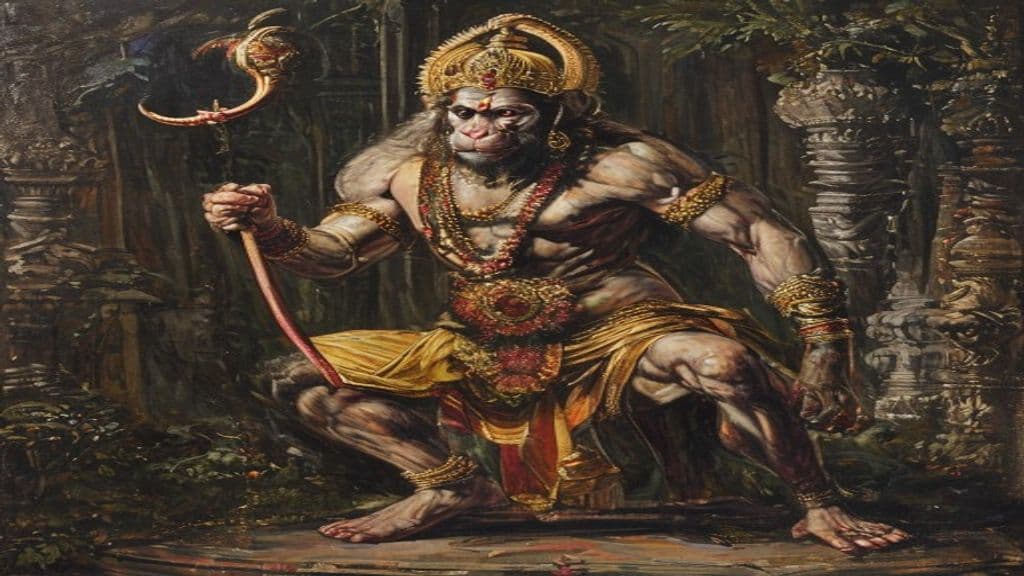
Hanuman
Hanuman is a divine vanara (monkey‑like being) in Hindu literature, foremost companion and devoted servant (Rama-dūta) of Lord Rama in the Ramayana. Revered in later Bhakti traditions, he is worshipped as a protector and exemplar of devotion, strength, and service.
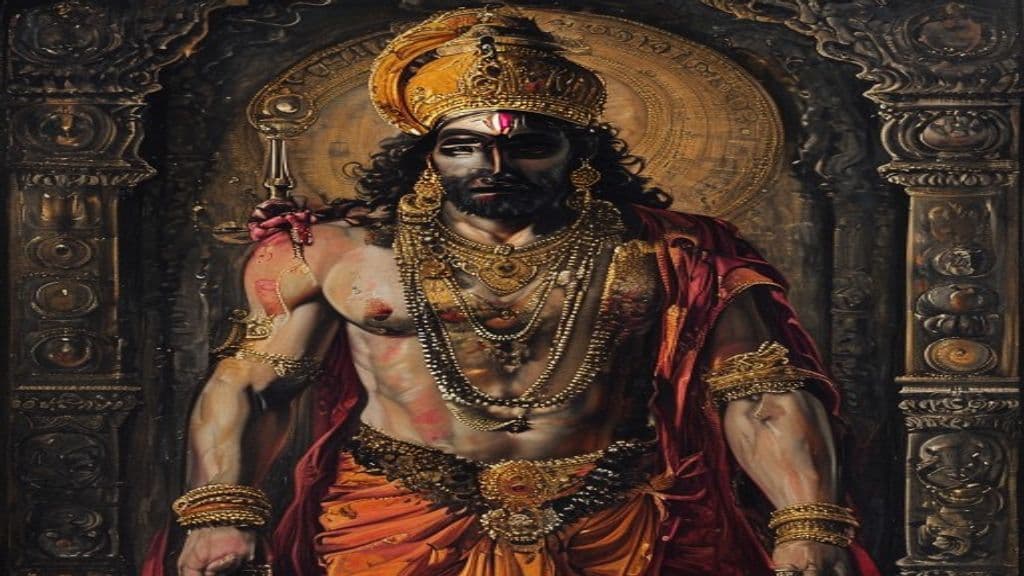
Rāma
Rāma is a major divine-hero in Hindu tradition, worshipped as the seventh avatar of Viṣṇu and the central protagonist of the Ramayana. He is portrayed both as the ideal man (maryāda puruṣottama) and, in Rama-centric sects, as the Supreme Being; his life-story (birth in Ayodhyā, 14-year exile, Sītā's abduction, and the defeat of Rāvaṇa) functions as a primary exemplar of dharma.
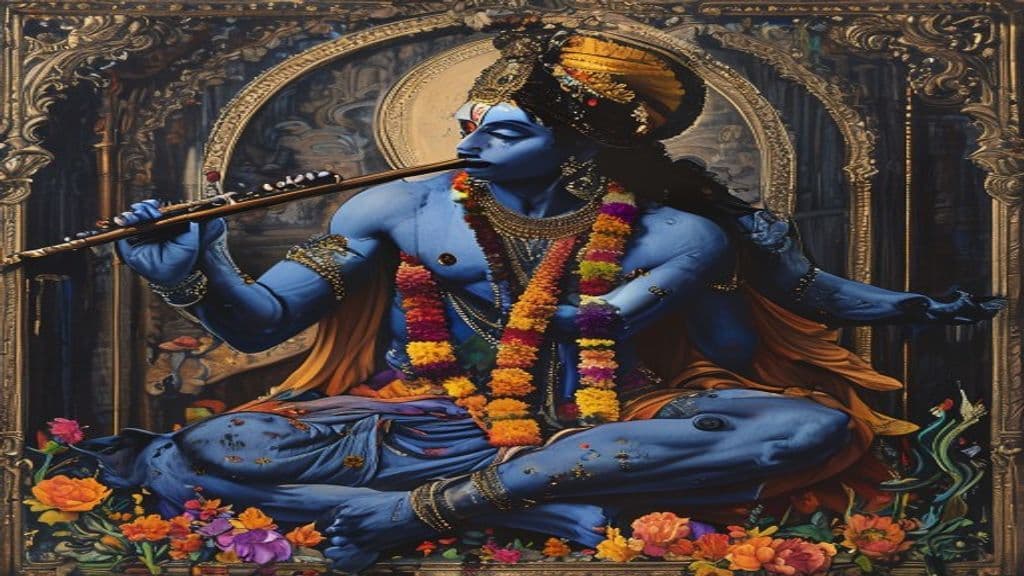
Krishna
Krishna (Sanskrit: Kṛṣṇa) is a major Hindu deity presented in the supplied sources both as the eighth avatāra of Vishnu and, in many traditions, as the Supreme Being (Svayam Bhagavān). He appears in a range of roles—child, cowherd, lover, charioteer, teacher and divine hero—and his life episodes (Krishna-līlā) are central to bhakti devotion, performance arts, and pilgrimage traditions.

Rakshasa (Himalayan variants)
A Himalayan reception of the pan-Indian rakshasa motif: hostile or disruptive non‑human beings known from Sanskrit epic and Puranic literature, here noted where Himalayan sources and discussions intersect with the broader epic tradition. The supplied sources do not document distinct, well‑attested Himalayan folklore variants; the entry therefore presents primarily the epic/legendary profile as transmitted into Himalayan contexts in general references.
Bharata (Ramayana)
Bharata is the younger half-brother of Rāma in the Hindu epic Rāmāyaṇa, who refuses the throne after Rāma's exile and serves as regent of Ayodhyā from Nandigrāma, ruling in Rāma's name while living an ascetic life. In devotional and pilgrimage traditions he is also assimilated into divine schema—described in some sources as an incarnation of Viṣṇu's Panchajanya and presented among the quadruple expansion of Rāmācandra.
Jaṭāyu
Jaṭāyu is a demigod in the Hindu epic the Rāmāyaṇa who takes the form of a vulture. He is presented as the younger son of Aruṇa and Shyeni, brother of Sampati, and fought Rāvaṇa in an attempt to rescue Sītā before dying of wounds; Rāma performs his final funeral rites.
Kumbhakarna
Kumbhakarna is a gigantic rakshasa featured in the Hindu epic Ramayana as a younger brother of Ravana, famed for prodigious size, an enormous appetite, great martial prowess, and a supernatural sleep pattern produced by a divine curse/boon; he recognizes Rama's divinity but fights out of loyalty and is slain by divine weapons during the war.
Jadis (the White Witch)
Jadis, commonly called the White Witch, is a fictional antagonist created by C. S. Lewis who rules Narnia as a sorceress-queen and whose magic enforces the prolonged 'Hundred Years Winter.' She is the principal opposing force in The Lion, the Witch and the Wardrobe (1950) and is a central figure in The Magician's Nephew (1955).
Jagaddhātrī
Jagaddhātrī is a name used in Bengali cultural production and, in one classificatory source, identified as an aspect of the Hindu goddess Durga. In the supplied materials the term appears in bibliographic records of Bengali-language books and as the title of a contemporary Bengali television series; the sources do not provide ritual, iconographic, or narrative detail about the figure.
Jah (Yah)
Jah or Yah (Hebrew: יָהּ, Yāh) is the short form of the Tetragrammaton (יהוה, YHWH), the personal name of the God of Israel (commonly vocalized as Yahweh). It functions as an abbreviated theonym appearing in Hebrew scripture and liturgical formulas (notably hallelujah) and is used in prayer, praise, and religious study rather than as an independent folkloric being.
Jahangirnama (Qasim Madih Harawi)
Epic poem written in Persian, detailing the story of Jahangir son of Rostam, composed in Herat and published in Mumbai. (Note: - Power tier: Primordial (given its cosmic scope and ancient origin) - Origin story: The source material provides the information on its origin, stating it was composed in Herat. - Appearance: Not app)
Jakhin
No information about a South Asian folk entity named Jakhin is present in the provided source. The archival document supplied is a corrupted or unrelated bibliographic/technical fragment and contains no references to Jakhin, its attributes, rituals, or cultural context.
James Bartley (whale story)
A late-19th-century maritime wonder tale circulated in newspapers claiming a whaler named James Bartley was swallowed whole by a sperm whale and later found alive in its stomach; later investigation and archival evidence cast significant doubt on the historicity of the incident. The story functions culturally as a 'modern Jonah' sea yarn rather than as an account of a supernatural being.
Jan Turpin
No folkloric supernatural entity named Jan Turpin is attested in the provided sources. The corpus contains two human-name references (Jordan Turpin; Benny Turpin) and a single terse Wikidata label linking a phrase 'giant of Nieuwpoort, Belgium' to an item associated with the label; these materials do not establish a coherent folkloric figure.
Janaka
Janaka is a legendary and dynastic king of Videha (capital Mithila) who functions in Indic sources as an exemplar of ideal kingship and spiritual realization—a ruler who combines political authority, patronage of Vedic learning, and non-attachment. The name is used both as a regnal title for Videha's kings and as the personal/regnal name of the famous monarch who is the adoptive father of Sītā in the Rāmāyaṇa.
Jangsanbeom (Jangsan tiger / Jangsan spirit)
The name Jangsanbeom (often rendered in English as 'Jangsan tiger' or 'Jangsan spirit') appears in a contemporary South Korean cultural product (the 2017 film The Mimic). The single provided source references only the film and does not supply traditional folkloric details about the entity; further research into primary folkloric materials is required to determine whether Jangsanbeom is an established traditional being or a modern invention for the film.
Community Record
- [1]Jambavan. Wikipedia, 'Jambavan' entrywiki
- [2]Jāmbavān (Wikidata). Wikidata item Q1642905other
- [3]Jambavan (encyclopedia entry, mythfolklore.net). Mythfolklore.net encyclopedia entry on Jambavanfolk
- [4]Lakshmana and Sugriva Being Carried by Palanquin to Receive Rama's Blessings (Ramayana folio). Archive.org — Ramayana folio item noting depiction of Hanuman and the bear king Jambavanliterary
- [5]The Syamantaka Ruby / Jambavan–Krishna combat (summary). Online summary of the Syamantaka narrative and Jambavan's fight with Krishnaother
- [6]Valmiki Ramayana - Yuddha Kanda - Sarga 74 (prose translation). Valmiki Ramayana, Yuddha Kanda referenceliterary
- [7]Archive: Gods and Monkeys (ep. 181). Archive.org item referencing Ramayana and related artother
- [8]Jambavati (Wikipedia). Wikipedia entry on Jambavatī (daughter of Jambavan who marries Krishna)wiki