
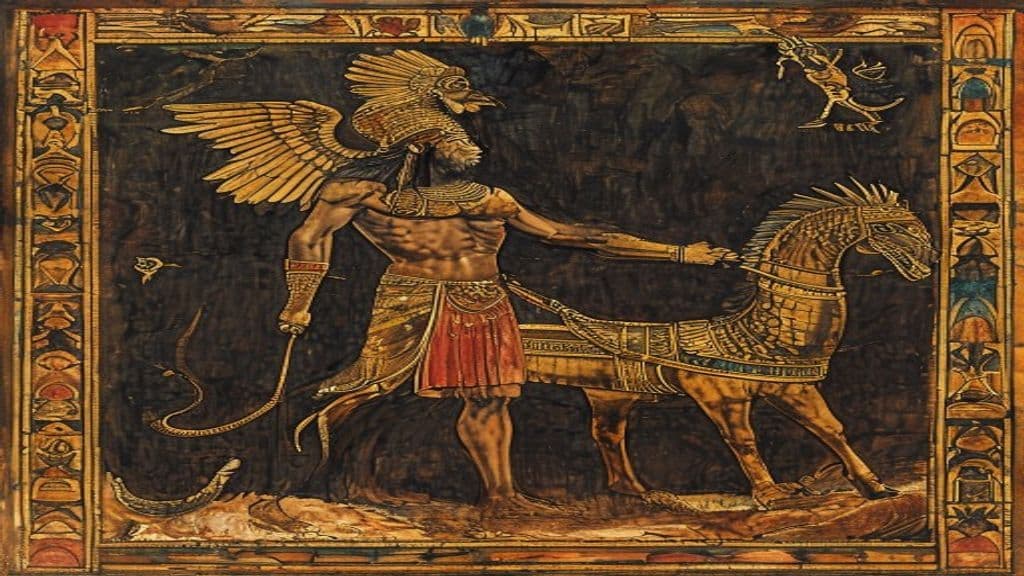
Kajamānu originates within Mesopotamian astronomical-theological practice as the name for the visible planet Saturn. The Akkadian name ka-a-a-ma-nu is glossed in sources as 'the constant,' indicating the term encoded perceived qualities of the planet. In Mesopotamian thought planetary bodies were observed, named, and integrated into religious relations; Kajamānu is specifically attested as being 'regarded as the star of Ninurta,' showing how an observed wandering star became relationally tied to a major deity. Over time the name and concept were transmitted into neighboring linguistic and religious worlds (e.g., Mandaean Kiwan, Persian Kayvan, Syriac Kēwān) and incorporated into later seven-planet systems.
In the provided sources Kajamānu is described as the astronomical planet Saturn—the visible 'wandering star' observed in the sky—rather than as an anthropomorphic or vividly iconographic being. A Sumerian form (Uduimin-saĝuš) and Akkadian forms are recorded; no anthropomorphic physical description or detailed iconography is given in the supplied materials.
The supplied material does not attribute narrative supernatural powers to Kajamānu beyond its status as the planet Saturn and its cultic/astral association with Ninurta. Within Mesopotamian practice more generally, planets served as tracked celestial bodies used in omen interpretation and formed part of divine entourages; the sources attest Kajamānu's role as an identifiable member of that astral framework but do not provide specific omen-lists or powers for this planet in the excerpts provided.
Kahumatamomoe
A revered Māori rangatira and ancestral figure associated with the upper North Island of New Zealand. (Note: 1. Power tier should be Primordial, as there is no indication of supernatural powers beyond those of a human leader. 2. Appearance should state "No physical description available" instead of making an)
Kahungunu
Kahungunu is a historical Māori ariki (chief) and eponymous ancestor of the Ngāti Kahungunu (and linked groups such as Te Aitanga‑a‑Māhaki) whose life‑narratives anchor whakapapa, land rights, and tribal identity. Traditionally placed in the waka Tākitimu lineage, he is portrayed as an industrious, physically large and capable chiefly founder active in settlement, warfare, courtship, and resource management, probably living around the late fifteenth century according to the sources.
Kahutara (Māori canoe)
A historical Māori waka (canoe) used for oceanic voyaging and migrations in New Zealand. (Note: 1. Power tier: Primordial (Kahutara is a specific canoe, not a cosmic entity) 2. Origin story: Add source to support the origin story 3. Abilities: Clarify or rephrase "facilitated migrations" to be m)
Kai Khosrow
Kai Khosrow is a legendary Kayanian king in Persian epic tradition, chiefly known from the Shahnameh and related material. He is remembered as the rightful heir who returns from exile, avenges his father Siavash, and rules Iran while repeatedly opposing the Turanian king Afrasiab.
Kaikeyī
Kaikeyī is a human royal figure in the Sanskrit epic Rāmāyaṇa: a princess of Kekeya who becomes queen consort of Kosala by marrying King Daśaratha. She is politically powerful among Daśaratha's wives; her invocation of two boons precipitates Rama's fourteen-year exile, Daśaratha's death, and the ensuing dynastic crisis, after which she repents and is forgiven.
Kaitangata (Māori mythology)
In Māori mythology, Kaitangata is a liminal figure occupying a space between mortality and divinity as either a mortal son of the demigod Māui or a son of Rehua, a star-god. His role reflects the cultural importance of genealogical relationships between humans and gods in Māori culture. (Note: * Power tier: Given the ambiguity in source material about whether he's considered a god or not, it should be revised to Primordial (as it's not clear if he's deity-level or not). * Origin story: Add )
Kala Rau (unattested in supplied sources)
The name 'Kala Rau' does not appear in the supplied source set. Materials provided instead document the Javanese/Balinese lunar goddess Dewi Ratih and general features of Balinese mythology; any association of the name Kala Rau with these traditions is not supported by the supplied texts and therefore remains unverified.
Kalakeyas
A sect of danavas in Hindu mythology, fighting under the asura banner. (Note: 1. Power tier: "Greater" is incorrect; given their number (60,000) and ability to fight under various banners, a more plausible power tier would be "Primordial". 2. Origin story: The draft claims the )
Kalanemi
In Hindu mythology, Kalanemi is an asura who participates in the Tarakamaya War and exhibits tyrannical behavior as a reborn entity. (Note: 1. Power tier should be revised to "Ancient" since Kalanemi is described as a commander in the Tarakamaya War and exhibits significant strength, but not on a cosmic or primordial level. 2. Appearance )
Kalantiaw (tradition)
Kalantiaw is a named pre‑Hispanic ruler presented in early 20th‑century Philippine publications as the author of a penal code dated 1433 and associated with Panay (Aklan). Modern scholarship, beginning with William Henry Scott's research in the 1960s and later formal recognition by Philippine historical institutions, classifies Kalantiaw and the Code of Kalantiaw as twentieth‑century forgeries originating in materials promoted by José E. Marco and others.
Kalaratri
Kālarātri is a fearsome form of the Great Goddess (Mahādevī) counted among the Navadurga; a personification of night and the devouring power of time who destroys demons and negative forces while granting protection and auspicious results to devotees.
Kalaviṅka
A Buddhist fantastical creature described as a human-headed, bird-bodied being famed for its exquisite, Dharma-preaching voice; represented across South, East, and Southeast Asian Buddhist art and liturgical contexts with regional iconographic variation.
Community Record
- [1]Kajamanu - Wikipedia. Wikipedia, 'Kajamanu' (accessed via provided research notes).wiki
- [2]Kiwan - Wikipedia. Wikipedia, 'Kiwan' (notes on Mandaean name for Saturn and its inclusion among the seven planets).wiki
- [3]Wikidata entry: Kajamanu. Wikidata entry for Kajamanu (provided in research notes).other
- [4]Archive: Contratonalité Communiqué #6. Archive item listed in research notes.other
- [5]Archive: Contratonalité Communiqué #2. Archive item listed in research notes.other