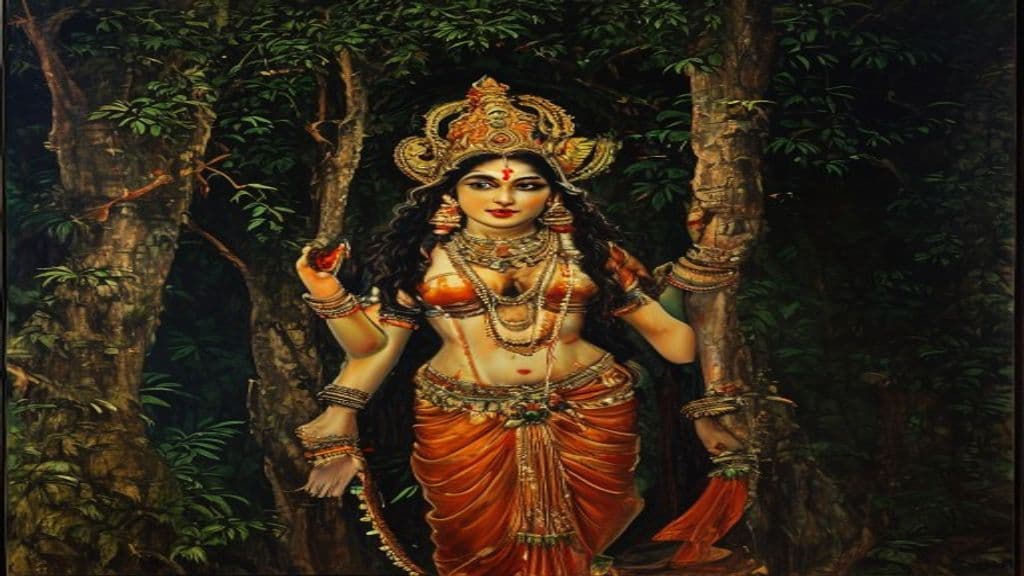
Born into the Mangalathu household at Kanjiracode and known in some accounts as Chiruthevi (also Sreedevi), she was a celebrated courtesan at court. After being murdered (accounts identify betrayal by a palanquin-bearer) and suffering extreme marana-vedana (death-throes), she was reborn as a yakshi. Legend says she initially took up residence in a massive Kanjiram (Strychnine tree) — the place-name element 'Kanjirottu' is said to derive from that tree. As a yakshi she seduced and terrorized men and drank their blood; in several variants she was later constrained by ritual negotiation, oath, or clerical intervention and became associated with temple ritual life, ultimately believed in some traditions to reside in Vault B of the Sree Padmanabhaswamy Temple.
Traditional accounts emphasize that she appears as an exceptionally beautiful courtesan; sources state she 'magically transformed into a bewitchingly beautiful woman moments after her birth' as a yakshi. Temple paintings at the Sree Padmanabhaswamy shrine portray both 'enchanting and ferocious' forms of the yakshi, reflecting attractive and fearsome aspects in local iconography.
Narratives attribute seduction and deadly predation to her: she seduces men, terrorizes them, and is said to drink their blood. She may pursue specific individuals from her human life (stories cite persistent harassment of the still-living Kunjuraman, whom she desired). Variants record that she was capable of entering into binding oaths (she 'swore on ponnum vilakkum') and could be tamed or reformed by ritual specialists or by becoming a temple devotee, after which she was represented within temple ritual geography.
Weaknesses
- ritualOath-bound constraint (sworn on 'ponnum vilakkum')
- ritualTaming by a ritual specialist (e.g., Kadamattathu Kathanar in some accounts)
- conditionInstallation as a temple devotee (becoming a devotee of Narasimha and being installed at a temple)
Wards
- ritualTemple installation and devotion (installation at a temple and becoming a devotee of Narasimha)
- ritualNegotiated oath with a ritual specialist (Govindan's agreement that set temporal and devotional conditions)
- otherSanctuary or refuge within a temple (seeking refuge at Sree Padmanabhaswamy Temple)
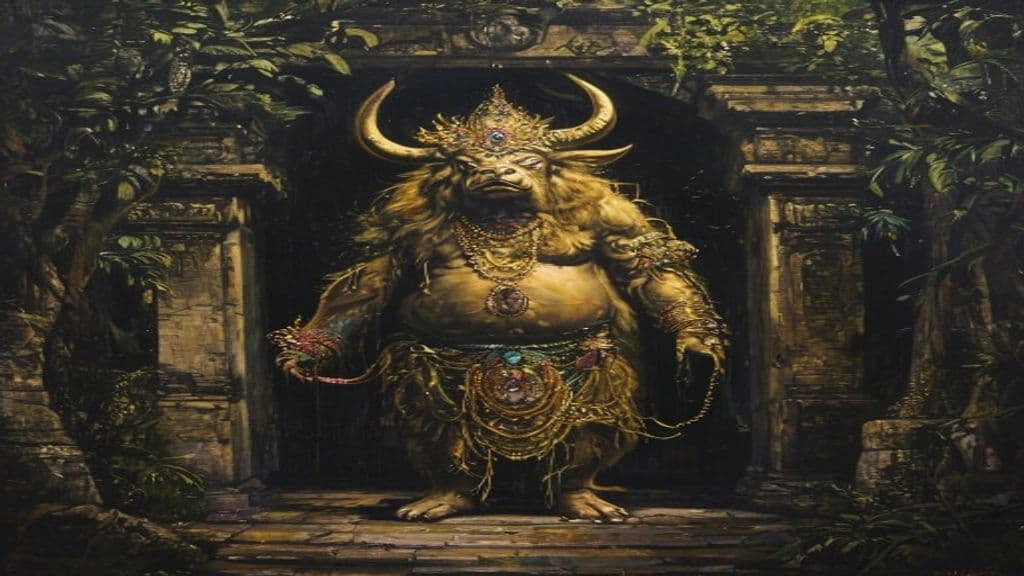
Yaksha
Nature spirits of Hindu, Buddhist, and Jain cosmology — guardians of forests, treasures, and wilderness. Ambivalent beings, capable of great benevolence to the respectful and terrible harm to the greedy.
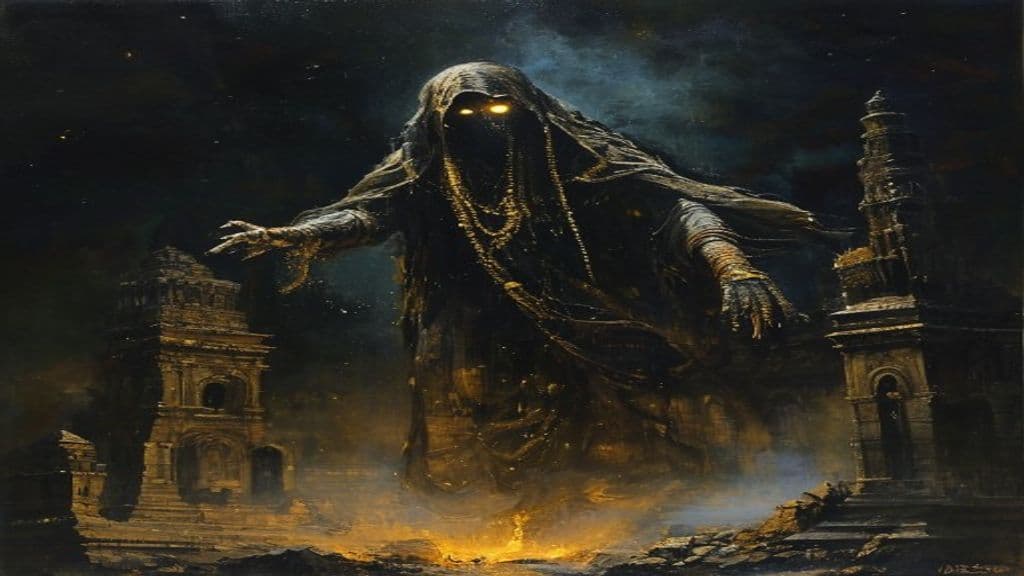
Brahmarakshas
The most learned and terrible of spirits — the ghost of a Brahmin who misused his scriptural knowledge in life and was condemned after death to be both demon and scholar, haunting places of learning.
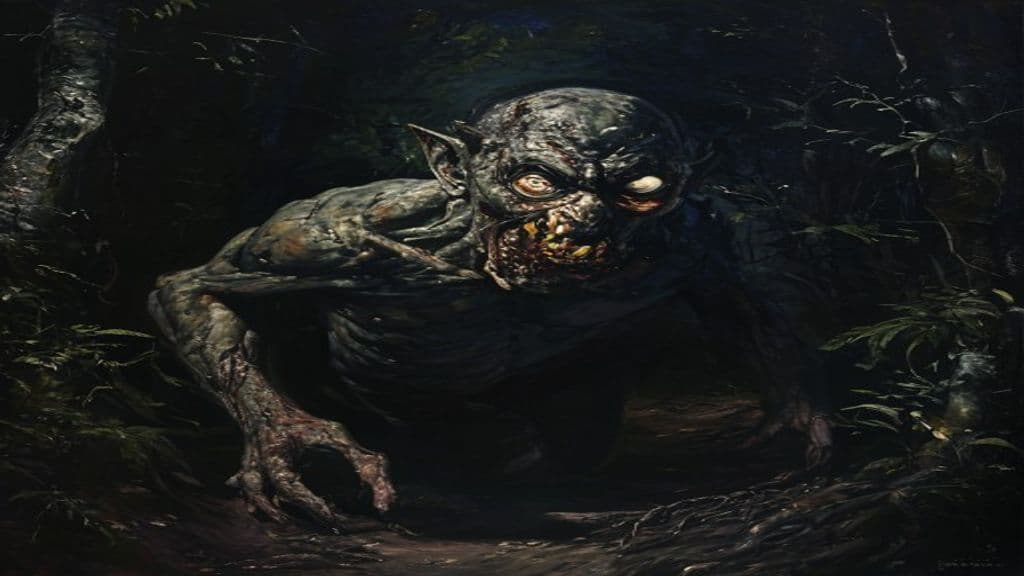
Pishacha
Flesh-eating spirits of Hindu mythology that haunt cremation grounds and are associated with disease, madness, and possession. The lowest class of demon in the Vedic hierarchy.
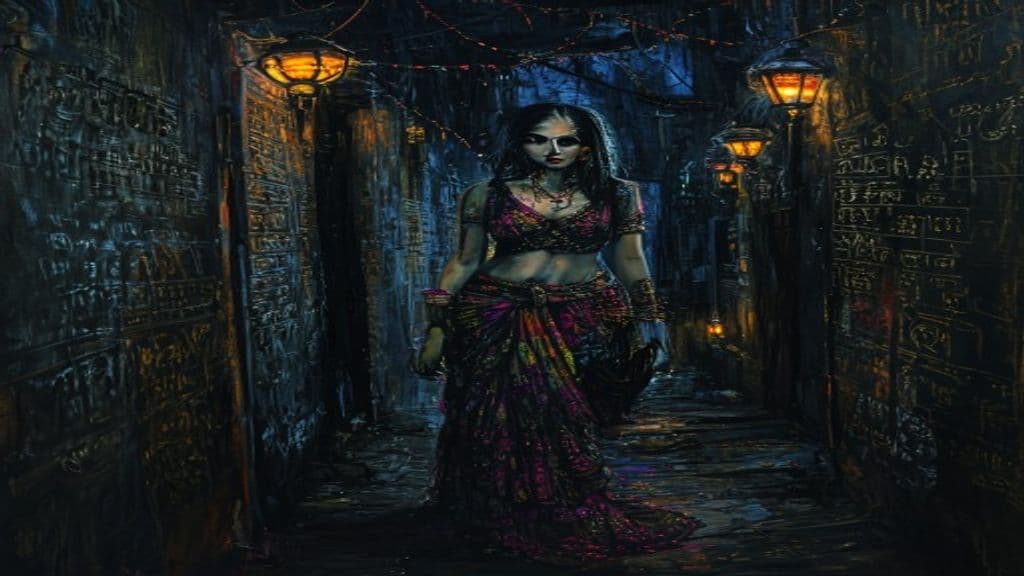
Stree
A vengeful female spirit from Chanderi who abducts men during festival nights. Warded off by the inscription 'O Stree, kal aana' — her legend, still practised on walls across Madhya Pradesh, inspired the 2018 Bollywood horror-comedy.
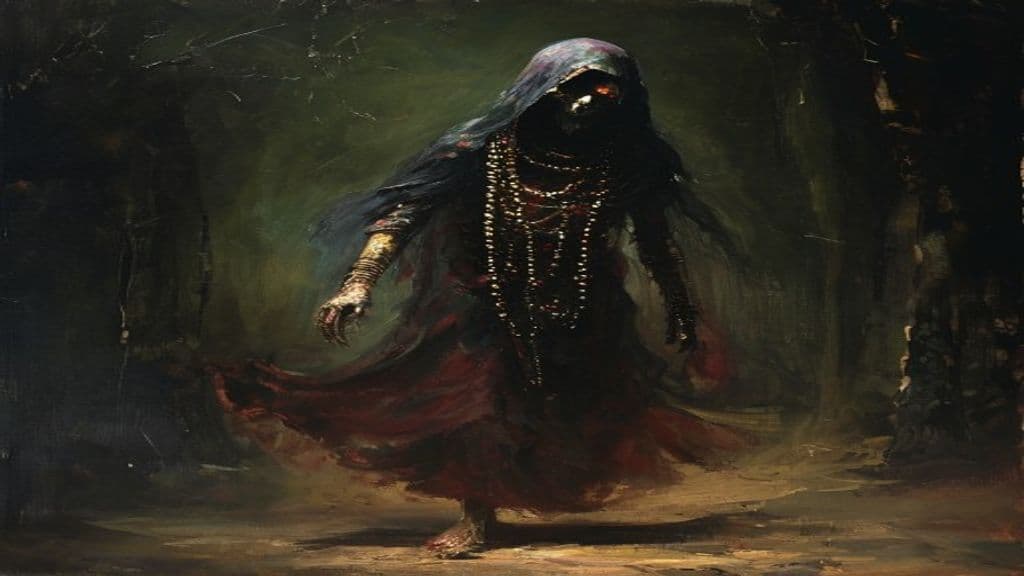
Bhoot (bhoota)
A bhoot (also bhoota, bhoot, bhut) is the culturally specific term across parts of the Indian subcontinent for a perturbed, restless spirit generally understood to be the ghost of a deceased person. Sources describe bhoots as arising when a person's death or post-death circumstances prevent them from moving on — for example violent death, unresolved affairs, or failures in funerary rites — and the term appears frequently in modern South Asian media and discussions.
Kamoebas
Kamoebas is a giant, turtle-like kaiju introduced in Toho's 1970 film Space Amoeba; depicted as a spiked, reptilian menace that is one of several island animals transformed or controlled by an alien organism known as the Space Amoeba. It functions in media as a physical, cinematic threat rather than a folkloric spirit.
Kamutef
Kamutef is attested in Egyptian temple inscriptions and iconography as an epithet/aspect attached to the major god Amun/Amun‑Ra, invoked in contexts of divine maternity, royal status, and creative power rather than as an independently described deity in the supplied sources.
Kan-Laon
Kan-Laon (variously Laon, Lahon, Lalaon, Lauon, Malaon, Raom, Laonsina) is a supreme female creator anito in Visayan pre-colonial belief whose domain is identified with Mount Kanlaon on Negros Island; she is associated with creation, agriculture, the sky, and divine justice and is attested across multiple Visayan ethnolinguistic groups.
Kanaloa
Hawaiian god associated with marine life and possibly tied to fertility or creation. (Note: * Power tier should be Greater (powerful regional), not Primordial (cosmic). * No information on appearance or abilities/behaviors is available, so these sections should be removed. * The association )
Kanedama
A yōkai associated with money in Japanese folklore and modern media; traditionally attested in a brief Adachi ward note as a moving, flying "ball of money" whose departure from a home is an ill omen for the household, and later reimagined in manga and tokusatsu as personified golden/robotic money yokai.
Kangiten (Shōten / Vinayaka)
Kangiten (歓喜天; also Shōten/聖天) is the Japanese esoteric Buddhist reception of the Indian Vinayaka/Ganapati figure. Historically described as an obstructive vinayaka, Kangiten was reinterpreted in Shingon and Tendai tantric contexts as a powerful, ambivalent protector who both removes impediments when propitiated and may punish if mishandled.
Kansa
Kansa (also spelled Kamsa) is a figure in Hindu narrative tradition depicted as the tyrannical king of Mathura whose cruelty and dynastic actions set the stage for the birth and intervention of Krishna (an avatar of Vishnu). Sources in the provided corpus present him as a royal antagonist, son of Ugrasena and kinsman of Devaki, with some disagreement over whether he is called Krishna's uncle or cousin.
Kanteletar
The Kanteletar is a collection of Finnish folk poetry compiled by Elias Lönnrot in the 19th century. (Note: - Remove Power tier: Minor Spirit (the source material does not describe any supernatural or spiritual aspects) - Summary: needs slight revision for accuracy - Appearance, Abilities, Sensory cues, Wea)
Kao (bull)
Kao is attested in the provided sources as a 'divine bull' from Meitei (Manipur) mythology. The only direct mention in the supplied corpus is a single-line listing on a Wikipedia disambiguation page; no further descriptive, narrative, or ritual information is present in the provided materials.
Kapitan Boom
Kapitan Boom (originally Captain Boom in comics) is a Filipino comic‑book superhero created by Mars Ravelo and illustrated by Ric Ravelo, first appearing in United Komiks (PSG Publishing House) in 1966. The character functions as a mass‑media crime‑fighting hero with a secret civilian identity (Lance Mercado) and was later adapted for Philippine television under the localized name Kapitan Boom.
Kapo
Kapo is a figure in Hawaiian mythology identified as a goddess associated with fertility, birth, and sorcery/witchcraft. She is attested with the epithet Kapo-ʻula-kīnaʻu (noting red clothing with black spots) and in some folklore summaries is described in narratives featuring a detachable or 'flying' sexual organ.
Kappa
A water-dwelling imp of Japanese folklore with a bowl of water on its head. Mischievous but bound by strict codes of politeness; dangerous near rivers.
Community Record
- [1]Kanjirottu Yakshi — Wikipedia. Wikipedia contributors, 'Kanjirottu Yakshi,' Wikipedia, The Free Encyclopedia.wiki
- [2]Kanjirottu Yakshi — Wikidata entry Q16277645. Wikidata entry Q16277645, 'Kanjirottu Yakshi' (labels include 'folkloric vampire').wiki