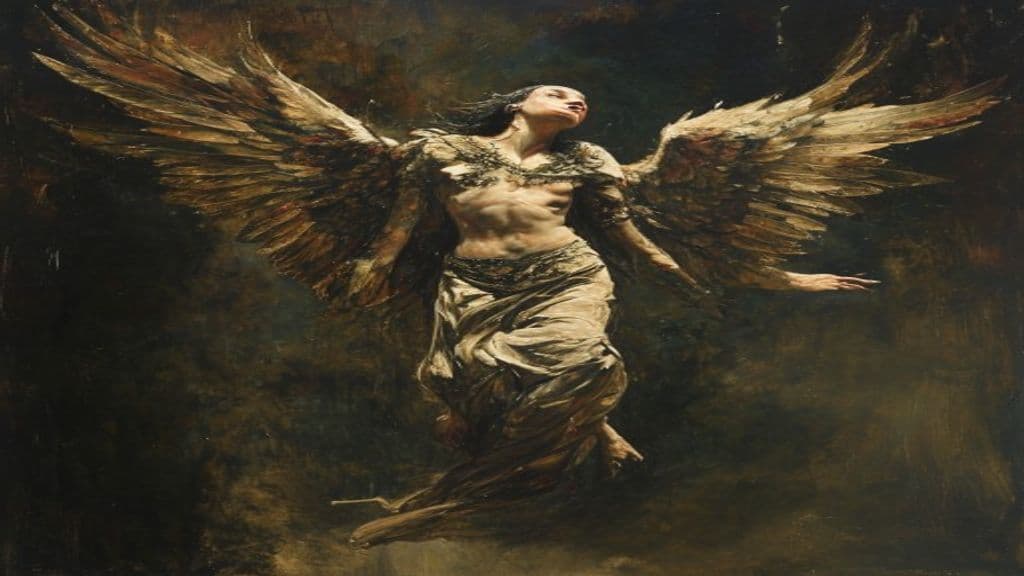
In the Persian tradition, Parīs are considered supernatural entities that exist in a realm separate from humans.
Parīs are described as winged creatures of immense beauty but no further details are provided regarding their physical appearance beyond this characteristic.
There is no information available in the source material regarding specific powers or behaviors possessed by Parīs.

Borzu Nama
A legendary hero from the Shahnameh epic cycle, embodying strength and courage. (Note: * Power tier should be Primordial (as it's a legendary hero from an epic cycle with no clear supernatural abilities). * Summary is accurate. * Appearance: No information available in source material, )
Cypress of Kashmar
A sacred cypress tree in Persian tradition, symbolizing the spread of Zoroastrianism. (Note: 1. Power tier is too low; based on its significance in Zoroastrian tradition, it should be Primordial. 2. Add sensory cues such as the scent of cedar or pine associated with cypress trees, and possibl)
Humban
Ancient Elamite god associated with divine protection and revered as a protector deity. (Note: 1. Power tier: Humban's association with "divine protection" and his importance as a deity suggest he should be placed at Ancient power tier is correct. 2. Weaknesses: absence of specific weaknesses m)
Jahangirnama (Qasim Madih Harawi)
Epic poem written in Persian, detailing the story of Jahangir son of Rostam, composed in Herat and published in Mumbai. (Note: - Power tier: Primordial (given its cosmic scope and ancient origin) - Origin story: The source material provides the information on its origin, stating it was composed in Herat. - Appearance: Not app)
Kashvad
Legendary hero from the Persian tradition, known for his valor and military prowess. (Note: 1. Power tier: Downgrade from Ancient to Greater, as Kashvad is described as a heroic warrior with exceptional bravery and military skills, but not necessarily a deity-level being. 2. Weaknesses: Add )
Khosrow and Shirin
Human protagonists of a romantic epic poem in the Persian tradition, reflecting cultural values of ancient Persia. (Note: 1. Power tier: Should be adjusted to Primordial (as they are historical figures in a cultural context that predates modern power tiers). 2. Summary: Should include more information about their cultura)
Sindukht
A female character in the Persian epic poem Shahnameh, described as beautiful and intelligent. (Note: - Power tier should be Primordial (since she's a character from an ancient epic poem, implied to have significant cultural or narrative impact). - Abilities should include her emotional influence and )
Zabulistan
A historical region in southern Afghanistan and southeastern Iran, with no known supernatural entity associated with it. (Note: 1. Power tier should be Ancient (deity-level) instead of Primordial (cosmic), since there's no indication of supernatural or deity-level associations with Zabulistan. 2. Remove "Supernatural entity as)
Parthenope
Parthenope is attested in the supplied sources as a named figure in Ancient Greek mythic tradition, identified specifically as one of the Sirens. The name Parthenope is also applied elsewhere in Greek contexts — notably as a daughter of Ancaeus in myth and as a toponym for an ancient Greek settlement on the site of modern Naples.
Parvati
Parvati is a principal goddess in Hindu tradition, worshipped as the consort of Shiva and as his shakti (divine power). She embodies a range of roles — devoted wife and mother, fertility and nourishment-giver, and in other manifestations a ferocious protector who destroys evil.
Parīkṣit
Parīkṣit is a legendary-historical Kuru king of classical north Indian tradition attested in Vedic, epic and Purāṇic materials. He is portrayed as a sacrificial sponsor and righteous ruler whose life intersects with sages, Nāgas, and divine protection; his death by the Nāga Takṣaka and the subsequent snake-sacrifice of his son Janamejaya form central narrative episodes.
Pasiphaë
Pasiphaë is a figure of ancient Greek myth tied to the royal house of Crete, traditionally wife of King Minos and mother of the Minotaur. Sources portray her variously as a daughter of Helios (semi-divine) or as a mortal queen; her story intersects divine punishment, magical arts, and monstrous maternity.
Community Record
- [1]Wikipedia: Parīwiki