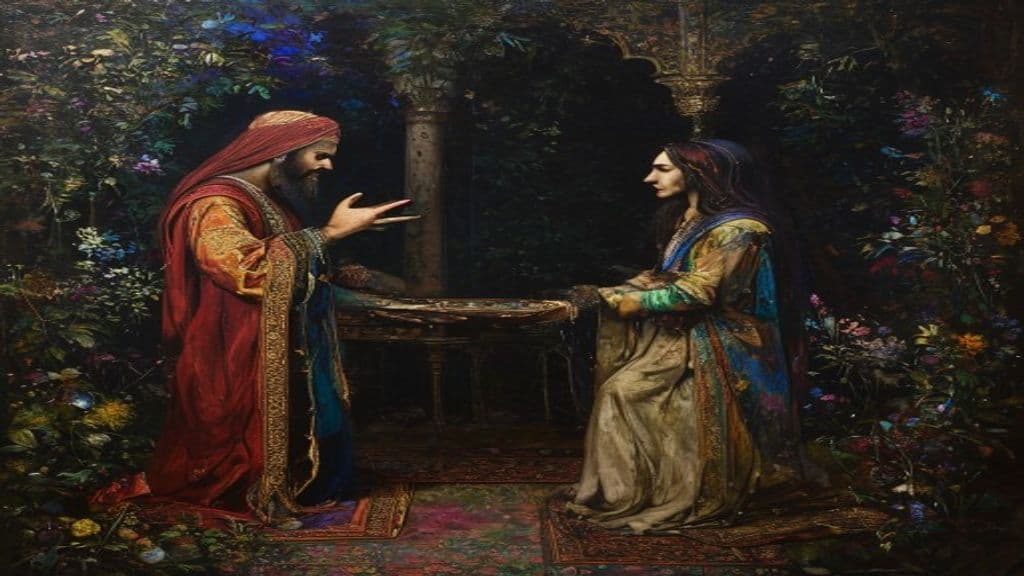
The story of Khosrow and Shirin is based on real people from the 7th century, with their names meaning 'governor of the house' (Khosrow) and 'pleasant' or 'delightful' (Shirin).
No physical descriptions available.
Khosrow and Shirin are human characters with no supernatural abilities or powers; their behaviors are driven by emotions, desires, and motivations characteristic of human relationships.
Borzu Nama
A legendary hero from the Shahnameh epic cycle, embodying strength and courage. (Note: * Power tier should be Primordial (as it's a legendary hero from an epic cycle with no clear supernatural abilities). * Summary is accurate. * Appearance: No information available in source material, )
Cypress of Kashmar
A sacred cypress tree in Persian tradition, symbolizing the spread of Zoroastrianism. (Note: 1. Power tier is too low; based on its significance in Zoroastrian tradition, it should be Primordial. 2. Add sensory cues such as the scent of cedar or pine associated with cypress trees, and possibl)
Humban
Ancient Elamite god associated with divine protection and revered as a protector deity. (Note: 1. Power tier: Humban's association with "divine protection" and his importance as a deity suggest he should be placed at Ancient power tier is correct. 2. Weaknesses: absence of specific weaknesses m)
Jahangirnama (Qasim Madih Harawi)
Epic poem written in Persian, detailing the story of Jahangir son of Rostam, composed in Herat and published in Mumbai. (Note: - Power tier: Primordial (given its cosmic scope and ancient origin) - Origin story: The source material provides the information on its origin, stating it was composed in Herat. - Appearance: Not app)
Kashvad
Legendary hero from the Persian tradition, known for his valor and military prowess. (Note: 1. Power tier: Downgrade from Ancient to Greater, as Kashvad is described as a heroic warrior with exceptional bravery and military skills, but not necessarily a deity-level being. 2. Weaknesses: Add )
Parī (Persian Tradition)
Supernatural entities existing in a realm separate from humans with complex social structures and described as winged creatures of immense beauty. (Note: - Power tier should be Primordial, but the source material does not specifically support this claim; it should be revised to a more accurate assessment based on available information. - Abilities sect)
Sindukht
A female character in the Persian epic poem Shahnameh, described as beautiful and intelligent. (Note: - Power tier should be Primordial (since she's a character from an ancient epic poem, implied to have significant cultural or narrative impact). - Abilities should include her emotional influence and )
Zabulistan
A historical region in southern Afghanistan and southeastern Iran, with no known supernatural entity associated with it. (Note: 1. Power tier should be Ancient (deity-level) instead of Primordial (cosmic), since there's no indication of supernatural or deity-level associations with Zabulistan. 2. Remove "Supernatural entity as)
Khopesh (khepesh)
The khopesh (also spelled khepesh) is a sickle-shaped sword from the Bronze Age that was adopted into ancient Egyptian military and royal iconography. It is a material weapon type and emblem frequently depicted with kings in New Kingdom statuary and later appears as a decorative/ornamental motif (e.g., a "khepesh crown") in Late Period and Ptolemaic votive reliefs.
Khor-akhti (Ra‑Horakhty / Re‑Horakhte)
Khor-akhti is an aspectual, syncretic solar deity of ancient Egyptian religion, formed by the fusion of the sun‑god Re/Ra and the horizon aspect of Horus (Horakhty). Representing the sun at the horizon (dawn and/or the west horizon in some contexts), this composite bears solar iconography and royal sky symbolism and appears in temple, funerary, and amuletic contexts across multiple pharaonic periods.
Khun Borom
Legendary ancestor and cultural founder of the Southwestern Tai-speaking peoples, revered for establishing the foundations of Thai culture. (Note: * Power tier: Should be "Ancient" as there's no mention of cosmic or deity-level powers. * Abilities and sensory cues: Since they're not described in the source, it would be best to rephrase these sec)
Khyah
Khyah is attested in a single data point as a 'newari mythical creature' in an online linked-data entry. The available source corpus for this dossier contains no descriptive ethnographic, ritual, or narrative material about the entity; other provided materials with the same lexical form refer to a contemporary person (Khyah Harper) and are unrelated to Newar folklore.
Community Record
- [1]Wikipediawiki