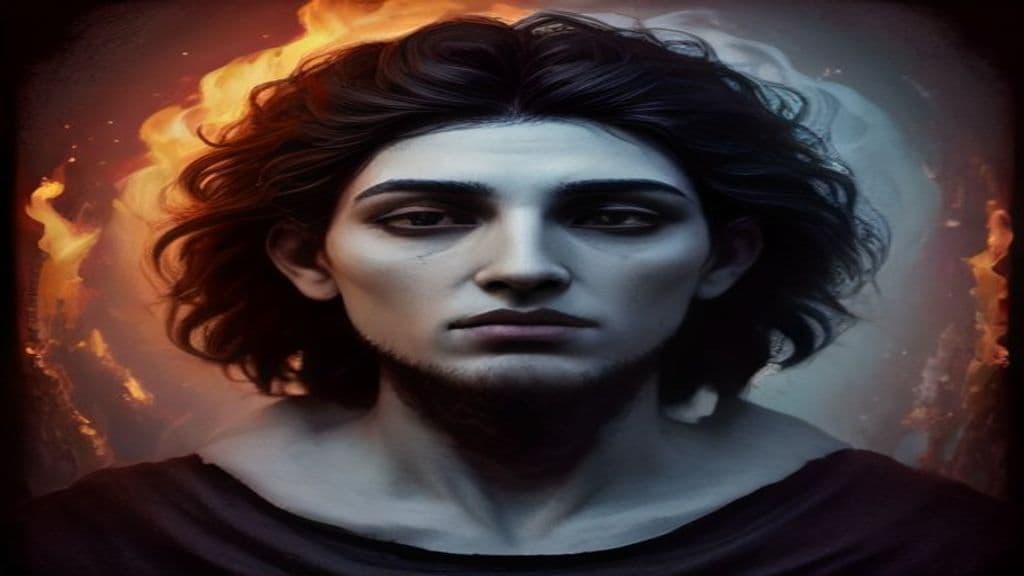
In the sources summarized here Kerubiel is presented within the Book of Enoch tradition (as reflected in modern tertiary summaries) as a primordial regent appointed over the order of Cherubim — described in one summary as reigning over the Cherubim "since Creation." The provided material does not supply direct primary-text quotations from Enochic manuscripts or a fuller mythic origin narrative beyond this princely, creation-era regency claim.
Descriptions in the available summaries portray Kerubiel as overwhelmingly non-human and theophanic: gigantic in scale (described as "about Seven Heavens tall"), a body of burning coals, face made of fire, covered with wings from head to toe, and studded with thousands of eyes. Eyes are characterized as sparks of light and eyelashes as lightning bolts; a crown of holiness rests on his head while "the bow of the Shekinah is between his shoulders." Poetic devotional renderings echo the blazing, crown-and-sword imagery but are presented in the sources as devotional elaboration rather than independent ethnographic attestations.
Summarized sources attribute primarily theophanic and cosmic manifestations to Kerubiel: speech that issues fire ("Fire spews forth with every word that he speaks"), constant accompaniment by thunder, lightning, and earthquakes, and a radiant presence identified with the splendor of the Shekinah. As "principal regent" over the Cherubim he is described in administrative terms within a celestial hierarchy; sources imply throne-attendant and guarding functions but do not provide narratives of interaction with ordinary humans.
Kelpie
A Scottish shape-shifting water horse that appears as a beautiful tame horse near lochs and rivers, then drowns and devours any rider foolish enough to mount it.
Keneō
Keneō (懸衣翁), literally "clothes hanging old man," is an underworld attendant in Japanese popular Buddhist tradition who sits at the edge of the Sanzu River. Described in sources as an Oni-like figure, he receives the garments of arriving souls, hangs them on a riverside branch whose bend registers the weight of sin, and participates with Datsue-ba in postmortem punishments.
Kenmet
Kenmet (Egyptian Knm.t) is a named figure attested in ancient Egyptian temple, dramatic, and decanal/astronomical texts. The attestations place Kenmet within mythic and stellar ordering contexts — as a named component associated with the divine stars and decanal schemata rather than as a fully attested cultic deity with independent biography.
Keong Emas
A princess magically transformed and contained within a golden snail shell, associated with the Panji cycle of Javanese folklore. (Note: - Power tier: Primordial (not Ancient), as it's described as a princess trapped in a magical object rather than having deity-level powers. - Abilities: Lack of information about abilities or behaviors)
Keres
In Greek myth the Keres (Κῆρες; singular Κήρ) are night-born, malevolent death-spirits associated with violent death, pestilence, and the ravaging aspects of mortality; they are often portrayed as a swarm of blood‑thirsty female spirits that hover over battlefields and seize the dead and dying.
Kerey Han
Kerey Han (also spelled Kirey Han) is a named son of Erlik in Turkic mythic genealogies who is associated with sowing sedition and setting people against one another; he is listed among Erlik's nine sons who hold specific duties and are said to assist shamans who descend into the underworld.
Kesari
Kesari is a male vanara in the Ramayana tradition, usually identified as the husband of Anjana and the father (or foster-father in some theological accounts) of the hero Hanuman. He is represented in secondary summaries as a ruler associated with Mount Meru/Sumeru and later as a chief commander among the vanaras of Kishkindha; later retellings also credit him with participation in the war against Ravana, though primary-text attestation for some wartime exploits is uncertain.
Keter
Keter (Hebrew: כֶּתֶר, "crown") is the highest of the ten sefirot in Jewish Kabbalistic cosmology, the first emanation from the Ein Sof that functions as the primal divine will or initial impulse toward creation. It is described as utterly concealed — "the most hidden of all hidden things" — and as the origin point from which subsequent sefirot emerge.
Khachkar Spirit (cross-stone guardian)
No primary or folkloric sources in the provided research identify a named supernatural 'Khachkar Spirit' or consistent guardian spirit associated with khachkars. What is documented in the supplied materials is the khachkar as a carved Armenian cross-stone monument (a material cultural object), including an archaeological example dated to 982 found in Wadi al-Natrun, Egypt, demonstrating Armenian presence outside Armenia.
Khan Garuda
Khan Garuda (Garuda) is a divine avian being from Indic religious cosmology, principally known as the mount (vahana) and attendant of the god Vishnu. The figure appears across Hindu, Buddhist, and Jain textual traditions and is embedded in mythic genealogies as a son of Kashyapa and Vinata and brother of Aruna.
Khan of Heaven (Tian Kehan / Tengri Khagan)
A politico-religious title used in Tang‑era diplomacy that linked imperial rulership to the supreme sky/heaven concept (Chinese Tian / Turkic Tengri). It functioned as a formula of recognition conferring celestially sanctioned authority on the Tang emperor in relations with Turkic and other Inner Asian polities between the early 7th century and the late 8th century.
Khandoba’s attendants
A referred category for attendant figures associated with the regional Hindu deity Khandoba in Maharashtrian tradition. The supplied sources discuss Khandoba himself but do not describe attendants such as Kaatoba; therefore no specific attendant identities, roles, or practices are attested in the provided material.
Community Record
- [1]Kerubiel - Wikipedia. Wikipedia, "Kerubiel"wiki
- [2]Kerubiel (Wikidata). Wikidata entry for Kerubielother
- [3]Kerubiel Angel (Imaginova glossary entry). Imaginova glossary, "Kerubiel"other
- [4]The Angel Kerubiel - The Flames Which Dance Around the Throne of God. Devotional/poetic composition titled "The Angel Kerubiel - The Flames Which Dance Around the Throne of God"literary
- [5]Archive: Paimon enn Lilith [111] (archive listing that references related materials). Archive.org item referenced in source setother
- [6]Spiritual Forums - Treeadoor (thread referencing Kerubiel and related devotional mentions). Spiritual forums threadfolk
- [7]Kerubiel: Revolutionizing cyber defense. – Aspioneer. Modern cultural usage reference: company named Kerubielother
- [8]KERUBIEL: Modern Age Data Protection Solution. Modern cultural usage reference: product/company named Kerubielother