
No cosmogonic origin or mythic birth narrative for Keneō is recorded in the supplied sources. Available accounts present him functionally as a component of popular Japanese Buddhist representations of the afterlife: an attendant at the Sanzu River whose role is procedural and punitive within the system of postmortem judgment. He appears in the tableau of riverbank punishments alongside Datsue-ba and other judges/attendants of the underworld, reflecting syncretic folk-Buddhist conceptions of karmic retribution rather than a distinct origin story.
The supplied material contains no detailed physical description beyond the name itself and the classification as an Oni. The kanji 懸衣翁 translate as "clothes hanging old man," indicating an old man associated with hanging garments. Sources identify him as an Oni in the Buddhist underworld, but do not provide further specifics of facial features, attire, or iconography.
Source accounts attribute to Keneō the actions of receiving and hanging the clothes of arriving souls on a riverside branch that bends to reflect the gravity of their sins, and of flaying and hanging a soul's skin if the soul arrives naked. He is described as working in tandem with Datsue-ba in administering corporeal punishments (for example, after Datsue-ba breaks a thief's fingers they together tie the sinner's head to the sinner's feet) and as walking the river edge to torment souls, including those of children too young to cross the Sanzu River. These behaviors are presented as postmortem enforcement actions recorded in popular accounts.
Weaknesses
None recorded.
Wards
- ritualplacement of 6 mon with the body

Datsue-ba
A supernatural old-woman ogress figure in Japanese Buddhist underworld imagery who sits by the Sanzu River and strips the deceased of their garments (or, in some accounts, their skin) as part of post-mortem judgement. She functions as a liminal, procedural agent within Ten Kings / Six Realms iconography rather than as a creator or cosmic force.
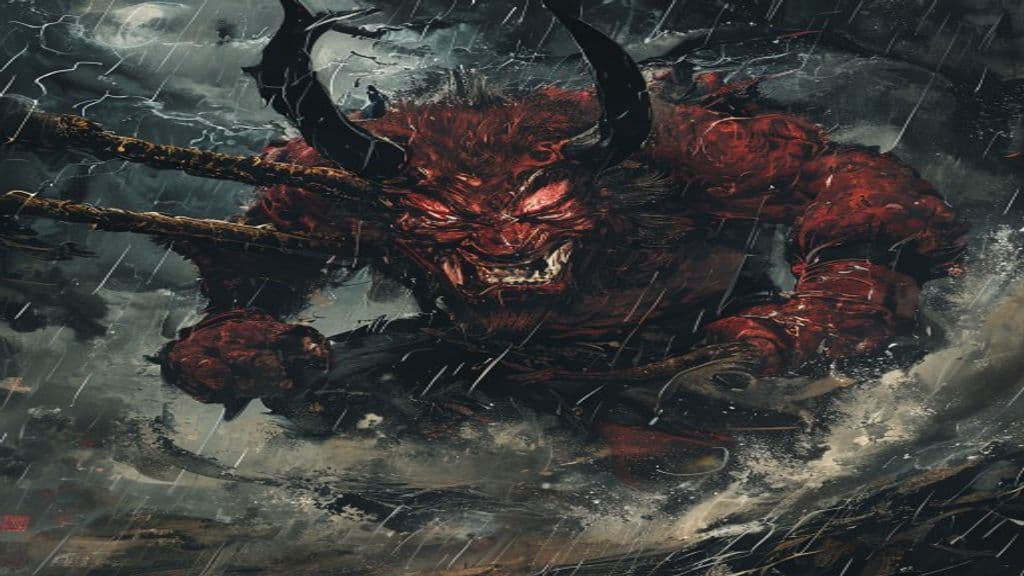
Oni
Powerful supernatural beings of Japanese folklore — associated with misfortune, disease, and the punishment of sinners in hell. Fearsome, often depicted as guardians of the underworld.
Kebehet
Kebehet is a minor divine figure attested in modern secondary literature on Ancient Egyptian funerary religion. She appears in discussions of the ensemble of attendant deities and personae invoked in royal mortuary ritual and the king's passage into the celestial afterlife, but primary-source details about her name, iconography, or distinct functions are sparse in the supplied sources.
Kechibi
Kechibi (けち火) are atmospheric ghost lights from the folk legends of Kōchi Prefecture (historical Tosa Province), Japan. They are local variants of onibi/funayūrei-type lights reported as human-linked luminous balls that emerge either at death or from sleeping persons and that figure in cautionary folktales about interaction with spirit phenomena.
Kehua (Māori Ghosts and Spirits)
In Māori culture, kehua are ghosts or spirits that appear as apparitions of long deceased family members to warn of upcoming danger. They hold a sacred status, implying tapu. (Note: 1. The draft states "Kehua are considered to be apparitions of long deceased family members," but Source 1 mentions it as "long deceased family members may appear." This implies Kehua could also refer)
Kejōrō
Kejōrō is recorded only as a named entry (or image) associated with Toriyama Sekien’s Konjaku Gazu Zoku Hyakki (c. 1779) within the context of Sekien’s illustrated bestiary of supernatural beings. The available supplied source (a Wikipedia summary of Sekien’s work) confirms Sekien’s role as compiler-illustrator but does not supply further descriptive or folkloric detail specific to Kejōrō.
Kelenken
Kelenken is both a Tehuelche mythic referent described in the scientific literature as “a spirit… represented as a giant bird of prey” and the name-bearing fossil taxon Kelenken guillermoi, a very large middle Miocene flightless predatory bird (a phorusrhacid) from Patagonia. The cited sources supply extensive paleontological description and taxonomy but provide only the single, brief ethnographic note that the genus name was taken from a Tehuelche spirit-image; no Tehuelche narratives or rituals are recorded in the supplied material.
Kelpie
A Scottish shape-shifting water horse that appears as a beautiful tame horse near lochs and rivers, then drowns and devours any rider foolish enough to mount it.
Kenmet
Kenmet (Egyptian Knm.t) is a named figure attested in ancient Egyptian temple, dramatic, and decanal/astronomical texts. The attestations place Kenmet within mythic and stellar ordering contexts — as a named component associated with the divine stars and decanal schemata rather than as a fully attested cultic deity with independent biography.
Keong Emas
A princess magically transformed and contained within a golden snail shell, associated with the Panji cycle of Javanese folklore. (Note: - Power tier: Primordial (not Ancient), as it's described as a princess trapped in a magical object rather than having deity-level powers. - Abilities: Lack of information about abilities or behaviors)
Keres
In Greek myth the Keres (Κῆρες; singular Κήρ) are night-born, malevolent death-spirits associated with violent death, pestilence, and the ravaging aspects of mortality; they are often portrayed as a swarm of blood‑thirsty female spirits that hover over battlefields and seize the dead and dying.
Kerey Han
Kerey Han (also spelled Kirey Han) is a named son of Erlik in Turkic mythic genealogies who is associated with sowing sedition and setting people against one another; he is listed among Erlik's nine sons who hold specific duties and are said to assist shamans who descend into the underworld.
Kerubiel
Kerubiel is named in modern summaries of the apocryphal Book of Enoch tradition as a highly exalted throne-attendant angel who is described as the principal regent over the Cherubim and as one of the most exalted princes of heaven, associated with divine light, fire, and the Shekinah.
Kesari
Kesari is a male vanara in the Ramayana tradition, usually identified as the husband of Anjana and the father (or foster-father in some theological accounts) of the hero Hanuman. He is represented in secondary summaries as a ruler associated with Mount Meru/Sumeru and later as a chief commander among the vanaras of Kishkindha; later retellings also credit him with participation in the war against Ravana, though primary-text attestation for some wartime exploits is uncertain.
Community Record
- [1]Keneō. "Keneō (懸衣翁) is a Japanese Oni who sits at the edge of the Sanzu River in the Buddhist underworld. His name translates to clothes hanging old man."; "Once the adult soul arrives at the river Datsue-ba forces the sinners to take off their clothes, and Keneō hangs these clothes on a riverside branch that bends to reflect the gravity of the sins. If a soul arrives without clothes, Keneō flays the person's skin and hangs it from the tree instead."; "For those who steal, for example, Datsue-ba breaks their fingers, and together with Keneō, she ties the sinner's head to the sinner's feet. Keneō and Datsue-ba also walk along the edge of the river and torment the souls of children that are too young to cross the river."wiki
- [2]Keneō (Wikidata). Wikidata entry categorizing Keneō as a Buddhist mythological creature / underworld figure.other
- [3]Sai no Kawara, Jizo, Judges of Hell (Underworld) — Japanese Buddhism Dictionary Project. Contextual material on Sanzu River, judges of hell, and related underworld figures referenced in the same field of belief.folk