
In the material summarized by the supplied sources, Kātyāyanī is presented as one of the nine manifestations of Mahādevī/Durga (the Navadurgā). Traditional accounts cited in reference summaries identify her as the slayer of the tyrannical asura Mahīśa; her form-name is also connected in some explanatory traditions to the rishi Kātyāyana (rendering the epithet Kātyāyanī, 'daughter/foster-daughter of Kātyāyana') as noted in secondary discussion, though the supplied corpus does not include a primary canonical narrative text of this genealogy. The sources therefore frame her identity relationally as a particular śakti/aspect within the larger Durga/Great Goddess complex and place her cultic prominence in the Navarātri festival cycle (sixth day). (Sources: Wikipedia: Kātyāyanī; Wikidata Q25087; Hinduism StackExchange Q&A.)
The provided sources do not include an authoritative iconographic description or detailed visual attributes for Kātyāyanī. What is attested in the available material is her role and epithet (the sixth Navadurgā and slayer of Mahīśa); no colors, implements, posture, vahana (mount), or other iconographic elements are specified in the supplied excerpts. (Sources: Wikipedia: Kātyāyanī; archive listings cited in the corpus but without accessible descriptive content.)
Within the summarized sources Kātyāyanī is characterized primarily by martial and protective capacity as a form of the Great Goddess: she is venerated as the slayer of the asura Mahīśa and is described succinctly as a 'goddess of power.' Secondary popular devotional material in the supplied set links later ritual practice (mantra petitions, particularly in popular contexts asking for assistance with marriage) to this form, but those claims are attested only in a single non-scholarly source in the corpus and are marked as popular/uncertain in the documentation. (Sources: Wikipedia: Kātyāyanī; Wikidata Q25087; Best Astrology Solution blog.)
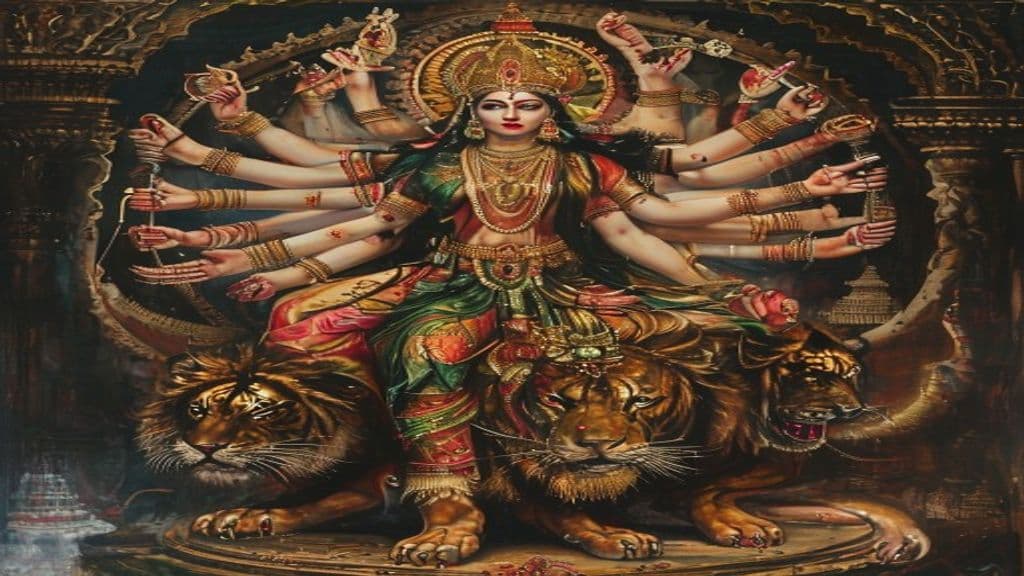
Durga
Durga is a major Hindu goddess, central to the Shakta tradition as an aspect of the Divine Feminine (Mahadevi). She is venerated as a protective, martial mother-goddess who combats demonic forces (notably Mahishasura) to uphold dharma, and is celebrated in major festival cycles such as Navaratri and Durga Puja.
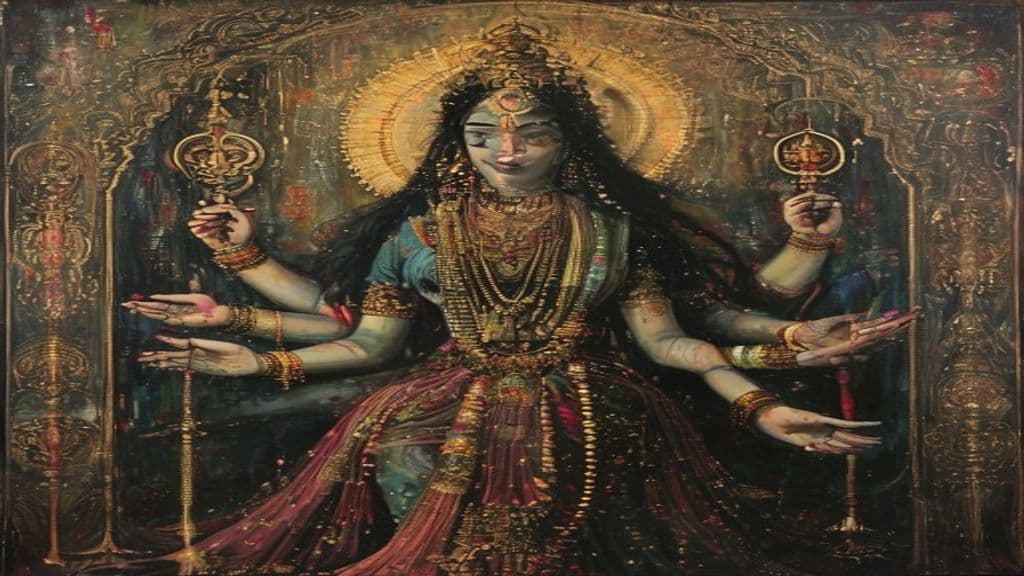
Mahādevī
Mahādevī (Sanskrit: महादेवी, IAST: Mahādevī) is the supreme feminine divinity in Hindu Shakta theological tradition, presented in the cited sources as the primordial feminine principle (Adi Parashakti, Mulaprakrti) who is both the unmanifest absolute (nirguna Brahman) and the manifest goddess (saguna) from whom the universe and other deities proceed.

Baba Yaga
Baba Yaga is an ambivalent female figure of East Slavic folktale tradition, depicted variously as a fearsome, child-eating crone or as a helpful, maternal donor. She is associated with the deep forest, a hut described as standing on chicken legs, and the motific accoutrements of a mortar and pestle.
Adi (asura)
Adi is attested in modern reference works as the name of an Asura who 'appears in the Matsya Purāṇa.' Beyond this single-line citation in secondary sources, no descriptive material about the figure is provided in the supplied research notes.
Adi Shakti
Adi Shakti (also Adi Parashakti, Mahadevi, Adya Shakti) is the primordial feminine power in Hindu/Shakta theology, regarded as the ultimate reality (Para Brahman) and the source from which all goddesses and gods manifest. She is both an impersonal cosmic principle (Mulaprakriti) and a focus of devotional invocation in temples, mantras, and pilgrimage sites such as Shakti Peethas.
Adi Vinayaka
Adi Vinayaka (Ādi Vināyaka; also called Nara Mukha Vinayaka) is a named iconographic and devotional form of the Hindu god Ganesha portraying the deity with a human head, described in sources as the form before the episode of decapitation by Shiva. It is rarely worshipped and appears in a small number of South Indian shrines and in devotional/musical repertoires.
Aditi
Aditi is a major Vedic goddess in Hindu tradition who personifies the boundless, infinite cosmic principle and functions as the maternal matrix from which many celestial deities (the Ādityas and other groups) are born. In the Vedic hymns she is invoked as a protective liberator who guards petitioners, provides wealth and safety, and frees devotees from hindrances such as sin and sickness.
Agni
Agni is the Vedic personification of fire in Hindu tradition: a sacred, mediating principle that manifests as terrestrial fire, atmospheric lightning, and celestial sun, and that receives and conveys sacrificial offerings. Prominent in the Rigvedic corpus, Agni functions as sanctifier, witness of rites of passage, and a transformational inner principle in later Upanishadic literature.
Ahalya
Ahalya is a mytho-legendary woman of South Asian (primarily Hindu) narrative tradition, described as created by the god Brahma, married to the sage Gautama, seduced (or tricked) by Indra, cursed by her husband, and ultimately redeemed by Rama. Her tale is a locus for themes of creation, desire, curse/penance, and redemption and she is counted among the ritual-mnemonic panchakanya.
Aindri (Indrani / Shachi / Paulomi)
Aindri (commonly rendered in sources as Indrani, also called Shachi or Paulomi) is a Hindu goddess presented as the queen-consort of Indra. She is depicted in the available material as a courtly queen associated with beauty, pride and kindness who also appears in at least one account as an active martial participant in the devas' battles with asuras.
Akshayavata
In Hindu mythology, Akshayavata is a sacred banyan tree and/or lake that symbolizes eternal life. It is mentioned in both Hindu and Jain traditions and associated with the Puranas. (Note: - The power tier should be "Greater" or at least "Ancient", as it is associated with the Puranas, which are considered ancient texts. - No specific physical description is provided, but that doesn't m)
Alakshmi
Alakshmi is an inauspicious female supernatural figure in Hindu tradition, presented as the negation or shadow-counterpart of the prosperity-goddess Lakshmi. She personifies poverty, grief, jealousy and social discord and is managed in domestic ritual and festival practice.
Alamelu
Alamelu (also Alamelu Manga / Alarmel Mangai) is a South Indian devotional name for the goddess Padmavati, identified in sources as an avatar of Lakshmi and the consort of Venkateswara; the name is also used widely as a female personal name and in titles of cultural works in Tamil and Telugu contexts.
Amrita (Buddhist tradition)
In the context of Indian religions, particularly within Hinduism and Buddhism, Amrita is a divine elixir that grants immortality and eternal life. (Note: - Power tier should be Ancient (deity-level), not Primordial. - Origin story appears accurate but lacks specificity on when Amrita was first mentioned in the Rigveda; add more detail. - Abilities are )
Ananta (Infinite)
Ananta (Sanskrit: अनन्त, 'without end') is primarily an epithet of Vishnu and a symbolic principle of infinity that is personified as the cosmic serpent Shesha. In Puranic imagery Ananta/Shesha forms the multi‑headed couch and canopy for Vishnu as he rests on the cosmic waters between cycles of creation (pralaya), and thus underwrites cyclical cosmogenesis.
Community Record
- [1]Kātyāyanī. "Katyayani is a form of the Hindu goddess Mahadevi, venerated as the slayer of the tyrannical asura Mahisha. She is the sixth of the Navadurga, and is worshipped on the sixth day of Navaratri." (Wikipedia: Kātyāyanī)wiki
- [2]Wikidata: Kātyāyanī (Q25087). Wikidata entry label: "Hindu goddess of power."wiki
- [3]Who was the Rishi Katyayan who became father of Goddess Katyayini?. Hinduism StackExchange Q&A linking the deity-name to the rishi Kātyāyana in explanatory traditions (user-contributed discussion).other
- [4]Goddess Katyayani Mantra for Love Marriage - Best Astrology Solution Blog. Popular devotional blog asserting that 'Goddess Katyayani is the 6th form of Maa Durga... girls chant this mantra to get marry with the person of their choice' (not a primary liturgical source).folk
- [5]Katyayana Charanavyuha Sutra (archive listing). Archive bibliographic entry for 'Katyayana Charanavyuha Sutra' listed among corpus materials; content not excerpted in the supplied notes.other