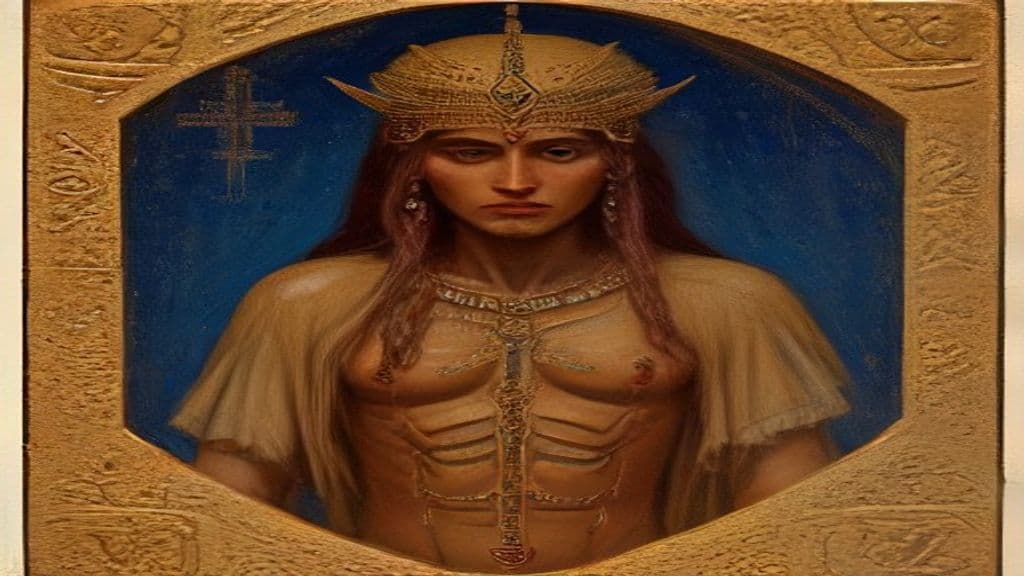
Labasu is not preserved in narrative myth as an individual with a birth-story; instead the entity is attested only in lexical, incantation and ritual lists. In bilingual Sumerian–Akkadian lists Labasu is recorded by the Akkadian form labāṣu and by the Sumerian logographic pairing ᵈdìm.me.A, placing it within the technical DÌM/kamad semantic field of harmful, disease-causing beings. The textual record therefore presents Labasu as a technical demon-name within a classificatory system of malefic agents rather than as a character of a cosmogonic narrative.
No consistent, detailed physical iconography or anatomical description of Labasu is preserved in the cited material. In the surviving sources Labasu chiefly appears as a name in enumerations of hostile spirits and in incantation formulas; the corpora that mention it provide no uniform corporeal portrait and treat the entity primarily as an unseen, malefic force responsible for illness.
Textual sources associate Labasu specifically with disease causation, most often in texts treating fever and related sicknesses (scholarly summaries note links to biphasic fevers without jaundice). Labasu functions as an etiological agent invoked in medical-astrological writings, and in anti-witchcraft and expulsion rites it is enumerated among hostile agents that can be adjured, expelled, or ritually transferred. In many tablets Labasu occurs in close association with Lamashtu and Ahhazu, forming a triad of disease-causing spirits in incantatory practice. The corpus treats it as removable or propitiable by ritual action.
Weaknesses
- ritualexpulsion by Maqlû-style anti-witchcraft rites (burning statues, torch rituals)
- ritualadjuration and transfer formulas that reverse the affliction onto its source (Maqlû reversal formulas)
- ritualincantations of the Utukku Lemnutu series (treatment incantations for demon-caused illness)
- ritualadjuration by heaven and earth and substitution of protective spirits (TIM 9 pattern invoking 'good udug' and 'good lama')
Wards
- ritualMaqlû anti-witchcraft ritual (naming, burning of statues, torch rites to destroy images of hostile agents)
- ritualUtukku Lemnutu incantations (recited treatments to remove demon-caused illness)
- ritualSumerian adjuration pattern (TIM 9) that commands all evil beings to stand aside and installs 'good udug' and 'good lama' as guardians
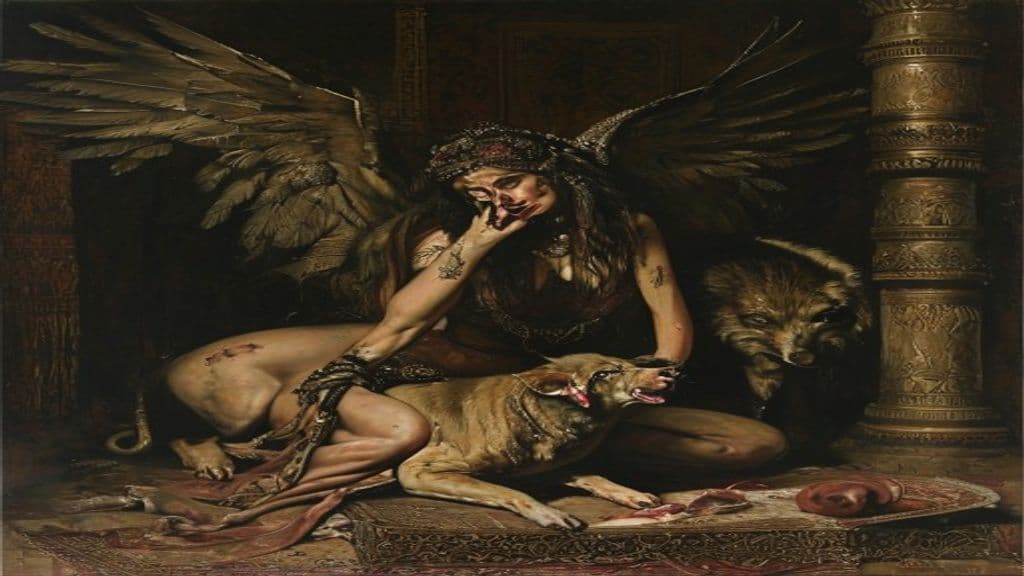
Lamashtu
The most feared demoness of ancient Mesopotamia — a divine daughter of Anu who preyed on pregnant women, caused miscarriages, and killed infants by nursing them with venom.

Akhkhazu
Akhkhazu (also Ahhazu; Sumerian Dimme-kur) is an Akkadian-era Mesopotamian malignant spirit described as a demon of jaundice who 'seizes' victims, brings fever and plagues, and is cited in later summaries as one member of a triad with Labasu and Labartu. Later popular summaries also describe her as preying on nursing infants while mothers slept.
Adapa
Adapa is a mythic figure from ancient Mesopotamian (Sumerian and Akkadian) literature: a mortal fisherman and temple sage of Ea at Eridu endowed with exceptional wisdom. He appears in a fragmentary tale in which he breaks the wings of the south wind and is summoned to the divine court; his name was later invoked in exorcistic and ritual contexts as an authoritative identity.
Aga of Kish
Aga of Kish (Aga, Agga, Akka) is an Early Dynastic Mesopotamian king recorded in the Sumerian King List, the Tummal Inscription, epigraphic objects, and the Sumerian poem "Gilgamesh and Aga." He functions in texts as a historical/legendary political actor who attempted hegemonic demands on Uruk and was ultimately captured and released by Gilgamesh.
Akhkhazu
Akhkhazu (also Ahhazu; Sumerian Dimme-kur) is an Akkadian-era Mesopotamian malignant spirit described as a demon of jaundice who 'seizes' victims, brings fever and plagues, and is cited in later summaries as one member of a triad with Labasu and Labartu. Later popular summaries also describe her as preying on nursing infants while mothers slept.
Alulim
Alulim is the legendary antediluvian 'first king' of Eridu in Mesopotamian tradition, presented in king lists and mythic compositions as the initial ruler appointed by the gods. He functions etiologically to explain the origin of kingship and, in late ritual texts, is invoked in agricultural incantations associated with driving off field pests.
Alû (Alu)
A named lemma attested in modern reference lists as 'ALU / Alu', but for which the supplied research corpus contains no substantive primary- or secondary-source information about nature, appearance, powers, or rituals in Mesopotamian tradition.
Amurru (Martu)
Amurru, Sumerian Martu, is a Mesopotamian deity who functions as the divine personification of the Amorites. Originating in Mesopotamian textual practice, he is associated with the steppe and mountains, depicted with a crooked staff, portrayed in hymnography as warlike and lightning-armed, and from the Old Babylonian period acquires a prominent exorcistic cultic role.
Ancestors of Enlil (Enki-Ninki deities)
A sequence of Sumerian divine pairs (en-/nin- names) conceived as the primordial ancestors culminating in Enlil; chiefly attested in god lists and invoked as authoritative primordial names in ritual, especially in incantations and exorcisms.
Anshar
Anshar is a Mesopotamian primordial deity whose name (Cuneiform AN.ŠÁR) literally means "whole sky" or "the whole heaven." He functions as an abstract ancestral figure in theogonic genealogies (not actively worshiped as a regular cult deity) and appears in literary contexts—most notably the Enūma Eliš—and in god lists where he legitimizes later supreme gods.
Anu
Anu (Sumerian An; Akkadian Anu/Anum) is the divine personification of the sky in ancient Mesopotamian religion, traditionally ranked at the top of god‑lists as the source of heavenly authority (anûtu/anuti) and the fount of legitimate rule for gods and kings. Though supreme in genealogies and astronomical schema, many periods portray him as a relatively passive or figurehead deity whose active cultic role is limited until a late Seleucid reinvention in Uruk.
Anunnaki
A variable collective of major deities in ancient Sumerian, Akkadian, Assyrian and Babylonian religious literature, described as offspring or descendants linked to the sky god An (Anu) and an earth/mother figure (Ki/Ninhursag). Texts portray them as participants in the divine assembly, decreers of human fate, and in some traditions a group of seven underworld judges; their number, membership, and functions vary across sources.
Anzû (Imdugud)
Anzû, also called dZû or Imdugud, is a large storm-associated bird-figure in Sumerian/Akkadian/Babylonian myth. Portrayed as a hybrid (commonly a massive bird with a lion's head or as a half-human storm-bird), Anzû is credited in mythic narratives with seizing the Tablet of Destinies and thereby challenging the authority of chief gods such as Enlil.
Apkallu (Abgal)
Apkallu (Akkadian; Sumerian: Abgal) are polyvalent Mesopotamian wisdom figures attested as mythic/semi-divine sages (notably a group of seven), as professional human experts (ummânu), and as apotropaic images used in household and cultic ritual. They are closely associated with the god Ea (Nudimmud) as transmitters of secret knowledge and are represented in diverse iconography including fish-man and bird-headed types.
Community Record
- [1]Labasu - Wikipedia. Wikipedia, 'Labasu' entry (accessed via provided research notes).wiki
- [2]Akkadian and Sumerian incantation corpora references (Maqlû, Utukku Lemnutu, TIM 9). Passages and line-citations summarised in the provided research notes describing Maqlû (Tablets I, II, V), Utukku Lemnutu (tablets 2–16), and TIM 9, 63.academic
- [3]LBAT 1597 - astral-medical text reference. Reference in research notes to an astral-medical text (LBAT 1597) listing Lamashtu, Labasu and Ahhazu in an astrological-medical context (region of Leo; Venus and Leo mentioned).academic