
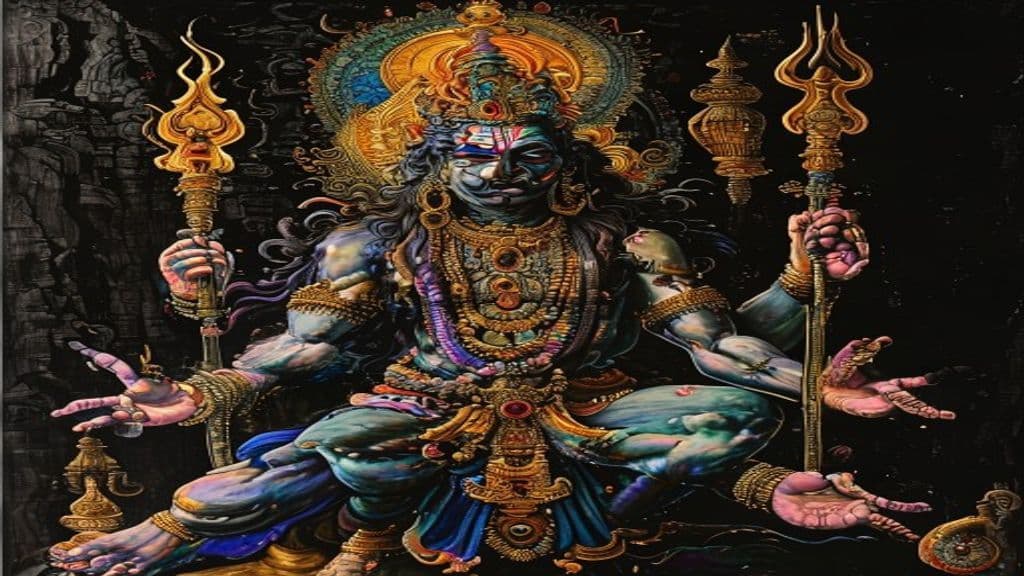
Sources describe Lākhe as spirits or demons who traditionally lived in forests and later became incorporated into town life as protectors of townspeople. The best-attested example of such incorporation is Majipa Lakhey of Kathmandu, who is worshipped as a deity and called the Peaceful Bhairava in local ritual contexts; he appears in the Yenya (Indra Jatra) festival and receives offerings from city dwellers during his procession.
Lākhe are depicted with a ferocious face, protruding fangs, and a mane of red, white, or black hair. In festival performance they are embodied by masked dancers wearing papier-mâché masks with yak-tail hair attached; the overall costume emphasizes a wild, fearsome visage.
In traditional belief Lākhe occupy an ambivalent role: forest-dwelling, potentially dangerous spirits who have been ritually domesticated and in at least one case (Majipa Lakhey) come to be propitiated as a protector-deity. In performance Lākhe dance wildly through streets, stopping at major crossroads and market squares to give dances accompanied by music. Certain named types (Michyāh Lākhe and Minpu Lākhe) are believed to cause fires by spontaneous combustion where they reside, and people possessed by Michyāh Lākhe are held to be capable of causing fires.
Weaknesses
None recorded.
Wards
- ritualPropitiation and festival incorporation (Majipa Lakhey offerings)
Lysinomus
Lysinomus (Ancient Greek: Λυσίνομον) is a Mycenaean prince in Greek mythic genealogy, one of the sons of King Electryon of Mycenae and Anaxo. He is recorded as having been killed in the feud between Electryon’s sons and the sons of the Taphian king Pterelaus; his death functions etiologically in the succession-disputes that precede the generation of Heracles.
Lysithea
Lysithea is a name applied to multiple unrelated referents in classical myth, modern astronomy, biological taxonomy, and contemporary fiction. In Greek mythic genealogies she appears as a daughter of Oceanus and is listed among lovers of Zeus; separately, Lysithea is the name of an irregular satellite of Jupiter, a genus of red algae, and a modern fictional character in the video game Fire Emblem: Three Houses.
Lyssa Drak
Lyssa Drak is a DC Comics character, a Talokian member of the Sinestro Corps who serves as a trainer and recorder for recruits, keeper of the Book of Parallax, and later becomes bound to and associated with the Book of the Black during Blackest Night/Brightest Day storylines.
Læraðr
Læraðr (also Léraðr; anglicized Laerad) is a named sacred tree in Old Norse mythic geography described as standing over Odin’s hall/Valhöll. In the Poetic Edda (Grímnismál) and Prose Edda (Gylfaginning) it is the tree browsed by the goat Heiðrún and the stag Eikþyrnir; modern scholars sometimes identify it with or as an aspect/name of the central world-tree Yggdrasill.
Líf and Lífþrasir
Two human individuals in Old Norse eschatology who are foretold to survive Ragnarök by hiding in Hoddmímis holt, subsisting on morning dew, and who repopulate the renewed world thereafter.
Lúthien and Beren
Lúthien and Beren are two central figures in J. R. R. Tolkien’s Middle-earth legendarium: Lúthien is a half-elven princess, daughter of the Elven King Thingol and the Maia Melian, and Beren is a mortal man of the House of Bëor. Their tale is an archetypal story of transgressive love and quest — including the bride-price of a Silmaril, enchantments and confrontations with Sauron and Morgoth — and it functions as a foundational myth within the First Age histories and later genealogies of Middle-earth.
Lạc bird
A mythical creature in Vietnamese culture, considered the national bird of Vietnam. (Note: * Remove "national bird of Vietnam" from summary, as it only mentions the Lạc bird is considered one. * Power tier should be set to Unknown or Unspecified, as no information is available on its abilit)
Ma (Vietnamese ghost)
Ma are wandering souls or spirits of the dead in Vietnamese cultural belief who, depending on ritual treatment, may become protective ancestors or remain restless ghosts that affect the living's luck and daily life. They are embedded in practices of ancestor worship, domestic offerings, and the work of spirit mediums.
Ma Da (ma đói) — Vietnamese "hungry ghost"
The supplied source corpus does not contain ethnographic or textual descriptions of Ma Da (ma đói) in Vietnamese tradition. Only two relevant fragments appear: the Vietnamese name for the Nīlakaṇṭha Dhāraṇī (Chú đại bi / Đại bi tâm đà la ni) and a note that auspicious/inauspicious days are recognized in Vietnam. No direct sourced information about ma đói’s attributes, rituals, or role is present in the provided materials.
Maaemä
Maaemä (Finnish) / Maaema (Estonian) is the personification of the earth as a maternal, generative principle in Finnish and Estonian runic-song and folk-ritual material; she functions as the 'earth mother' who receives offerings and is invoked regarding fertility, harvest, and things that come from the ground.
Maara
Maara is attested in the provided materials not as a traditional supernatural being but as a contemporary proper name: the title and central character of a 2021 Tamil film and its soundtrack, and as a modern personal/artist/place name in several publications. No folkloric cosmology, rituals, or mythic origin are documented for Maara in the supplied sources.
Maat
Maat is the ancient Egyptian concept and personified goddess of truth, balance, law, morality, and justice. As both an abstract ordering principle and a divine personification, she underlies cosmic order, legitimizes kingship, and functions as the judicial standard in life and the Weighing of the Heart in the afterlife.
Community Record
- [1]Lakhey. Wikipedia: 'Lakhey' pagewiki
- [2]Majipa Lakhey. Wikipedia: 'Majipa Lakhey' pagewiki
- [3]Wikidata: Lakhey. Wikidata entry for Lakheywiki
- [4]10 different forms of Bhairavs in KTM that keep people safe. OnlineKhabar article referencing Bhairava forms and civic protectionother